

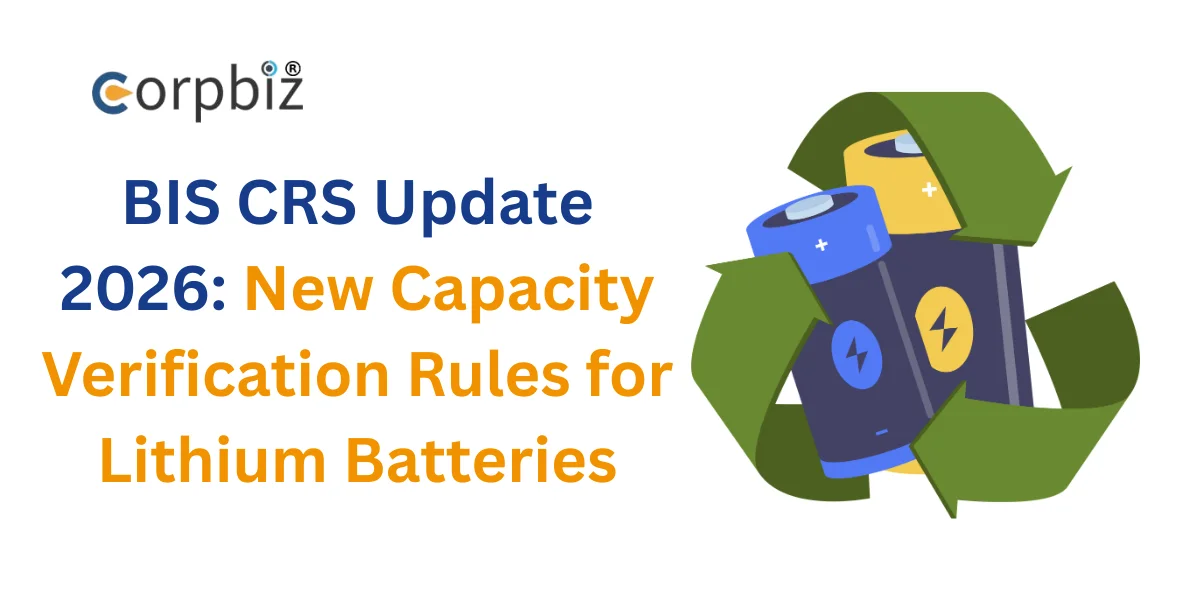
New rules have come into effect in the field of lithium-ion batteries in India. The BIS will now check more strictly whether the declared capacity of the battery is correct or not. This instruction has come from the Ministry of Electronics and Information Technology (MeitY). The aim is to stop the wrong or exaggerated capacity in the market.
The use of lithium batteries is now increasing very rapidly. So, the regulatory agencies are looking at the matter seriously. This new rule will have the greatest impact on manufacturers, importers, and brand owners with a BIS CRS registration. In this article, we will explain the new rules, the testing requirements, and the impact on businesses.
Importance of Lithium-Ion Battery Regulation
The use of lithium-ion batteries has increased a lot in the last few years. Mobile phones, laptops, electric vehicles, and solar system batteries are used everywhere. As the market grows, the importance of quality control has also increased. Regulatory agencies have seen that the declared capacity of many batteries does not match reality. This is misleading for consumers.
Stricter rules were now needed to deal with this situation. So, India is moving towards a stricter verification system.
Key points:
- Usage in electronics, EVs, and solar is increasing rapidly
- The risks have also increased as the market grows
- The capacity has been increased in many cases
- Real performance verification has become necessary
- India is now tightening the rules even more
Why did BIS issue the New Rated Capacity Guidelines?
On February 3, 2026, MeitY issued an important order. The rated capacity of many lithium batteries was declared incorrectly. Consumers were not getting the expected backup. There was also confusion in the market. BIS was instructed to tighten the verification process.
According to the regulators, giving wrong information harms consumers, and honest manufacturers are set back. Therefore, new rules have been brought so that the declared capacity must be proved in tests. This step will take India closer to international standards.
Risks identified by regulators:
- Waste of consumer money
- Low device runtime
- Unfair competition in the market
- Discrepancy of technical information
Talk To Expert

Get Expert help on Lithium Batteries
(4.8)


Key Standards Involved in the New Framework
Two important standards are working together in the new framework. One looks at safety, the other verifies performance.
1. IS 16046 (Part 2):2018- Safety Requirements
This is a mandatory safety standard for lithium cells and batteries. According to this standard, the safety of batteries is tested. Such as overcharging, short circuits, and thermal hazards. This standard was already applicable for CRS registration and is still mandatory.
2. IS 16047 (Part 3):2018- Rated Capacity Test
According to Clause 7.3.1 of this standard, the discharge test of the battery is carried out. This test is usually carried out at a temperature of 20°C. This shows whether the declared capacity is correct or not. This test is very important, as it verifies the actual performance of the battery.
Read more – BIS for Lithium-Ion Batteries
New Testing Requirements for Rated Capacity Verification
BIS has made it mandatory to verify the rated capacity. According to the new rules, the actual performance of the battery will have to be proven with safety. This will reduce the number of false or exaggerated capacities in the market. The key aspects of the new testing system are given below.
- Mandatory Capacity Measurement Test
All lithium-ion cells and batteries will now have to undergo a full charge–discharge test. In this test, the battery is fully charged and discharged under specified conditions. This clearly shows the actual capacity.
This test must be carried out in a BIS-approved laboratory. Usually, the test is carried out at a temperature of 20°C so that the results are consistent. Finally, it is checked whether the declared capacity and the measured capacity match. If they do not match, the product will not be considered compliant.
2. Unified Test Report Format (UTRF)
BIS has introduced a revised Unified Test Report Format. It brings all lab reports in a single format. This makes it easy to verify.
What should generally be included in a TRF:
- Measured discharge capacity shows actual performance
- Declared rated capacity shows the manufacturer claim
- Test conditions ensure test reliability
- Compliance result: final pass/fail status
This format increases transparency and reduces the possibility of giving wrong information.
3. LIMS-Based Reporting Requirement
The new rules have made it mandatory to use BIS’s Laboratory Information Management System (LIMS). Test requests are created and tracked through this digital system.
Its major advantage is its complete traceability. All information about the tested samples was on record. Manufacturers will have to submit reports through LIMS. Skipping this step may result in rejection of the application.
Implementation Guidelines for Existing Licensees
The new rules are also applicable to companies that already have BIS registration. However, BIS has given a phased compliance period so that businesses do not face sudden problems.
Compliance Deadlines
- Licenses valid until 30 April 2027: Capacity verification must be completed by this date.
- Licenses valid until 30 April 2027: Compliance must be completed before the expiry date of the license.
Mandatory Actions for Existing Registrants
- Appoint a BIS-accredited third-party lab
- Create a test request through LIMS
- Submit test reports for all lead models
- Give undertaking for series models, if required
- Update CRS profile
Read more – Potential of Lithium-ion Batteries in India
Guidelines for New Applicants under BIS CRS
The rules have now become stricter for the applicant for registration under BIS CRS. It is no longer enough to just do the safety test.
New applicants will have to do the safety test and capacity test together. This test must be done in a BIS-accredited lab. If the application is submitted without capacity verification, it may be considered incomplete, and the process may be blocked.
Documentation Expectations
The documentation should be very clear at the time of application. Typically, the following will be required:
- Declared rated capacity
- Complete product specifications
- Report consistency with the information given on the label
- Test report in the revised UTRF format
Any discrepancies in the documentation may delay approval or even lead to rejection of the application.
Impact on Manufacturers, Importers, and Brand Owners
The new BIS guidelines have brought about a major change for the industry. It is not just about safety compliance. Battery performance will also have to be proven. This will change the way manufacturers, importers, and brand owner’s work.
- Greater Technical Accountability
Now, it is no longer possible to claim an estimated capacity. The declared capacity will have to be tested. This will require more emphasis on design, cell selection, and quality control. Providing incorrect information will directly create compliance risks.
- Stronger Role of Third-Party Laboratories
Accredited third-party labs will now play a central role. The importance of independent testing has increased significantly. Self-declaration alone will no longer work.
- Enhanced Digital Compliance
The entire process will be more transparent due to the LIMS system of the BIS. There will be a digital record of each test, which will make auditing easier.
- Fairer Market Competition
The increased capacity will be reduced in the market. This will benefit honest manufacturers and help to gain consumer confidence.
Consequences of Non-Compliance
If the new rules are not followed, BIS can take strict action. The possible risks are given below:
- BIS registration may be suspended
- The license may be cancelled in serious cases
- The specific model may be removed from the approved list
- New or renewal applications may be rejected
- If the product is caught in market surveillance, action may be taken
- The company’s reputation may be damaged
- The risk of business loss and market loss increases
So, timely compliance is the safest way.
Impact on India’s Battery Market
This new rule will make the Indian battery market more mature and trustworthy. Now the regulation is moving towards a performance-based model. This will verify safety and actual capacity.
Potential Impact:
- More compliance with international standards
- Improved product quality
- Positive impact on the EV and electronics sector
- Reduced the entry of low-quality products
- A strong compliance culture will be created in the long term
Read more – How Lithium-Ion Battery Recycling Plants Reduce E-Waste?
Conclusion
BIS’s new guidelines signal a major shift in the lithium battery industry. Now it becomes necessary to ensure the safety and actual performance of the battery. Manufacturers and importers need to prepare quickly. Failure to conduct timely testing and proper documentation can put the license at risk.
Professional support is very useful for keeping up with this change. Corpbiz can assist you with the entire process, such as:
- BIS CRS registration support
- Rated capacity testing coordination
- LIMS and documentation support
- Scope change and renewal management
So, contact Corpbiz experts today for hassle-free compliance.
Answers to Common Questions About Lithium-Ion Battery Regulation
What is the BIS-rated capacity verification guideline?
The BIS-rated capacity verification guideline is a rule where the declared capacity of lithium batteries must be proven through lab tests. Earlier, the focus was mainly on safety, but now performance verification is also mandatory. The BIS introduced this rule to stop false capacity claims in the market and introduce consumers' real performance.
Why did MeitY introduce this requirement?
The Ministry of Electronics and Information Technology (MeitY) introduced this rule to oversaturate the capacity of many batteries in the market. This allowed consumers who were not getting the expected backup. The regulatory body understands that safety alone is not enough. Therefore, actual performance verification has been made mandatory to increase consumer protection, and honest manufacturers get fair competition.
Which batteries are covered under the new rule?
The new rule applies to portable sealed secondary lithium cells and lithium-ion batteries. These are commonly used in mobiles, laptops, power banks, EVs, and storage systems. If a product is registered under BIS CRS as per IS 16046 (Part 2):2018, then this rated capacity verification rule will also be applicable.
Is rated capacity testing mandatory for BIS CRS registration?
Yes, rated capacity testing has now become a mandatory part of BIS CRS registration. Safety testing alone will not get approval. The manufacturer will have to prove that the declared capacity matches the actual testing. If the capacity report is not submitted, the application may be considered incomplete, and the approval may be delayed or cancelled.
What is Clause 7.3.1 of IS 16047 (Part 3):2018?
Clause 7.3.1 is a standard test method through which the rated capacity of the battery is measured. In this test, the battery is usually charged and discharged at a temperature of 20°C. This compares the declared and actual capacity. All labs test in the same manner, resulting in reliable and comparable results by following this clause.
What is the deadline for existing license holders?
BIS has given a phased deadline for existing license holders. Those whose licenses are valid until 30 April 2027 will have to complete the capacity verification by that date. And those whose licenses are valid till after that will have to comply before the expiry of their licenses. Delaying this can put their licenses at risk.
What happens if a company fails the capacity test?
If a battery fails to perform as per the declared capacity, it will be considered non-compliant. BIS may block the application or cancel the model. There are also chances of cancelation of the license in some major cases. So, it is important to verify the design and quality of the product before testing.
Do new applicants need safety and capacity testing?
Yes, new applicants will now have to do both tests: the safety test and rated capacity test. Without these two reports, it is difficult to get CRS approval. Both tests have to be done in a BIS-accredited lab. This ensures that the battery is not only safe but also meets the declared performance.
How does LIMS help with BIS compliance?
LIMS is BIS’s digital platform where test requests are created and tracked. This makes the entire process transparent, and data can be easily verified. Using LIMS for manufacturers increases traceability, reduces errors, and makes it easier to show documents during audits.
How can Corpbiz help with BIS lithium battery compliance?
Corpbiz provides professional support throughout the BIS compliance process. We help with proper test plans, lab coordination, LIMS filing, and document preparation. Our expats can guide you in new applications, renewals, or scope updates. So, companies can meet BIS requirements quickly and hassle-free.
Read more – Important Aspects of Lithium-ion Battery Recycling in India