

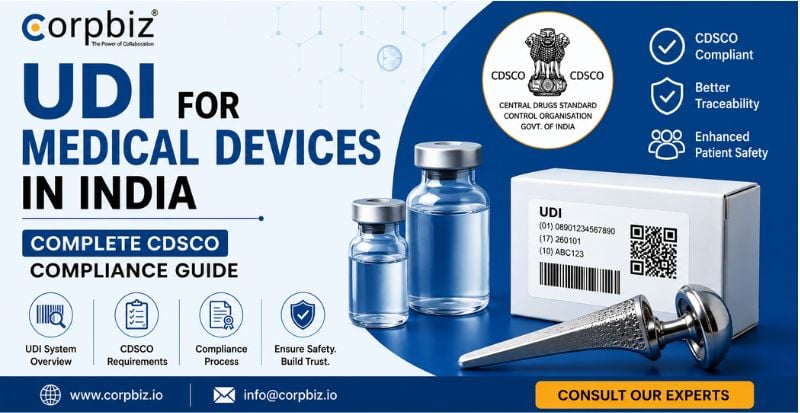
The use of medical devices in India is increasing rapidly. Various types of devices are now used in hospitals, clinics, and other healthcare institutions. It has become important to identify and track them accurately.
Unique Device Identification (UDI) has become important in this context. This system helps each medical device get a unique and specific identity. This helps a medical device be tracked from production to distribution, use, complaints, recalls, and post-market surveillance.
In India, medical devices are regulated under the Central Drugs Standard Control Organisation (CDSCO). The Medical Devices Rules 2017 play an important role. UDI is directly related to regulatory compliance, supply chain tracking, patient safety, and product recall. Therefore, manufacturers and importers should consider UDI requirements while planning CDSCO registration or managing post-registration compliance.
This guide will discuss in detail the structure of UDI, the legal framework in India, device classification, the compliance process, labelling, data submission, common mistakes, practical challenges, and benefits of UDI.
What is a UDI for Medical Devices?
Unique Device Identification, or UDI, is a special identification system. It helps each medical device or specific device model be given a unique code.
A UDI works as an identification card for a device. This code helps the manufacturer, regulator, hospital, distributor, and healthcare professional identify the device.
The UDI system has two main parts, as below:
Device Identifier (UDI-DI)
The UDI-DI is a fixed part of the UDI. It identifies a specific manufacturer or labeller, and a particular device model, version, or product configuration.
A separate DI may be required when there are significant changes to a device model or product characteristics. So, it is necessary to determine the information for each device.
The UDI-DI serves as the device’s primary identifier. This identifier is associated with various information about the device in the regulatory database.
Production Identifier (UDI-PI)
The UDI-PI is a variable part of the UDI. It provides information about specific production.
Depending on the type of device, it may contain:
- Batch or lot number
- Serial number
- Manufacturing date
- Expiry date
The UDI-PI provides information about a specific batch or unit. It is also very useful during a recall or field safety corrective action. Because then the device of a specific batch or serial number can be identified. This entire system maintains traceability of a medical device throughout its lifecycle.
Talk To Expert

Need Help? Contact Our Experts Today.
(4.8)

Legal Framework for UDI Compliance in India
The regulatory framework for medical devices in India is based on the Drugs and Cosmetics Act, 1940, and the Medical Devices Rules, 2017.
The main regulatory authority in this case is the Central Drugs Standard Control Organisation, or CDSCO. Various issues like classification, licensing, quality, and labelling of medical devices come under the regulatory framework of the CDSCO.
Rule 46 of the Medical Devices Rules, 2017 is mentioned as an important legal basis for unique identification and medical device traceability. A regulatory framework has been created to better identify and track devices.
India’s UDI system also tries to be consistent with international regulatory principles. This is influenced by international frameworks like the International Medical Device Regulators Forum (IMDRF). This creates an opportunity to align the Indian medical device identification system with global practices.
However, just knowing the Medical Devices Rules, 2017 is not always enough. Manufacturers and importers should also check the new notifications, guidance documents, labelling requirements, and updated regulatory instructions of the CDSCO.
The implementation timeline and technical requirements of UDI may change over time. So, it is advisable to check the latest CDSCO update without relying on any outdated guidelines or information.
Read more – CDSCO Classification of Medical Devices
Three Major Parts of the UDI System
UDI is not just the name of a code or barcode. In a complete UDI system, these three things are important.
1. UDI Code
The UDI code is the main identification information of the device. It contains the Device Identifier (DI) and the Production Identifier (PI) if necessary.
DI identifies the model or product of the device. On the other hand, production details such as batch, lot, serial number, manufacturing date, or expiry date can be known through PI. Together, these two parts helps identify a medical device.
2. UDI Carrier
The UDI carrier is the physical format where the UDI code can be seen or scanned.
Examples of this are:
- Linear barcode
- 2D Data Matrix code
- RFID, where applicable
However, it is not enough to have only a machine-readable code. UDI should be provided as a human-readable text. So, even if the barcode cannot be scanned, people can understand the information by looking at the code.
3. UDI Database
Another important part of the UDI system is the database. Device-related information may be linked to the regulatory system or online platform required by the CDSCO.
This may include information such as manufacturer details, device description, model, classification, license information, and production-related data.
The information in the database matches the product label and regulatory documents. Mismatches in the information can lead to compliance issues later.
Which Medical Devices in India Require UDI Compliance?
UDI requirements may apply to medical devices regulated under the Medical Devices Rules, 2017. The compliance requirements and implementation may vary depending on the risk level of the device.
In India, medical devices are divided into four risk classes:
- Class A: Low-risk devices
- Class B: Low to moderate-risk devices
- Class C: Moderate to high-risk devices
- Class D: High-risk devices
Traceability is more important for higher-risk devices. Especially in the case of some implantable devices and life-supporting devices, rapid product identification is required for safety issues. UDI requirements can be relevant for both imported and domestically manufactured medical devices.
UDI Implementation Timeline and Risk-Based Approach
The key reason for taking a phased or step-by-step approach to UDI implementation in India is that not all medical devices have the same risk level.
The traceability requirement for a high-risk device is much higher than for a low-risk device. So, higher-risk products may be prioritized for compliance. Lower-risk devices may be included later according to the applicable regulatory schedule.
In general, the risk-based approach prioritizes as follows:
- Class D: Highest-risk devices
- Class C: Moderate to high-risk devices
- Class B: Low to moderate-risk devices
- Class A: Lowest-risk devices
However, it is not appropriate to assume that the old timeline or deadline is final. CDSCO may change the implementation timeline through a new notification or regulatory update.
So, manufacturers and importers should check the latest applicable deadline for their devices before deciding to change the label or old inventory.
UDI Compliance Process under CDSCO: Step by Step
It is necessary to understand the regulatory status of the medical device well before starting UDI compliance. The entire process can be done in several steps-
Step 1: Determine the Classification of the Medical Device
First, it is necessary to determine whether the device is Class A, B, C, or D. Then, according to that class, the CDSCO licensing and other compliance requirements must be verified.
Step 2: Choose a Recognized Issuing Agency
A recognized issuing agency’s coding system should be used to generate the UDI code. Examples include GS1, HIBCC, or ICCBBA, where applicable.
It is not right for the company to generate random codes at its own discretion. It is very important to follow the approved coding structure.
Step 3: Assign UDI-DI
A unique device identifier must be generated for each applicable device model or configuration. This code needs to be associated with the correct manufacturer and product information.
Step 4: Determine UDI-PI
You need to decide which production information code will be in it. This can include lot number, serial number, manufacturing date, or expiry date.
Step 5: Update Label and Packaging
The UDI needs to be added to the label or packaging in two formats- human-readable and machine-readable.
Step 6: Check Barcode Quality
The barcode or Data Matrix code needs to be scanned and checked. Poor print quality can cause scanning problems at the factory, distributor, or hospital.
Step 7: Submit and Maintain Device Data
The required device information needs to be submitted to the applicable CDSCO online system or database. If the product information changes later, the database information should also be updated.
UDI Labelling and Packaging Requirements
UDI compliance is related to medical device labelling. A UDI should be provided in two types of formats.
Human-Readable Interpretation (HRI): Text or code that can be read by humans
Automatic Identification and Data Capture (AIDC): Format that can be read by a scanner
The following can be used as UDI carriers:
- 1D barcode
- 2D Data Matrix
- Other accepted identification technologies
The UDI may be on the device label, primary packaging, higher-level packaging, and the applicable shipping carton, as required. Some reusable devices may require permanent marking on the device. However, this depends on the design and technical feasibility of the device.
It should be remembered that the UDI cannot be used in place of other mandatory label information. Manufacturer details, license information, device name, sterility information, and other required particulars must be included on the label.
Read more – Class-A Medical Device Manufacturing Business in India
What Information Should Manufacturers and Importers Store?
UDI compliance involves a lot of important product and regulatory information. So, manufacturers and importers need to store accurate information.
The company should have the following information:
- Name and address of the legal manufacturer
- In the case of imported devices, details of the Authorised Indian Agent
- Information about the CDSCO manufacturing or import license
- UDI-DI or GTIN details
- Brand name and model name
- Description of the medical device
- Device classification
- Sterility status
- Information about whether the device is single-use or reusable
- Applicable batch or lot number
- Serial number
- Manufacturing date and expiry date
- Storage and handling conditions
- Applicable recall and field safety information
Most importantly, this information should be consistent. The information given on the product label should also be consistent with the information in the technical documentation, internal system, and CDSCO regulatory submission.
Mismatches in data can create problems later during compliance review, product recall, or regulatory inspection.
Common Challenges of UDI Implementation and Their Practical Solutions
Many companies face some challenges while implementing a UDI system. However, these can be minimized by planning.
Space Issues in Small Medical Devices
Some devices are very small in size, so there is less space for a label or barcode.
Small codes like the 2D Data Matrix can be used as per the requirement. UDI can be given on appropriate packaging permitted by the regulations.
Internal Data System Issues
If there is different information across ERP, inventory, quality, and regulatory systems, there can be mismatches. Data can be aligned with various internal systems by creating a central UDI master database.
Differences between Global and Indian Requirements
Even if a company is UDI-compliant in another country, the requirements in India may not be the same.
The existing global UDI system can be used, but Indian CDSCO requirements need to be verified separately.
Changes to Existing Packaging
Using UDI may require changes to the label artwork and packaging.
Label redesign and existing inventory management should be planned before the applicable compliance deadline.
Lack of Internal Expertise
Many companies do not have separate expert teams for regulatory or UDI-related work.
Regulatory, quality, production, IT, and supply chain teams can be trained. If necessary, professional support can be taken for UDI planning and CDSCO compliance.
How Can Corpbiz Help Companies with UDI and CDSCO Compliance?
Medical device manufacturers, importers, and startups must manage many regulatory issues at once when it comes to UDI compliance. Maintaining consistency between device classification, documentation, labelling, and regulatory data is often not easy.
So, a professional compliance support partner like Corpbiz can help businesses understand the necessary regulatory requirements.
Companies can seek help with UDI and CDSCO compliance by:
- Understanding applicable CDSCO requirements
- Reviewing device classification
- Preparing compliance documentation
- Aligning UDI information with regulatory records
- Reviewing labelling and packaging requirements
- Tracking regulatory changes
Proper compliance planning in advance can help avoid many common mistakes. This improves a company’s compliance readiness and can also reduce the risk of future regulatory issues.
To Wrap Up
The medical device industry in India is growing rapidly. UDI compliance is becoming more important for device identification, patient safety, and product traceability.
With the help of UDI, supply chain visibility increases. Post-market surveillance is easier. In case of a safety issue, the affected device or batch can be found quickly. Recall management is also more effective.
However, UDI compliance is not just the responsibility of the regulatory team. It requires the regulatory, quality, production, IT, packaging, and labelling teams to work together.
Companies should review UDI requirements in advance, rather than wait until the last minute. If necessary, UDI and broader CDSCO compliance requirements can be understood and managed with the help of a professional support partner like Corpbiz. Besides CDSCO registration and compliance management, our experts help in securing a CDSCO test license, CDSCO import license for medical devices, and other CDSCO licenses.
Popular Queries About UDI for Medical Devices in India
What is UDI for Medical Devices in India?
UDI, or Unique Device Identification, is an identification system. It helps a medical device to be accurately identified throughout its lifecycle. It consists of a fixed device identifier and a variable production identifier as required. UDI can be in human-readable text and machine-readable barcode or data matrix format. UDI in India is linked to the medical device regulatory and traceability framework of the CDSCO.
Is UDI mandatory for all medical devices in India?
UDI requirements may apply to medical devices regulated under the Medical Devices Rules, 2017. Implementation requirements may differ depending on the risk classification of the device. Medical devices are divided into classes A, B, C, and D. CDSCO may update the timeline or technical requirements through new notifications. So, manufacturers and importers should review the current requirements for their devices and make a compliance plan.
What is the difference between UDI-DI and UDI-PI?
UDI-DI is a fixed part of UDI. It identifies the manufacturer and the specific device model or version. UDI-PI is the variable part. It can contain production information such as batch number, serial numbers, manufacturing dates, or expiry dates. Together, these two identifiers help to track a medical device more accurately. Both are important for maintaining traceability from production to distribution and post-market monitoring.
Which organization can issue a UDI Code for Medical Devices?
Manufacturers should use the coding system of a recognized issuing agency. It is not appropriate to create their own random internal code. GS1 is a widely used system for medical product identification. Also, internationally recognized organizations such as HIBCC and ICCBBA may be relevant depending on the specific healthcare product or applicable requirement. However, it is better to check the applicable CDSCO requirements and coding expectations before choosing an agency.
What type of information does a UDI code contain?
The information contained in the UDI code depends on the device and the applicable UDI structure. The fixed part identifies the manufacturer, labeller, and the specific device model or version. The variable part may contain the lot or batch number, serial number, manufacturing date, and expiry date. The device information associated with the UDI must accurately match regulatory documents, quality records, technical files, and information from the supply chain system.
Where does the UDI need to be displayed on a medical device?
The UDI is typically provided on the medical device label, primary packaging, and applicable higher-level packaging. It may need to be in a machine-readable format, such as a barcode or 2D Data Matrix. It may also include human-readable text. For some reusable devices, permanent marking can also be done on the device when necessary. However, where and how the UDI is provided depends on the type of device and applicable CDSCO labelling requirements.
Is UDI Compliance required in India for imported medical devices?
In India, regulated imported medical devices may also have applicable UDI and traceability requirements. The importer and the Authorised Indian Agent are required to maintain consistency between device identification, labelling, license details, and regulatory records. Even if a foreign manufacturer has global UDI compliance, it may not automatically meet all Indian requirements. So, Indian CDSCO requirements should be reviewed separately before shipping the product to India.
Is there any fee to upload UDI data to the CDSCO Portal?
Currently, CDSCO does not charge any separate fee for uploading data to the central UDI registry. However, manufacturers may have to pay registration and annual maintenance fees to the chosen issuing agency. For example, if a company prefix or identification structure is taken from an issuing agency like GS1, there may be applicable fees to maintain it. So, the charges of the issuing agency should also be considered while calculating the total cost of UDI compliance.
How does UDI help with Medical Device Recall?
UDI is very useful when there is a safety problem with a medical device. It helps to understand the manufacturer, the device, the batch, or the serial number of the product. So, it may be possible to trace only the affected products without recalling the entire stock. This speeds up the recall process. Without a UDI, it may take time to find out where a product has gone or which batch is affected.
Can professional help be taken for UDI and CDSCO Compliance?
Yes, during UDI compliance, many things must be considered regarding device classification, labeling, documentation, and regulatory data. For new manufacturers or importers, the matter can be a little confusing. So, professional support like Corpbiz can be beneficial. We help businesses understand UDI requirements, review documents, and reconcile issues with CDSCO compliance.