

Filing your income tax return, or ITR, on time is very important. This can save you from penalties, additional interest, and many other problems later. For AY 2026-27, the government has not set a single deadline for all taxpayers. Different deadlines have been set based on the type of income, the applicable ITR form, and whether a tax audit is required.
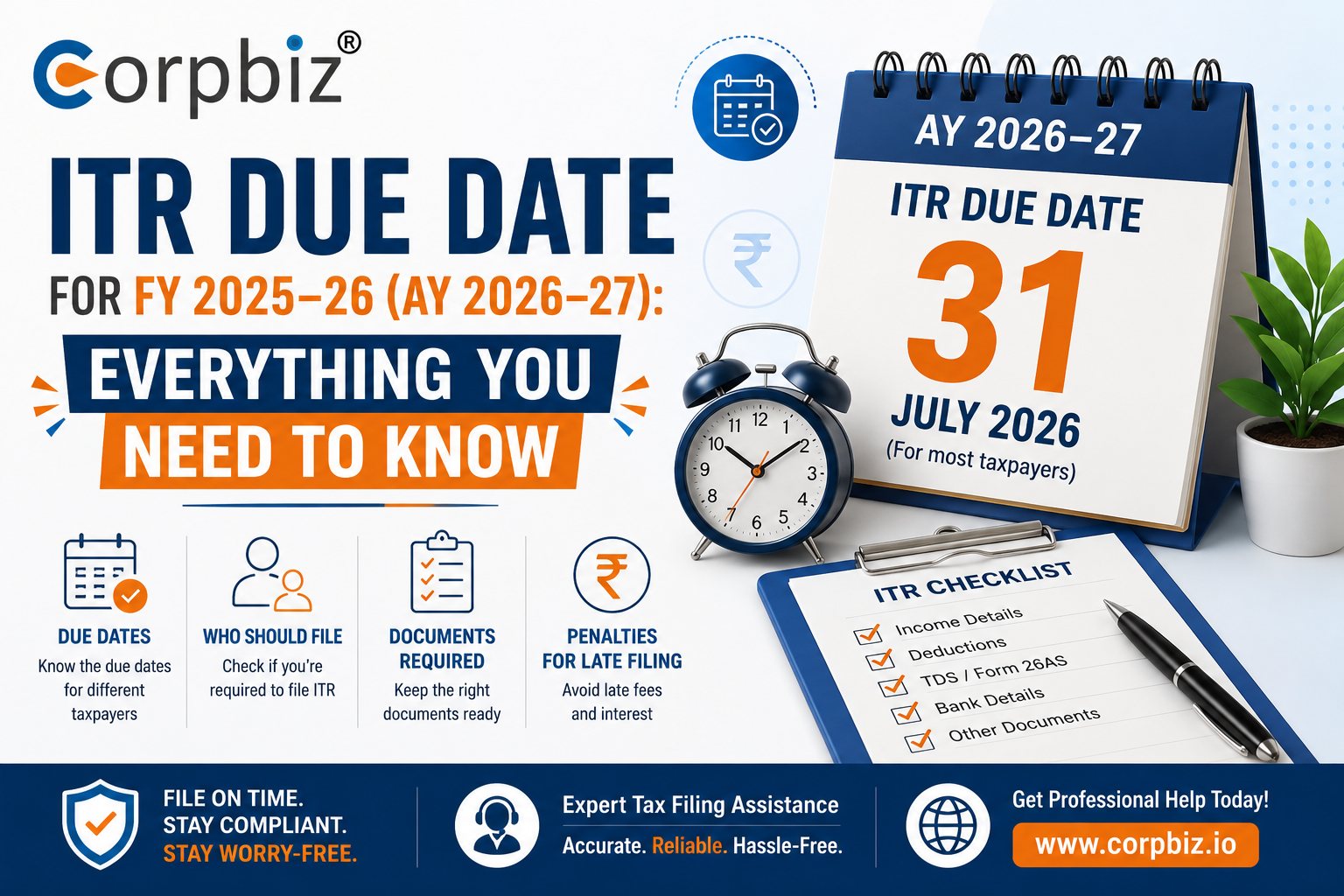
The big change is the deadline for filing non-audit ITR-3 and ITR-4 has been extended to 31 August 2026. However, the deadline for ITR-1 and ITR-2 remains on 31 July 2026. This article discusses which ITR form applies to whom, which date applies to you, and what problems can arise if you delay.
ITR Filing Deadline for FY 2025-26 (AY 2026-27)
This time, there has been a small change in the rules for filing ITR. Earlier, many people used to remember the same deadline. Now that is not the case. Different deadlines have been set according to the type of taxpayer.
If you are employed or a regular income taxpayer, the last date to file ITR-1 or ITR-2 is 31 July 2026. If you have business, freelance, or professional income and are not subject to a tax audit, you will have time to file ITR-3 or ITR-4 until 31 August 2026.
It is better to know in advance which date applies to you. Otherwise, you may be late. Then you may have to face a penalty, interest, or some other problems.
Important ITR filing deadlines for AY 2026-27
| ITR Form / Taxpayer Category | Who Should File? | Last Date to File |
| ITR-1 & ITR-2 | Salaried individuals, pensioners, and eligible individuals/HUFs not covered under tax audit | 31 July 2026 |
| ITR-3 (non-audit) | Business owners, freelancers, and professionals who are not required to undergo a tax audit | 31 August 2026 |
| ITR-4 (non-audit) | Eligible taxpayers opting for the Presumptive Taxation Scheme and not liable for tax audit | 31 August 2026 |
| ITR-3 & ITR-4 (Tax Audit Cases) | Businesses and professionals whose accounts are subject to tax audit | 31 October 2026 |
| Transfer Pricing Cases | Taxpayers having international or specified domestic transactions requiring transfer pricing compliance | 30 November 2026 |
| Belated Return | Taxpayers who miss the original due date and file under Section 139(4) | 31 December 2026 |
| Revised Return | Taxpayers who wish to correct mistakes in an already filed return | 31 March 2027 |
| Updated Return (ITR-U) | Eligible taxpayers filing an updated return under the prescribed conditions | Up to 48 months from the end of the relevant Assessment Year |
Talk To Expert
Need Help? Contact Our Experts Today.
(4.8)

Which ITR Form is for which Taxpayer?
It is very important to choose the right ITR form to avoid future problems. So, first know which form is for you.
ITR-1: It is generally for employees, pensioners, and those with very simple income.
ITR-2: It is for capital gains or assets abroad or for those whose income does not fall within the rules of ITR-1.
ITR-3: It is for business owners, freelancers, people working in various professions, and those who do not use the Presumptive Taxation Scheme.
ITR-4: Those who file returns under the Presumptive Taxation Scheme usually use this form. If you understand which ITR form you need for yourself at the beginning, then you will not have much trouble later.
ITR Form and Applicable Taxpayers
| ITR Form | Applicable Taxpayer | Due Date |
| ITR-1 | Salaried Individuals | 31 July 2026 |
| ITR-2 | Individuals/HUFs (Non-Business) | 31 July 2026 |
| ITR-3 | Business & Professionals | 31 August / 31 October |
| ITR-4 | Presumptive Taxation | 31 August / 31 October |
Read more – How to Rectify ITR Filing online?
ITR Due Dates Based on Taxpayer Category
For salaried individuals
Those whose main source of income is salary can usually file ITR-1. However, there are some conditions to be met for this. For example, the total income should not exceed ₹50 lakh, rental income from a maximum of two houses, long-term capital gains within a certain limit, and other income like interest or gifts.
However, if you have foreign assets or business income or do not meet the conditions for ITR-1, then you will have to file ITR-2, ITR-3, or ITR-4. The last date for filing ITR-1 and ITR-2 for AY 2026-27 is 31 July 2026.
For freelancers and professionals
Freelancers, consultants, doctors, lawyers, architects, or other professionals usually file ITR-3. However, those who have opted for the presumptive taxation scheme and meet the prescribed conditions can use ITR-4.
Now there is a big change. The last date for filing non-audit ITR-3 and ITR-4 has been extended to 31 August 2026. So, taxpayers in this category will get a little more time than before.
Businesses and professionals for which tax audit is mandatory
In some businesses and professions, it is mandatory to get a tax audit done if the sales, turnover, or gross receipts cross the prescribed limit. In this case, first the tax audit report has to be submitted by 30 September 2026. Then the ITR has to be filed by 31 October 2026.
And if the rules of transfer pricing are applicable to the business, then the last date for filing the ITR is 30 November 2026. Unnecessary penalties and other problems can be avoided by completing the auditing and ITR filing on time without delay.
What Happens if you Miss the ITR Deadline?
If you are unable to file ITR within the stipulated time, it is not all over. As per Section 139(4) of the Income Tax Act, you can file a belated return. The last date for filing a belated return for AY 2026-27 is 31 December 2026. However, filing a return late can lead to some additional problems.
Consequences for missing the ITR deadline:
- A belated return can be filed only after the due date.
- It is allowed to file it as per Section 139(4).
- The last date is 31 December 2026.
- Late filing fee of up to ₹5,000 may be payable.
- Interest may also be payable if tax is due.
- There may be no option to opt for the Old Tax Regime in many cases.
- Most losses, like business losses or capital losses, cannot be carried forward to the next year.
- Your refund may also be delayed.
Read more – What is ITR 4 in Income Tax Return filing?
What is Revised Return and Updated Return (ITR-U)?
Sometimes after filing an ITR, it is found that some information is omitted or incorrect. In such a case, there are some arrangements to file a new return. However, Revised Return and Updated Return (ITR-U) are not the same thing. The purpose and rules of both are different.
Revised Return
If you file an ITR on time and later find any mistakes, then you can file a revised return.
Things to remember-
- If you have filed an ITR earlier, you can file a revised return.
- If there are any mistakes in income, TDS, exemption, or any other detail, they can be corrected.
- Last date: 31 March 2027
- It is possible to file a revised return more than once within the prescribed period.
Updated Return (ITR-U)
Those who meet the prescribed conditions and want to update their return later can file ITR-U. Generally, this facility is used when any income is omitted or additional information is provided.
Things to remember-
- Only eligible taxpayers can file ITR-U.
- It can be filed up to 48 months after the end of the assessment year.
- ITR-U can be filed only once.
- Additional tax is also payable while filing ITR-U.
Additional tax on filing ITR-U
| ITR-U Filed Within | Additional Tax |
| 12 Months | 25% |
| 24 Months | 50% |
| 36 Months | 60% |
| 48 Months | 70% |
Checklist before Filing ITR
Before submitting ITR, checking a few things will reduce the chances of making mistakes later.
- Compare the information in Form 16.
- Verify TDS and other tax information in Form 26AS.
- Check AIS (Annual Information Statement) and TIS (Taxpayer Information Summary).
- Make sure your bank account information is correct.
- Verify whether PAN and Aadhaar are linked.
- Select the right ITR form for you.
- Decide first whether the old or new tax regime is convenient.
- Don’t forget to do e-verification after submitting the ITR.
How can Corpbiz help with ITR Compliance?
While filing ITR, many people face problems in selecting the right form and preparing tax calculations or documents. Corpbiz provides professional help and income tax advisory services to simplify this entire process. Individuals, freelancers, startups, businesses, and other taxpayers can get help as per their needs.
Our services:
- Help in selecting the right ITR form for you.
- Calculating the applicable tax liability.
- Help in choosing the right option between the old and new tax regimes.
- Preparation and verification of required tax documents.
- Filing ITR correctly within the stipulated time.
- Help in filing a revised return if required.
- Help in dealing with income tax notices or other queries.
- Ensuring timely and hassle-free income tax compliance.
Conclusion
Filing ITR on time helps avoid unnecessary penalties, interest, and other tax-related issues in the future. So, it is important to know in advance which deadline applies to you. There are also different deadlines for different ITRs. Also, there are separate deadlines for tax audits and other special cases.
If you find any difficulty in filing an ITR, Corpbiz can be your true companion. Our expert team can guide you to complete the entire ITR filing process.
Helpful Questions About ITR Due Date for FY 2025–26
What is the last date to file ITR for FY 2025-26?
The last date for filing ITR is not the same for everyone. It depends on the ITR form you are filing. The last date for filing ITR-1 and ITR-2 is 31 July 2026. And for non-audit ITR-3 and ITR-4, you have till 31 August 2026. If your business is subject to tax audit, the last date is 31 October 2026.So, first check which date is applicable in your case.
What is a Belated Return as per the Income Tax Act?
If you are unable to file ITR on time, there is no need to worry. You can file a belated return later. This can be done as per Section 139(4) of the Income Tax Act. For AY 2026-27, the last date is 31 December 2026. However, if you file your return late, you may have to pay a penalty or interest. So, it is better to file as early as possible.
What happens if I miss the actual due date of ITR?
If you are unable to file ITR on time, you can still file a belated return later. However, this may incur some additional costs. Sometimes you must pay a penalty, and if there is tax due, interest may also be charged. In some cases, you may not be able to opt for the Old Tax Regime. So, it is better to file the return on time without delay.
How much penalty is there for filing ITR late?
If you file ITR late, you may have to pay a late filing fee. Generally, this fee can be up to ₹5,000. However, if your total income is less than ₹5 lakh, then in many cases you must pay a fee of ₹1,000. And interest may also be added for any due tax. So, it is better not to wait for the last day.
Can I correct it after filing ITR?
Yes, if after filing your ITR you find that any information is incorrect or something is omitted, then you can file a Revised Return. This can be done by 31 March 2027 for AY 2026–27. If necessary, corrections can be made multiple times within the prescribed time limit. However, try to provide all the information correctly for the first time as far as possible.
What is Updated Return (ITR-U)?
ITR-U is a mechanism through which eligible taxpayers can update their returns later. If any income has not been shown earlier or some information is omitted, then ITR-U can be filed as per the prescribed rules. This can be done up to 48 months after the end of the assessment year. However, ITR-U can be filed only once.
If an employee has Crypto Income, which ITR form should be used?
If an employee has income from Crypto or Virtual Digital Asset (VDA) along with his salary, then ITR-1 cannot be used. In this case, ITR-2 has to be filed. Because there is no scope to show information about crypto income in ITR-1, it is important to choose the right ITR form before filing the return.
Does filing ITR late delay the tax refund?
Yes, sometimes filing ITR late also delays the refund process. So, it may take more time to get the money. Although this does not happen in all cases, there is a high chance of getting the refund quickly when you file your return on time.
How much penalty is there if you miss the July 31 deadline?
If the last date for filing your ITR is 31st July and you miss it, then you may have to pay a penalty under Section 234F while filing your return later. Generally, this fee is up to ₹5,000. However, if the total income is less than ₹5 lakh, a fee of ₹1,000 is required. Also, if there is any tax due, then interest may also be charged on it.
What to do if the information in Form 16 does not match AIS?
If the information in Form 16 and AIS does not match, then inform your employer immediately. Request correction of Form 16 if necessary. Correct information should be used while filing ITR. You may get a notice from the Income Tax Department later when you provide incorrect information.
What documents should be kept ready before filing ITR?
Before filing ITR, keep PAN, Aadhaar, Form 16, Form 26AS, AIS, TIS, bank account details, and investment or tax exemption documents ready if required. Having all the information in advance makes it easier to file the return, and the chances of making mistakes are also greatly reduced.
Read more – Consequences of not filing ITR: A Complete Overview