

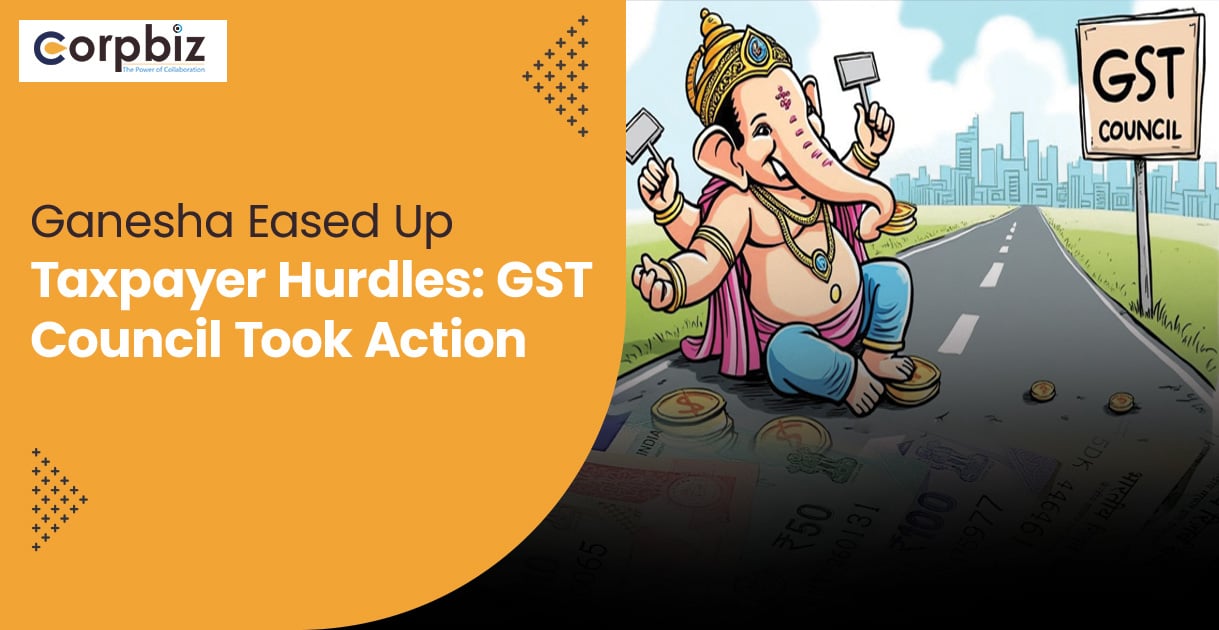
India, the nation, believes in God and keeps full faith in it. On the occasion of Ganesh Utsav, the recent events made by the GST Council are intended to ease compliance and give taxpayers relief. On September 9, 2024, several severe modifications were made at the 54th GST Council meeting.
New reverse charge mechanisms for metal scrap and commercial property rentals were introduced, while GST rates for namkeens and life-saving cancer medications were lowered. The GST rate on shared helicopter trips has been reduced, and taxpayers who pay by March 31, 2025, will not be charged interest or penalties under Section 128A.
Also, government board affiliation services are excluded from GST, and a B2C e-invoicing pilot project is planned to increase the transparency of retail transactions. It was also suggested that the GST return system be improved and that the exemptions for research and development services and electricity connection services be removed. These steps aim to lighten the burden of compliance and improve accessibility to the tax system.
Ganesha removes our roadblocks and remedies the problems with our tax system, particularly regarding GST, during this Ganesh Utsav. The GST Council has worked to resolve trade issues, assist businesses, and simplify compliance. On September 9, 2024, at the 54th GST Council meeting, several beneficial suggestions were made to make things easier for businesses and taxpayers.
Key Recommendations to Simplify GST Compliance
Here is an explanation of these key recommendations to simplify GST compliance:
· GST Rate Reduction for Namkeens and Savoury Products
The Council suggested lowering the GST rate from 18% to 12% for savoury products, which include namkeens, mixes, and bhujia. These products are similar to the candies we indulge in during Ganesh Utsav and are now more reasonably priced.
· Lower GST on Cancer Drugs
The council suggested lowering the 12% GST on several life-saving cancer medications, such as trastuzumab and osimertinib, to 5%. Patients and their families would experience significant relief.
· Reverse Charge Mechanism (RCM) on Metal Scrap
The Council suggested imposing a GST charge on unregistered metal scrap sellers to registered purchasers; the receiver would be responsible for paying the tax. Once the supplier’s sales reach the level, they must register.
Talk To Expert

Ganesha Eased Up Taxpayer Hurdles: GST Council Took Action
(4.8)


· RCM for Commercial Property Rentals
The council has also suggested implementing the RCM for commercial property rentals from unregistered parties to registered ones.
· Helicopter Passenger Transport
The Council suggests a 5% GST rate reduction for shared helicopter rides, which would lower the cost of such travel.
· Waiver of Interest and Penalty under Section 128A
The Council suggests establishing the guidelines and requirements to use this section for the fiscal years 2017–18, 2018–19, and 2019–20. To qualify for this relief, taxpayers must pay their taxes by March 31, 2025. The first day of Section 128A’s implementation is November 1, 2024.
· Educational Institutions’ Affiliation Services
To maintain equity, the Council clarified that while services offered by private universities are still subject to an 18% tax, affiliation services given by government boards to government schools are not subject to GST.
· Clarifications Regarding Composite Supplies
When goods are transported, if a Goods Transport Agency (GTA) performs services such as loading and packing as part of the total transportation, those services will be considered a composite supply and subject to transportation-related taxes as a single service. If they are billed separately, they will be taxed individually and not regarded as a composite supply.
· B2C E-Invoicing Pilot Project Launch
The council is launching a pilot program for B2C e-invoicing following the successful implementation of e-invoicing for B2B transactions. As a result, retail transactions will be more transparent and compliant.
· Improvements to the GST Return Architecture
The GST return system has been suggested to include the RCM ledger, input tax credit reclaim ledger, and invoice management system (IMS). Using this IMS, taxpayers can accept, reject, or hold onto invoices for input tax credits.
· Life and Health Insurance
To handle GST-related matters about life and health insurance, the GST Council has suggested the establishment of a Group of Ministers (GoM). The GoM has until October 2024 to turn in its report. Services related to electricity connections, such as application costs, testing fees, and meter rental fees, are proposed to be exempt from goods and services tax (GST) when rendered as a component of a composite supply of energy distribution.
Read More Blogs – Key Highlights of 53rd GST Council Meeting
· Preferential Location Charges (PLC)
The Council suggested that PLC pay for complex residential, commercial, or industrial construction projects before they are finished and included in the composite supply of construction services, subject to the same GST rate as construction services.
· Research and Development Services
Using government or private sector funds, the GST Council has suggested exempting government agencies, research associations, colleges, universities, and other organisations listed in the IT Act of 1961 from providing research and development services.
Streamline your compliance with expert GST return filing services to get benefits from the latest GST council updates and ensure accurate, timely submissions for peace of mind.
Conclusion
For taxpayers, the most important takeaway from these changes is being knowledgeable and flexible. The goal of proposing new ledgers, B2C e-invoicing, exclusions, and other changes is to streamline and simplify compliance. Most significantly, since these improvements are intended to eliminate the roadblocks to seamless and effective compliance, taxpayers should ensure their tax filings are accurate and filed on time. In the realm of GST, these reforms provide a way to prosperity and transparency.
Simplify your tax journey by visiting our Corpbiz website to get started with GST registration and, stay ahead of the latest updates, and ensure seamless compliance.
Frequently Asked Questions
How does the GST Council benefit taxpayers?
The GST Council plays a significant role in streamlining the tax system, reducing compliance burdens, and ensuring uniformity across the country.
What key initiatives did the GST Council take to ease the road for taxpayers?
Know the initiatives taken by the GST Council to ease the rod for taxpayers:
· Rate rationalisation: The Council has worked towards simplifying the GST rate structure.
· Compliance measures: It has introduced measures to ease compliance burdens on taxpayers.
· Dispute resolution: The Council has appointed mechanisms for resolving disputes between taxpayers and tax authorities.
· Technology adoption: Technology adoption has encouraged the use of technology to streamline GST processes.How has the GST Council simplified the tax system for taxpayers?
GST Council simplified the tax system for taxpayers by:
· Reducing the number of tax rates and exemptions.
· Introducing a common GST return form.
· We are clarifying various GST provisions.Can taxpayers expect more simplification in the GST regime in the future?
Yes, the GST Council continuously reviews taxpayer and business feedback. Further steps are expected to simplify the GST system, including process automation, more streamlined return filing, and better dispute resolution mechanisms.
How can taxpayers benefit from the new compliance measures?
The new measures, such as waiver of interest and penalties for timely payments, improvement to the GST return architecture, and clarification on composite supplies, can benefit taxpayers because they are designed to simplify compliance and reduce burdens.
Read more Blogs – GST Council Announce Amnesty Scheme & Rate Rationalization