

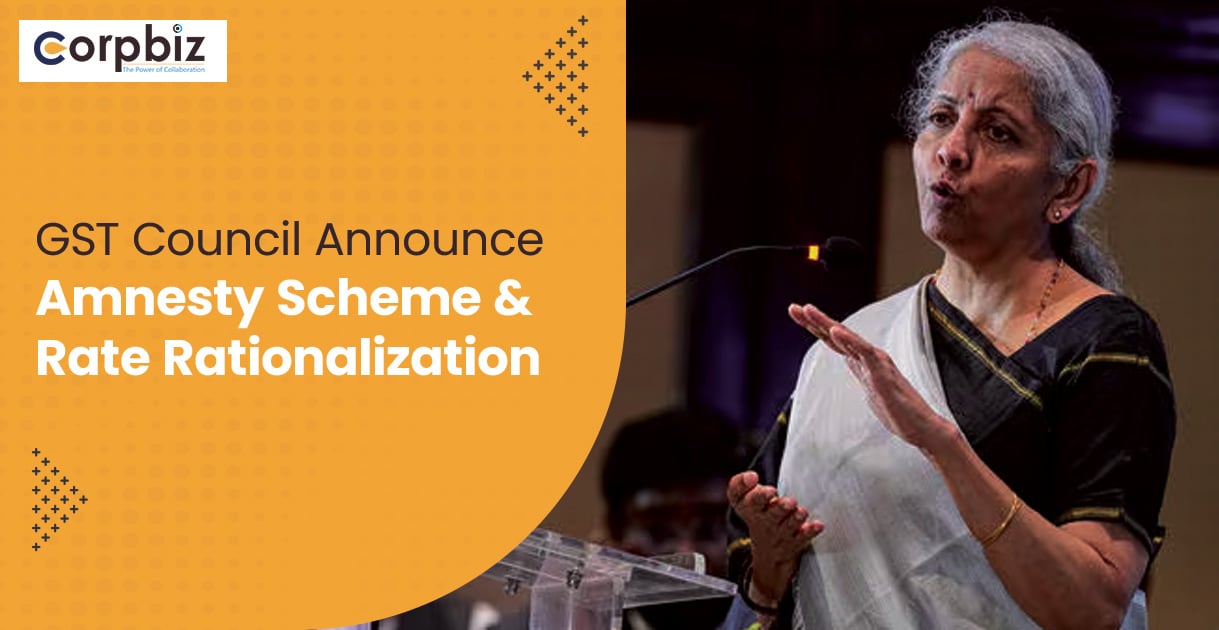
The 54th meeting of the GST Council, chaired by Union Finance Minister Mrs Nirmala Sitharaman, was held in New Delhi. Mrs Sitharaman was expected to announce implementing the amnesty scheme and rate rationalization for specific goods and services, simplifying and improving compliance.
Glimpse of GST Rate Rationalization
Before proceeding further, let’s delve into what exactly GST rate rationalization is. GST rate rationalization is adjusting GST rates to make them more suitable and efficient. This process involves revising tax rates to simplify the tax structure, reducing the burden on consumers and businesses. It aims to address discrepancies in tax rates across different goods and services.
Simplify your tax obligations with streamlined GST registration and stay ahead of rate rationalization changes to ensure your business complies with the updated GST structure.
ITC Claiming Deadline Extension & Tax Rate Rationalization
According to a news report quoting a source, many taxpayers have received notices and have not availed of the authentic ITC (input tax credit). These notices now amount to thousands of crores of rupees. In the last GST council meeting, the time frame for availing of ITC was extended, details of which were expected to be finalized in this meeting. People are awaiting an official announcement on this matter, as it is expected to bring relief to the taxpayers.
In response to a post on X (formerly Twitter) about the timing of relief under Section 16 (4) of the CGST Act, the Central Board of Indirect Taxes and Customs (CBIC) clarified that the new rules for claiming input tax credit would be implemented only after the 54th GST Council meeting, which was held on September 9thin New Delhi.
After the 53rd GST Council meeting, which was held on June 22, the Ministry of Finance stated the deadline to claim an input tax credit for invoices or debit notes under Section 16(4) of the CGST Act. The ministry had communicated that those returns filed by November 30, 2021, for the financial years 2017-18 to 2020-21 would be considered November 30, 2021.
It suggested that businesses can use the extended deadline to claim ITC for invoices or debit notes from July 1, 2017 (when GST started). However, it was clarified that these rules would be enforced after the GST Council’s recommendations. The delay gives time to the central government to coordinate with states, as the states need to update their State GST (SGST) laws to align with the new rules.
Mrs Sitharaman highlighted the importance of GST Council meetings in improving GST reforms at an event hosted by the Revenue Bar Association in Chennai. During the event, she reiterated that the GST Council was committed to simplifying the GST tax structure, facilitating compliance, and effectively generating revenue over political concerns.
Tax experts have also weighed their belief in the Council’s commitment towards these issues, acknowledging its benefits in instilling taxpayers’ confidence. It is pertinent to note that a group of ministers, led by Bihar Deputy Chief Minister Samrat Chaudhary, is working on integrating the GST slabs of 5%, 12%, 18%, and 28% into three tax rates. Mrs Sitharaman also mentioned that the GST Council will consult tax rate rationalization, but the final decision on revising taxes and slabs will be made later. If media reports are to be believed, Mrs Sitharaman, who had earlier suggested discussing the compensation cess on luxury and ‘sin’ goods, took the matter up in the recently concluded meeting.
Stay ahead of GST updates with GST advisory services on ITC claiming deadlines and tax rate rationalization. Ensure compliance and optimize your tax strategy with a tailored GST solution.
Key Recommendation of the 54th GST Council Meeting
Some of the key recommendations of the 54th GST Council Meeting include the following:
- The GST Council suggested a Group of Ministers (GoM) for GST on life and health insurance, along with the existing GoM on Rate Rationalisation, to submit a report by October 2024.
- The GST Council is considering a significant move by proposing the creation of a GoM to study the future of compensation cess. This could lead to substantial changes in the future.
- The Council recommended exempting research and development services supplied by government entities or institutions under Section 35 of the Income Tax Act, funded by government or private grants.
- The Council recommended reducing GST on life-saving cancer drugs like Trastuzumab Deruxtecan, Osimertinib, and Durvalumab from 12% to 5%. This could significantly relieve patients and their families.
- The Council also recommended launching a pilot program for B2C e-invoicing.
- The 54th GST Council Meeting introduced critical recommendations to simplify tax processes and support different sectors.
- The proposals highlight the Council’s focus and commitment to future tax reforms.
Keep your GST return filing on track with insights from the 54th GST Council meeting, navigate new proposals, and optimize your compliance strategy.
Final Thoughts
The 54th GST Council meeting has introduced significant reforms that simplify compliance and ease financial burdens for taxpayers. It is important for the tax paper to stay compliant and informed to navigate the changes effectively. Additionally, the reduction of GST on life-saving cancer drugs and the exemption for research and development services reflect an obligation to ease financial burdens. These reforms aim to create a more equitable tax system in the future.
Maximize your GST savings by visiting our website Corpbiz and stay ahead of the curve with simplified compliance and expert-backed tax strategies.
Frequently Asked Questions
What is GST rate Rationalisation?
GST rate Rationalisation is adjusting tax rates to simplify the structure, reduce the burden on consumers and businesses, and address rate disparities.
What is the objective of GST rate Rationalisation?
The objective of rate Rationalisation is to simplify the GST rate structure, review the current tax slabs, and recommend changes to increase revenue.
What are the main objectives of GST?
The main objectives of GST are:
· Uniform Tax Code – Facilitate a uniform tax rate for a product or service nationwide.
· Simplify Administration – Streamline billing, invoicing, tax administration, and compliance processes.
· Uniform Tax Law – Create a uniform tax law applicable nationwide.
· Ease Filing – Simplify the process by removing the complex and time-consuming tax filing processes.How are GST rates decided in India?
The GST Council, a critical authority in the tax system, decides the GST rate slabs in India. This council regularly reviews the rate slabs for goods and services, setting high rates for luxury items and low for necessary items.
What is the new amnesty scheme for GST?
The new GST amnesty scheme specifically resolves uncertainties and clarifies issues. A taxpayer can benefit from this Scheme by paying the total tax by March 31, 2025. It is important to note that the Scheme does not cover tax demands related to incorrect refunds.