
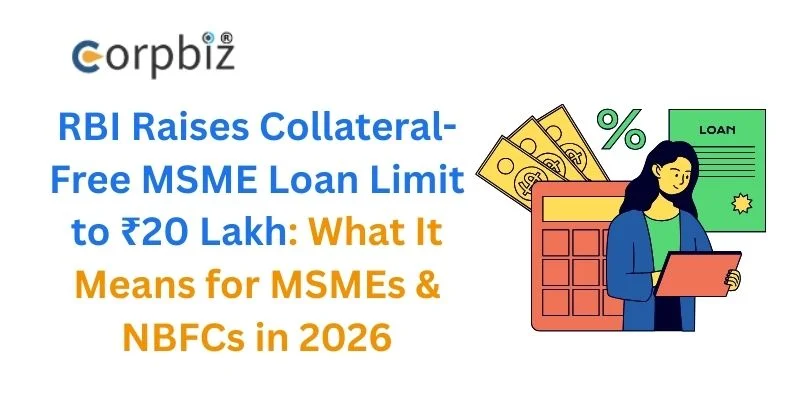
RBI enhances the collateral-free MSME loan limit to ₹20 lakh, revolutionising MSME finance in 2026. With the revised RBI MSME lending policy, small businesses can obtain loans without collateral, promoting NBFCs’ involvement in MSME finance. Discover the key eligibility criteria, RBI’s recent directions, and the MSME finance implications of collateral-free loans.
Introduction
The MSME (Micro, Small, and Medium Enterprises) sector is the backbone of the Indian economy since it is a major contributor to GDP, exports, and employment. Although MSMEs are very important, they face significant challenges in accessing formal credit. It is due to high collateral requirements and the limited financial history of the business. The Reserve Bank of India (RBI) designed the ongoing institutional reforms to ease credit availability and enhance financial inclusion.
In 2026, the RBI made a significant decision to raise Rs. 20 lakhs for a collateral-free limit on MSME loans. The new RBI MSME lending provisions will most probably assist and empower small businesses, decrease their dependency on informal borrowings, and increase the portion of NBFCs’ (Non-Banking Financial Companies) share in MSME financing. The step taken by the RBI to provide a push to collateral-free MSME loans would help in entrepreneurship, innovation, and sustainable growth in sectors. Continue reading the blog if you are a business owner or an NBFC registration seeker to know how RBI reforms impact your business.
RBI Raises Collateral-Free Loan Limit: Applicability and Impact
This section outlines RBI’s revised collateral-free MSME loan limit, its applicability to new and existing borrowers, and the broader financing impact on small business growth and credit access.
RBI’s Announcement
The Reserve Bank of India (RBI) introduced an important reform with respect to the financing of MSMEs, increasing the limit of collateral-free loans for MSMEs up to ₹20 lakh. The amendment changes will be applicable from April 1, 2026, aims at providing seamless financial assistance for these businesses.
Limit for Collateral-Free Loans: Previous Vs Current
Earlier, the limit for availing collateral-free loans was only up to ₹10 lakh. This was adversely affecting the survival of MSMEs, as it was becoming difficult for them to avail sufficient loans for smooth business operations. Now, the RBI has doubled the limit under the updated MSME lending guidelines.
- Earlier limit: ₹10 lakh
- New limit: ₹20 lakh (effective from 1st April 2026)
Applicability of RBIs New Framework
The revised guidelines ensure that both new borrowers and existing MSMEs benefit from the improved collateral-free loans. The update covers the following:
- New loan applications filed after April 1, 2026
- Renewed loan facilities under existing arrangements
Implications for MSME Financing
To expand the scope of MSME loans without collateral, the RBI hopes that the burden on informal sources will ease, with a higher participation of NBFCs in MSME financing. This is expected to reform the MSME financing space in 2026, providing support to entrepreneurship, sustainable growth and innovation.
Talk To Expert

Get Expert help on MSME
(4.8)


Regulatory Background: RBI’s Legal Authority Behind the Amendment
RBI’s legal authority section explains that the statutory framework covers amendments, governing laws, regulatory directions, and the policy rationale behind revising collateral-free MSME loan limits.
The powers under which the Reserve Bank of India may exercise supervisory control over lending practices are derived essentially from the Banking Regulation Act, 1949. Specifically:
- Section 21 provision empowers the RBI to regulate advances by banks in the public interest.
- Section 35A provides the RBI with the authority to issue binding directions to banks for maintaining sound credit practices.
Role in public interest lending
Through these measures, the RBI ensures proper alignment of policies with the nation’s financial needs. The provision of collateral-free loans to MSMEs is an essential aspect of the RBI’s mandate as it relates to financial inclusion.
Importance of master directions
RBI has framed Master Directions on MSME Lending, which act as the compliance mechanism for banks and NBFCs. These directions bring together various guidelines, rules, and regulations, and criteria for MSME operations.
Why were Amendments Needed?
The pre-existing limit on purely collateral-free loans of ₹10 lakh had become inadequate for the MSMEs due to increasing costs, expansion needs, and inflationary levels. Thus, the RBI, by amending the guidelines to increase the quantum to ₹20 lakh, effective April 1, 2026, has attempted to keep the credit policy aligned with the changing realities. This would enable formal credit access for businesses without collateral requirements, which otherwise may have been sourced through the informal market.
Key Highlights of RBI MSME Lending Amendment Directions, 2026
The RBI’s revised lending directions, effective April 1, 2026, for MSMEs attempt to give a fillip in broadening the scope of credit availability, with adequate safeguards to ensure compliance.
These highlights reflect the balance between the borrowers’ empowerment and the risk management of lenders. The amendments given below help strengthen the financing of MSMEs in 2026 by ensuring that collateral-free loans remain accessible and comply with the RBI’s overarching public interest mandate.
Collateral-free Loans of up to ₹20 Lakh are Mandatory
According to the revised norms, banks and NBFCs shall not require any collateral for extending loans up to ₹20 lakh.
- Applies uniformly to all MSE (Micro and Small Enterprises) units.
- Ensures wider access to formal credit without asset pledging.
Enhanced Limit up to ₹25 Lakh (Conditional)
This update calls for a multi-tiered approach that incentivises responsible borrowing with verifiable histories of accountability. The RBI has permitted collateral-free loans up to ₹25 lakh, subject to certain conditions:
- Strong repayment history and discipline in maintaining good credit.
- Demonstrated financial health of the enterprise.
- Compliance with the internal credit policy of the bank.
PMEGP Units: Special Inclusion
Beneficiaries of the Prime Minister’s Employment Generation Programme (PMEGP) are included.
- Collateral-free loans extended to PMEGP units.
- Schemes implemented by the Khadi and Village Industries Commission (KVIC) are included in this.
Credit Guarantee Scheme Coverage
The role of the Credit Guarantee Fund Trust for Micro & Small Enterprises (CGTMSE) continues to remain the same.
- Provides risk mitigation for lenders.
- Encourages banks and NBFCs to offer collateral-free loans without worrying about the threat of default.
Gold & silver as Voluntary Collateral
The RBI has made it clear that the pledging of gold and silver is voluntary and the borrower’s decision.
- Prevents regulatory violations by banks requiring such collateral.
- Ensures borrower autonomy while allowing flexibility for borrowers who prefer asset-backed lending.
Read more – Comprehensive Guide to Business Loans for MSMEs
Deletion of Paragraph 6.5: What it Signals?
This amendment is also part of the RBI’s larger drive to modernise MSME financing in 2026, aiming to achieve a balance between regulatory supervision and practical lending freedoms.
What Paragraph 6.5 Covered Earlier?
The paragraph 6.5 of the RBI Master Directions on MSME Lending provided the following guidelines, under which banks could exercise discretion regarding collateral. The specific conditions that banks need to comply with in exercising this discretion.
Why did the RBI Remove Paragraph 6.5?
The deletion of this clause, in particular, signifies the RBI’s commitment to easing regulations while eliminating redundant provisions. It has, in this sense, streamlined the system by ensuring clarity, as reflected in the deletion of this specific clause.
Impact on Operational Flexibility
- Banks and NBFCs benefit from the increased flexibility they get to operate.
- Lack of ambiguity in compliance improves decision-making and efficiency.
- A more transparent lending scenario is favourable for MSMEs, keeping in line with the increased limit for a collateral-free loan of ₹20 lakh.
Impact on MSME Businesses: Opportunities and Advantages
The RBI’s move to increase the limit of MSME loans that are not collateral-based to up to ₹20 lakh opens up several doors for small-scale industries, start-ups, and micro-level units. The step specifically targets the long-persisting problems in these sectors and strengthens the foundation for growth.
Easier access to formal credit
MSMEs can now access loans even without collateral, thus becoming less dependent on the informal sector. The result is improved financial inclusion, ensuring they only operate within a regulated system.
Lower entry barriers for new MSMEs
Startups and microenterprises stand to benefit the most, with the higher collateral-free threshold, and lowered entry barriers. New businesses can get funding to meet working capital and investment requirements.
Improved availability of working capital
The increased limit smooths cash flows, thereby helping the MSMEs manage their day-to-day operations with greater efficiency. A surety of credit ensures that supply chain management will be smoother and payments to vendors will be timely.
Encouragement of business expansion
Similarly, collateral-free loans of up to ₹20 lakh or less will add to capital expenditures and growth financing. The MSME sector is enabled to invest in technology, infrastructure, and expansion, to improve its competitiveness in 2026.
Impact on NBFCs and Lending Institutions
The latest development in this area is the RBI’s move to amend regulations to increase the collateral-free loan limit for MSME sector enterprises to ₹20 lakh. The implications of this development for NBFCs are substantial.
Increased demand for MSME credit
The increased threshold is likely to result in more demand for MSME loans, thereby increasing opportunities for NBFCs. This will open doors for them to lend to more startups, micro units, and small businesses.
Credit risk and due diligence challenges
The threat of increased risk exposure will be high in the case of collateral-free loans. A greater emphasis will be laid on cash flow-based lending models by non-banking financial companies.
Role of credit guarantee schemes
The risk-sharing mechanisms are offered by the Credit Guarantee Fund Trust for Micro and Small Enterprises (CGTMSE). This coverage makes NBFCs willing to offer collateral-free loans since a portion of the default risk is covered.
Policy alignment and compliance readiness
NBFCs must modify their internal lending policies in line with RBI MSME lending guidelines. This is to ensure compliance readiness, as it can lead to smoother MSME Lending, along with credit growth.
Read more – E-Waste Recycling Business Model for the MSME Sector
Comparison: Old vs New RBI MSME Collateral Norms
A marked shift can be seen in RBI’s Amendment Directions, 2026, which pertains to credit policy for MSMEs. The changes between RBI’s old framework and the updated norms are clearly outlined in the table given below:
| Criteria | Old Norms (Pre-2026) | New Norms (2026 Amendment) |
| Collateral-free loan limit | Up to ₹10 Lakh. | Up to ₹20 Lakh (mandatory). |
| Collateral requirement | Banks can ask for collateral worth over ₹10 lakh. | Banks are not allowed to demand collateral up to ₹20 lakh; scope to extend to ₹25 lakh for strong borrowers. |
| Risk mitigation tools | Limited dependence on internal policies. | Expanded coverage under Credit Guarantee Fund Trust for Micro & Small Enterprises (CGTMSE) to share default risk with lenders. |
| Applicability Timeline | Existing framework until March 31, 2026. | New norms effective April 1, 2026, applicable for both new and renewed loans. |
This comparison highlights the RBI’s intentions of improving MSME funding through doubling the collateral-free amount and the formalisation of risk-sharing models.
Strategic Takeaways for MSMEs and NBFCs
The RBI’s collateral-free loans for MSMEs, as amended in 2026, present MSMEs and NBFCs with opportunities and challenges they need to address for maximum benefits.
To achieve this, MSME businesses and NBFCs must have disciplined strategies in place.
By employing the measures below, MSMEs can gain easier access to capital for expansion, while NBFCs increase their lending portfolios sustainably.
RBI’s Collateral-free Loans Ffr MSMEs
- Maintain financial discipline: Timely payments and sound credit habits will enable MSMEs to avail higher collateral-free limits up to ₹25 lakh.
- Better documentation and improved compliance: Timely documentation and GST returns, combined with transparent financial statements, will improve loan applications and speed up loan approvals.
RBI’s Collateral-free loans For NBFCs
- Strengthening credit appraisal models: With collateral-free lending, NBFCs would put greater emphasis on assessing cash flows, sectoral risk, and repayment possibilities than on collateral itself.
- Leverage the flexibility offered by RBI wisely: The updated policies offer flexibility and freedom to operate, and institutions need to ensure that these systems are compliant with RBI’s Master Directions.
Documents Required to Avail Collateral-Free MSME Loans
To access collateral-free MSME loans based on the RBI’s 2026 guidelines, appropriate documentation is required. Proper documentation not only meets the RBI’s compliance requirements but also increases the credibility of the borrower, increasing the probability of approval for their collateral-free loan.
Here is a list of essential documents required to avail the free-collateral MSME loans. See the pointers below:
- Business registration proof: Certificate of Company Registration, Udyam Registration, or partnership deed.
- KYC documents: PAN Card, Aadhaar Card, and address proof of the promoters.
- Financial statements: Audited balance sheets, profit & loss accounts, and cash flow statements.
- GST filings and tax returns: Latest updates on GST tax returns and income tax filings to ascertain compliance.
- Bank statements: For confirming the recent transactions and repayment capacity.
- Project report or business plan: For startups or expansion finance, indicating the objectives and their cash flow projections.
- Repayment track record: For existing borrowers, a demonstration of their previous repayment history to benefit from higher limit facilities up to ₹25 lakh.
Read more – MSME Sector Growth in India
Final Words
The RBI’s amendment to collateral-free MSME loan norms in 2026 indicates a strong desire to modernise the Indian credit system. With the loan limit being increased to ₹20 lakh, the regulator has been focusing on financial inclusion so that micro and small businesses can have access to formal credit, without being limited by the necessity to have an asset. Not only does this reform enable startups and micro units, but it also provides the base for economic growth as it balances working capital and promotes growth.
To lenders, particularly the NBFCs, the amendment is an opportunity to grow the MSME portfolios with the inclusion of credit guarantee schemes to reduce risk. The long-term impacts are an improved credit culture, a low level of reliance on informal financing, and enhanced institutional involvement in MSME development.
Nonetheless, regulatory awareness and compliance preparedness are the keys to success. MSMEs are required to keep financial discipline and records, and NBFCs are to match the policies with the Master Directions of the RBI. All these activities will culminate in sustainable growth and a strong MSME sector.
Looking for assistance for MSME registration, NBFC registration, or compliance? Contact Corpbiz now and get professional counselling and end-to-end support.
Helpful Questions About MSME Loan Limit
What do you understand by a collateral-free MSME loan?
A collateral-free MSME loan is a credit service for micro, small, and medium enterprises (MSMEs) that does not involve the pledging of assets or properties in order to access such credit.
Has RBI increased the MSME collateral-free loan limit?
Yes, the Reserve Bank of India (RBI) has more than doubled the collateral-free loan limit under the MSME category from ₹10 lakh to ₹20 lakh under its updated lending guidelines of 2026.
When will the ₹20 lakh collateral-free loan be applicable from?
The increased limit of the collateral-free MSME loan, which is up to ₹20 lakh, will be effective from April 1, 2026, for both new applications as well as renewed loans.
Who is eligible for collateral-free MSME loans?
In accordance with the RBI MSME lending guidelines, all the registered micro, small, and medium enterprises (MSE units) that are not subject to collateral may obtain loans without furnishing collateral, so long as the units are operating in accordance with bank policies.
Are new MSMEs eligible to take collateral-free loans?
Yes, new MSMEs, including start-ups and micro enterprises, can also seek collateral-free loans of up to ₹20 lakh and therefore find it easy to gain access to formal credit markets without necessarily making a pledge of collateral.
Are credit scores still necessary for MSMEs applying for such loans?
Yes, although collateral is not mandatory for MSMEs, these businesses must have good credit scores and repayment policies, as the bank evaluates financial conditions before allowing collateral-free loans, according to the RBI.
Do NBFCs also have to offer collateral-free MSME loans?
Yes, NBFCs need to adhere to RBI MSME lending guidelines and provide collateral-free loans of up to ₹20 lakh, thereby ensuring equal access to formal financial institutions.
How does CGTMSE protect lenders in collateral-free loans?
The CGTMSE offers credit guarantee coverage the default risk is hence shared by the banks and NBFCs. This approach helps in encouraging banks and NBFCs to take collateral-free loans.
Can banks still ask for collateral of above ₹20 lakh?
Yes, collateral may be required by the banks on loans beyond ₹20 lakh; however, collateral-free loans up to ₹25 lakh may be provided to MSMEs with strong repayment behaviour and financial stability.
What documents are required to avail collateral-free MSME loans?
Proof of business registration, GST filing and tax returns, financial statements, KYC documents, bank statements,project report or business plan,and repayment records need to be furnished by MSMEs for the sanction of loans without collateral, adhering to RBI norms.
Can I take a loan of ₹20 lakh without collateral?
Yes, under RBI guidelines of 2026, MSMEs can avail collateral-free loans of up to ₹20 lakh if they fulfil all eligibility criteria, documentation, and other compliances required by the banks or NBFCs.