


The Food Safety and Standards Authority of India (FSSAI) issued a notice on May 20, 2025, to invite comments on their latest proposal to amend provisions on renewal dates and long-term validity of food licenses.
The first proposal aims to streamline the registration and renewal process for food licenses with the FSSAI. The proposal intends to introduce fixed renewal periods with standard dates at the expense of the business owners.
The second proposal wants to provide long-term validity of up to 10 years for specific businesses, such as wholesalers, online vendors, and distributors.
The proposal, when amended into law, will help reduce the administrative process system, enhance the compliance system, and reduce the overhead costs associated with such a process for food businesses in India.
In this blog, we’ll cover the legal background, FSSAI’s latest proposals, the benefits of the supposed changes, and the challenges of the current system.
What is FSSAI?
The Food Safety and Standards Authority of India (FSSAI) is a governmental regulatory body that was established under the Food and Standards Act of 2006. It was founded to establish scientific standards for food articles, manufacturers, storage, distribution, sale, import, and export of food items to ensure food safety.
The FSSAI plays a significant role in ensuring public safety concerning the quality of food products. It provides licenses and permits that are vital for food business operators (FBOs).
Role & Responsibilities of the FSSAI
Given below are the role and responsibilities of the FSSAI-
- The FSSAI drafts rules and regulations to prescribe standards concerning the quality of food items.
- It frames provisions regarding instructions and rules for permits of regulatory bodies involved in the certification of food-related economic activities.
- This regulatory body also provides insights to the central and state governments for matters relating to the law changes as per food safety and nutrition.
- It is responsible for creating appropriate channels to send information to the general public, including semi-urban and rural areas.
- The FSSAI collects information concerning food consumption, any biohazards, and contamination.
- It also helps new food businesses through training programs.
- This body also contributes to the development of international food standards.
- The FSSAI also promotes awareness relating to food safety and its related standards.
Background Behind FSSAI Proposal on License Renewals
The FSSAI’s food registrations and licenses are governed by Food Safety and Standards (Licensing and Registration of Food Businesses) Regulations, 2011.
The provisions under the validity and renewal of licenses and registrations are being amended by the latest proposal of the FSSAI.
As per the current rules, the food business operators (FBOs) obtain basic registration, state licenses, and central licenses for a period of 1 to 5 years. The FSSAI is looking to increase the validity period up to 10 years.
The FSSAI also intends to extend the minimum registration period to 3 years from 1 to 2 years for basic registration. Scroll down and find out more about the new proposal if you’re thinking of venturing into the food business in India.
Understanding the FSSAI Proposal on Food Licenses
Discover the FSSAI proposal on food licenses if you’re a food business operator (FBO) as described below:

1. The First Proposal
With the first proposal, the Food Safety and Standards Authority of India (FSSAI) aims to provide a set of deadlines for the renewal of food licenses for food businesses and entrepreneurs.
All food businesses will have the option to choose from the below-mentioned deadlines, as prescribed in the proposal are as follows:
- January 15th
- April 15th
- July 15th
- October 15th
How Will the FSSAI Implement the First Proposal?
The FSSAI will implement the first proposal in two ways as explained below:
1) For Old & Existing Food Business Operators (FBO)
All existing and old food business operators (FBOs) will be able to choose any of the above-mentioned dates to renew their licenses and permits. The fees will be determined based on such deadline selection.
2) New Applicants/Business
The Food Safety Compliance System (FoSCoS) will auto-assign the nearest renewal date as per their automated system for new applicants or businesses to streamline the process.
It is important to note that the new applicants have the option to change the renewal date with a surcharge payment in case the new chosen date goes beyond the license’s validity period.
The main objective of this proposal is to simplify the license renewal process, reduce the administrative burden of the government, and provide a great amount of flexibility to food business owners all across India.
2. Second Proposal
Through the second proposal, the FSSAI aims to extend the validity of licenses for specific food businesses like “Kind of Business” under the Trade/Retail head.
It will include both medium to large businesses. The license validity will increase up to 10 years from 5 years.
The different types of businesses that will benefit from the FSSAI’s new proposal:
- Storage (Except Controlled Atmosphere and Cold)
- Storage (Cold & Refrigerated)
- Storage (Controlled Atmosphere and cold)
- Wholesalers
- Retailers
- Distributors (Small and large scale)
- Food Transporters
- Food Vending Agencies and Services
- Online Food Delivery apps
- E-commerce Grocery Stores like Amazon, Blinkit, Zepto, Swiggy Instamart
- Import Businesses
- Export Companies
- Direct Sellers
3. Third Proposal
The third proposal will fix the minimum validity of FSSAI registration to 3 years. It will also remove the previous rule of 1- and 2-year validity and requirement of consultants for obtaining and renewing the registration, simplifying the process with a cost-effective solution and streamlining the overall compliance approvals.
Small businesses and entrepreneurs will be able to obtain registration for 3 to 5 years after the amendment of the law.
Who Does This Apply to?
Small & Medium Enterprises and businesses engaged in India’s food business, covering both central and state registrations.
Reason Behind FSSAI’s Proposal on Licenses & Renewals
Read the below-mentioned key reasons behind the Food Safety and Standards Authority of India (FSSAI)’s latest proposal on licenses and renewals:
- To extend the validity of licenses to up to 10 years for large-scale business operators.
- Reduce red tape and administrative burden for all food businesses and entrepreneurs.
- Increase the validity to 3 years for FSSAI registration for small and medium enterprises (SMEs) and small-scale entrepreneurs.
- Streamline the compliance obligations of all stakeholders in the food industry.
Types of Food Licenses & Registrations by FSSAI
The types of food licenses and registrations by FSSAI are as follows:
FSSAI Registration
- Natural and artificial persons engaged in the food business, including distribution, manufacturing, processing, storage, and sale of food articles, should obtain an FSSAI registration. It includes both small- and large-scale entrepreneurs and corporations.
- Every business is allotted a 14-digit unique identification number that represents the product’s authorization. This number is printed on each of its goods.
Businesses with an annual turnover of INR 12,00,000 or less should obtain FSSAI registration. The list is as follows:
- Small condiment stores
- Fast food and temporary stalls
- Dairy entrepreneurs, namely milk vendors
- Wholesalers and retailers
- Repacking businesses
- Meat and Fish processing factories and units
- Cold and freezer storage facilities
- Restaurants and Hotels
- Food trucks and wagons
- Transport facilitators, including insulated refrigerators, and online grocery stores.
FSSAI State License
- This license is mostly obtained by medium-sized food operating businesses (FBOs), including medium-scale manufacturers, marketers, producers, transporters, and traders.
- So, if you’re a mid-size FBO with an annual turnover of more than INR 12,00,000, but less than 20 crores, then you must acquire an FSSAI state license. The maximum limit is set at 30 crores for wholesalers and transport facilitators.
- The license validity is 1 to 5 years, which is being extended to up to 10 years as per FSSAI’s latest proposal.
FSSAI Central License
- The FSSAI central license is acquired by large-scale manufacturers, producers, importers, and exporters involved in the food business.
- All big corporations with a gross revenue of more than INR 20 crores should acquire an FSSAI central license from the Indian government.
- Just like state licenses, the limit is set at INR 30 crore for wholesalers and transport corporations.
Apart from the above-mentioned large-scale economic activities, the FSSAI central license is required by the following businesses, irrespective of the thresholds if you’re a:
- Food operators in two or more Indian states.
- Owner of non-specified food items.
- Corporation with an online food business presence
- Entrepreneurs operating economic activities in the premises of the central government authorities.
- The company engaged in the food supplement business.
- Corporations involved in foreign trade through import and export
- A business that uses radiation for food processing.
Documents Required to Obtain FSSAI Basic Registrations
The list of documentation requirements to acquire FSSAI basic registration is as follows:
- A Business plan
- Identification and address proof of the food business operator (FBO).
- A copy of the company registration certificate if you’re an LLC or any other legal entity
- Business registration certificate or partnership deed, whichever is applicable.
- Trade licenses, such as shop and establishment trade licenses.
- A bank account statement
- Local municipality approvals, if applicable.
- Food safety strategic management report
- A list of food articles and products that you’ve planned to manufacture, produce, repackage, or sell.
- An address proof of the business establishment.
- A no-objection certificate (NOC) in case you’re renting the business premises.
- Electricity or water bills
Documents for FSSAI State & Central License
Below-mentioned is a list of documents required by medium-scale businesses to obtain an FSSAI state license:
- ID and address proofs of the main personnel, namely directors, shareholders, and managing partners.
- A copy of a valid shop and establishment license.
- A certificate of company formation and business registration (LLC, a private limited company (Pte Ltd).
- Memorandum of Association (MOA)
- Articles of Association (AOA)
- Medical certificate and insurance of all employees.
- Building Use (B.U.) permit.
- No objection certificate (NOC) from the manufacturer.
- A list of food products, including raw materials, ingredients, and end products.
- Machinery and equipment list, if applicable
- Information on sources of raw materials.
- A copy of the BIS certificate for package water business operators.
- Relevant NOC from water supply agencies.
- Bank statement as proof of annual turnover.
- Property tax receipt
Benefits of FSSAI’s Proposal on License Renewals
The new proposal will not only simplify the process but also reduce the unnecessary administrative costs that are associated with food license renewals. The benefits of FSSAI’s proposal on license renewals are as follows:

1. Uniformity
The new proposal includes a fixed and uniform renewal period with four deadline options. This will help food business operations (FBOs), especially large-scale producer with several outlets in different states, to plan their renewals accordingly. These changes will no longer require them to track multiple deadlines, increasing operational efficiency.
2. Support for Small Businesses
With the increase in the validity of the FSSAI registration to 3 years from 1-2 years, the regulatory body aims to reduce the overhead costs associated with compliance renewals.
3. From Awareness to Prevention
The FSSAI has prescribed that it will be launching awareness programs to educate small and medium-scale businesses and individuals. The programs will explain to them the new changes, the importance of timely renewals, and the consequences of noncompliance, such as license cancellations and subsequent penalties.
4. Time Efficient
The food business operators (FBOs) with “Kind of Business” registered as a head office will have the opportunity to do bulk renewals for their multiple outlets in different locations. This will save time, eradicating the possibility of missing any major deadlines.
Challenges About FSSAI’s Current License Renewal System
Food business operators (FBOs) that have outlets in multiple states or different types of businesses all over India mostly face challenges relating to regulatory compliance approvals and renewals. Some of the challenges are as follows:
1. Uneven Expiration & Renewals
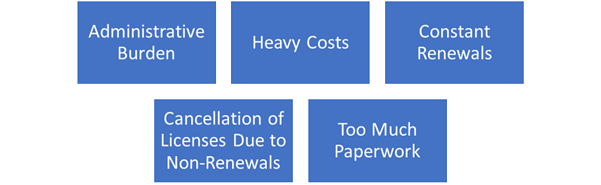
Food business operators (FBOs) with multiple licenses in one or more states often have different registration grant dates, which creates confusion because the validity period is determined as per the issuance of the license. A lot of businesses miss important deadlines due to such inconsistencies.
2. Heavy Bureaucracy
As per the current laws, food businesses and entrepreneurs have to manage multiple renewal deadlines, which often require constant monitoring, which ultimately increases the operating and overhead costs due to the filing of multiple applications.
3. Short Term Renewals
Most food business operators obtain specific license permits, including FSSAI state and central licenses are usually valid for a period between 1 to 5 years, increasing paperwork and administrative costs.
To Wrap Up
To sum everything up, the Food Safety and Standards Authority of India (FSSAI)’s latest proposal on license and registration for food businesses will not only reduce the administrative burden but also help them increase their revenue, save hours on paperwork, and decrease costs on license renewal approvals.
After the amendment of the law, small businesses will be able to obtain and renew their FSSAI registration for 3 to 5 years, eliminating the need to register every 1 to 2 years, reducing costs in the long run.
The proposal also aims to simplify bulk renewals for e-commerce, manufacturing, and transport businesses with multiple outlets in the country.
The new changes are highly beneficial for you if you’re a medium or large corporation engaged in the food business. With the help of FSSAI’s proposal, big and mid-size firms will be able to obtain state and central licenses and renewals for up to 10 years, as compared to the current provision of 1 to 5 years.
With the introduction of fixed renewal cycles, all food business operators (FBOs) will be able to plan their compliance obligations, which would help them avoid important deadlines and penalties for noncompliance. All in all, the FSSAI’s new proposal is cost-competitive and time-efficient
Do you want to help shape FSSAI’s new proposal? If yes, then send your comments or suggestions within 30 days from the issue of FSSAI’s notice of consultation if you operate a food business or are any other stakeholder.
Need assistance for obtaining FSSAI food license or registration? Contact and visit us on https://corpbiz.io/.
Frequently Asked Questions
What is FSSAI?
The Food Safety and Standards Authority of India (FSSAI) is a regulatory body that governs the registration and license approvals for food businesses and entrepreneurs in India. It also provides standards and guidelines on food quality for public safety.
Which law is being amended by FSSAI’s proposal on food license renewals?
The provisions relating to the validity and renewal of registration and licenses under the Food Safety and Standards (Licensing and Registration of Food Businesses) Regulation of 2011.
What are the highlights of FSSAI’s new proposal on food registrations and licenses?
Explore the highlights of the Food Safety and Standards Authority of India (FSSAI) as listed below:
– Fixed renewal deadlines for basic registration, state license, and central license.
– Bulk renewal filing for large and medium corporations with multiple outlets in different Indian states.
– Minimum validity increases to 3 years with an extension of up to 5 years for FSSAI basic registration.
– Increase in the validity of state and central licenses for a period of up to 10 years as compared to 5 years under the current law.What are the benefits of FSSAI’s new proposal on food license renewals?
The benefits of the proposal are as follows:
– Streamlined renewal management for large-scale manufacturers, distributors, and e-commerce operators.
– 10-year long-term license validity for “Kind of Business” food business operators (FBOs) to ensure uninterrupted business operations.
– A minimum 3-year validity for small business to reduce their administrative costs.
– Simplified paperwork for big producers with multiple outlets for audit purposes.What are the challenges that are associated with the old law?
The challenges of the previous law are best described as mentioned below:
– Too much renewal monitoring and deadline tracking
– Frequent renewal every 1 to 5 years, increasing administrative and financial burden concerning food licenses.
– Overhead cost issue for small businesses that have to renew their FSSAI registration every 1 to 2 years.What are the types of FSSAI’s licenses and registrations?
The different types of FSSAI licenses are as follows:
– FSSAI Registration: This is a basic registration, which is obtained by small to medium entrepreneurs with less than INR 12,00,000 annual turnover.
– FSSAI Central License: mostly obtained by large-scale corporations and entrepreneurs with a gross revenue of INR 20 crores.
– FSSAI State License: This license is acquired by medium-sized firms with an annual turnover of at least INR 12,00,000, but less than 20 crores.What are the important dates for fixed renewal cycles?
The uniform dates for renewal are as follows:
– January 15
– April 15
– July 15
– October 15What type of food businesses will benefit from the FSSAI Proposal?
The list of businesses is as follows:
– Small-Scale Businesses
– Manufacturers
– Catering Services
– Restaurants & Food Hotels
– Food Transportation Services
– Freezer Storage Facilities
– Food Item Warehouses
– Retail Grocery Stores
– Wholesale Outlets & Supermarkets
– Food Importers and Exporters
– Online Food Delivery CompaniesHow will large-scale food companies benefit from FSSAI’s new proposal on license renewals?
The benefits for large food business operators (FBOs), including manufacturers, transporters, storage, distributors, wholesalers, and traders, are as follows:
– FBOs with “Kind of Business” as a head office can renew licenses for their multiple outlets in different states in bulk.
– Big Corps will be able to renew their state and central FSSAI licenses for up to 10 years.
– They will get an option to choose their renewal date at their convenience.How will FSSAI’s proposal impact small food businesses in India?
Small-scale businesses can now obtain and renew FSSAI registrations for a period of 3 to 5 years. This will help reduce unnecessary operational costs related to regulatory approvals.
Can I choose a later date than the one that is assigned to me by the FSSAI for license renewals?
The FSSAI has provided an option for new businesses to choose a different date if they aren’t satisfied with the assigned one, with a differential fee.
Can I do a bulk renewal of all my businesses in multiple locations as an e-commerce food delivery business in different Indian states?
Yes, according to the new FSSAI proposal, you’ll be able to renew your multiple licenses in bulk if your “Kind of Business” is listed as the head office.
What is the cost of FSSAI registration and licenses?
The fee structure for the FSSAI license and registration is as follows:
– Basic Registration: INR 100
– Central License: INR 7,500
– State License: ranges from INR 2,000 to INR 5,000