

Introduction
EVs (Electric Vehicles) are experiencing strong growth in India. The Indian EV market was valued at approximately $3.21 billion in 2022 and is projected to grow to $113.99 billion by 2029, reflecting a compound annual growth rate (CAGR) of 66.52%. Such a high CAGR means that the populace is ready to accept electric options more readily than ever.
The main benefit of EVs is that they reduce dependence on fossil fuels and consequently control greenhouse gas emissions in the atmosphere. For the user, it means that they can finally do away with fossil fuels such as diesel and petrol, which are getting more and more expensive each day, and switch to electricity.
This change was heavily encouraged all throughout the world, and in the previous 10 years, EVs have finally become a realistic option for the normal Indian consumer. However, with this adoption of EVs, India is now facing a major problem—the treatment of EV batteries at the end of their life span.
The Growing Demand for EVs and Its Environmental Impact
As of 2020, there were approximately 200,000 metric tons of battery material available for recycling worldwide. A sad statistic regarding the recycling of batteries and their material is that only about 5% of EV batteries are currently recycled globally. Such a low number is due to many reasons, the main ones being:
Safety Concerns: Batteries cannot simply be dumped into landfills as they are a fire hazard. Improperly disposed batteries can cause large fires and may cause a lot of pollution and endanger the residents who unfortunately come into contact with discarded batteries. They have also been known to explode because of the highly reactive metals such as Lithium, which are used to make these batteries.
Lack of Facilities: Properly handling battery disposal requires high-tech and properly designed facilities that can handle fire hazards and can also harvest the battery material efficiently. Unfortunately, there are just not enough facilities available that can handle battery recycling. In countries like India, around 90% of used batteries are processed by the unorganized sector or end up in landfills. This not only poses environmental hazards but also represents a missed opportunity for resource recovery.
High Cost: Setting up recycling centres for EV batteries is expensive. It not only requires capital and infrastructure, but the staff handling the batteries and the equipment that handles the batteries are to be specially trained and designed (respectively) to be able to take that task on. This requires heavy investment, which is not readily available for budding industries, including the Electric Vehicles market.
Focus on the Boom: Whatever investment has been coming to the EV sector is primarily for research and design right now. Because the boom is so fresh and new, no one cares about the time in the future when the EV batteries will have to be disposed of.
Talk To Expert

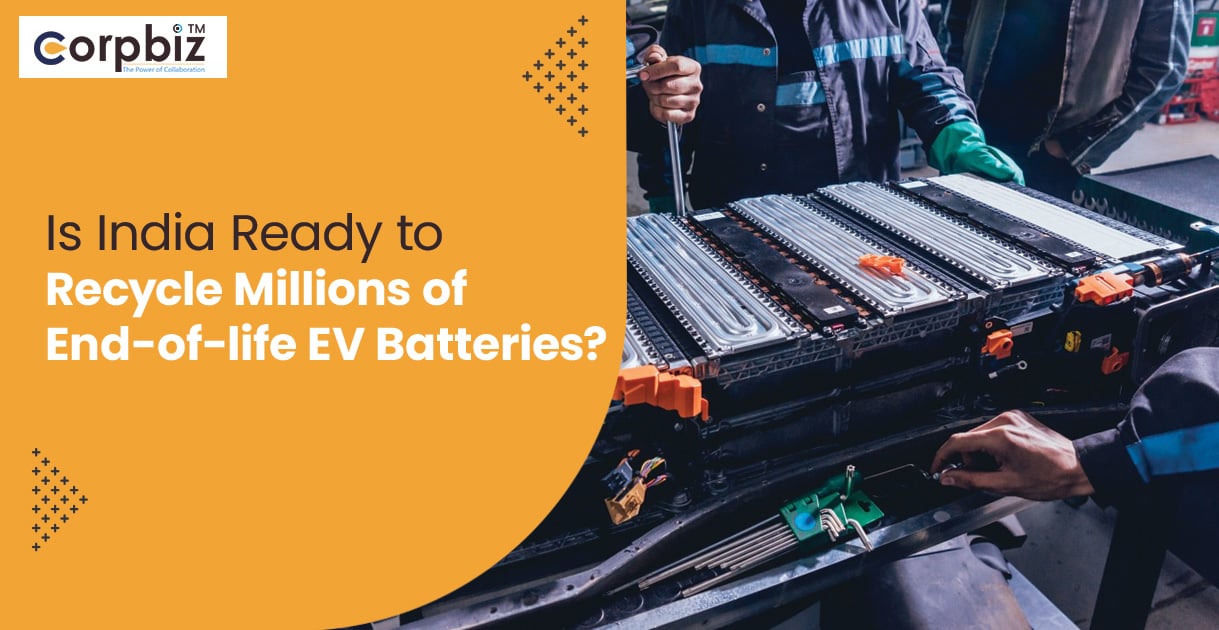
Is India Ready to Recycle Millions of End-of-life EV Batteries?
(4.8)


End-of-life EV Batteries
The average EV battery has a capacity of around 40 kWh, but some can be as high as 100 kWh. This makes EV batteries some of the largest available batteries for consumer purposes (excluding industrial batteries). The average lifespan of these batteries is 20 to 30 years, but the manufacturers have only been making EVs for the past decade, or at max 15 years, which means that we haven’t fully seen the impact of EV batteries in waste management and recycling.
EV batteries use a lot of hazardous, precious, and non-precious materials in intricate chemical combinations and compositions. This not only makes improperly disposed batteries a fire hazard, but it also means that materials such as nickel, cobalt, and lithium, which are found in abundance in batteries and whose mining is very tough, are wasted if the batteries are not properly recycled.
95% of the materials used in EV batteries can be recycled and harvested, but only about 5% is recycled each year. These abysmal numbers show that it is high time to address the challenges involved in EV battery recycling and come up with solutions for them.
Challenges in Recycling of EV Batteries in India
India faces several key challenges in scaling up its EV battery recycling efforts. While the world is moving on to solve EV recycling challenges, India’s overall recycling efforts for normal products are also lacking, making a focus on EV batteries a far-off hope. India only recycles around 8% of its plastic waste, which is a major counter to efforts for EV battery recycling.
The most prominent challenges faced in the recycling of EV batteries are:
- Insufficient Recycling Infrastructure: India’s existing recycling infrastructure, as previously stated, is not equipped to handle the growing volume of lithium-ion batteries from EVs. Most facilities are geared towards lead-acid battery recycling, and even those only recycle around 2000 tons of batteries every year, leaving a gap in handling the more complex components of EV batteries. Building adequate infrastructure is vital to prevent environmental hazards and ensure the recovery of valuable materials like lithium and cobalt from EV batteries.
- High Recycling Costs and Technology Gaps: The technology required to efficiently recycle EV batteries—such as hydrometallurgy and direct recycling—is not yet widely available in India. Moreover, the cost of recycling these batteries often exceeds the value of the materials recovered reducing the incentives to actually set up plants that recycle EV batteries. Closing this gap by investing in advanced recycling technology will be crucial to making the process economically viable and sustainable.
- Low Public Awareness and Consumer Engagement: Public awareness around the importance of recycling EV batteries is still in its infancy. Without consumer participation in proper battery disposal and recycling programs, the effectiveness of these initiatives is severely limited. Raising awareness and encouraging consumer responsibility will play a key role in the success of recycling efforts.
- Weak Regulatory Framework and EPR Compliance: While there is growing emphasis on Extended Producer Responsibility (EPR) in India, enforcement and compliance remain inconsistent. A stronger regulatory framework with clear guidelines for battery disposal, transportation, and recycling is necessary to drive producer accountability and establish a cohesive recycling ecosystem.
Addressing these challenges is crucial for India to build a sustainable, efficient, and safe system for recycling millions of EV batteries, ultimately reducing environmental impact and dependence on imported raw materials. Conducting environmental impact assessment and social impact assessment is essential.
India’s Regulatory Structure Around Recycling of EV Batteries
Even though the EV market in India is new and fledgling, there are some rules and regulations already in place that direct manufacturers to handle battery waste management.
The main regulatory frameworks concerned with battery waste management in India are:
Battery Waste Management Rules (2022)
The Indian government introduced the Battery Waste Management Rules in 2022, replacing the previous guidelines under the e-waste management framework. These rules are designed to regulate the safe collection, recycling, and disposal of different types of batteries, including lithium-ion, which are used in EVs. The rules mandate that producers are responsible for collecting and recycling batteries through Extended Producer Responsibility (EPR).
According to the EPR rules, some recovery targets have been set for battery materials:
- 70% recovery by 2024-25
- 80% recovery by 2026
- 90% recovery from 2026-27 onwards
Another important rule is that manufacturers are required to incorporate a minimum of 5% recycled materials in new batteries by 2027, increasing to 20% by 2030-31.
National Electric Mobility Mission Plan (NEMMP)
The NEMMP is a broader policy initiative that focuses on the development of the EV industry in India but indirectly supports battery recycling by fostering innovation in battery technology and sustainability. Technological prowess in manufacturing batteries will directly support recycling efforts.
The government encourages research and development in battery management systems, including reuse and recycling techniques, to strengthen the circular economy under this scheme.
Compliance and Monitoring
The CPCB (Central Pollution Control Board) is responsible for overseeing compliance with these rules. Producers must file annual reports detailing their sales, sourcing and recycling efforts to obtain EPR certificates.
These rules and regulations show us that India has been taking large strides in making EVs a safe, secure option for consumers from an environmental and sustainability standpoint. A major obstacle in ensuring EPR compliance with the rules is the existence and dominance of the informal sector in India. According to studies, more than 90% of the battery waste is sorted and collected by the informal sector, which does not adhere to any guidelines or protocols.
The initiatives should be aimed at teaching and training the informal sector and creating government-backed opportunities for them, thereby formalising them and bringing them under the purview of the regulations.
Global Comparisons in Terms of EV Recycling Efforts
India’s battery recycling capacity currently stands at 44000 metric tonnes per year. Compared to this, India produces around 35000 metric tonnes of batteries each year. However, a large proportion of our batteries are actually imported (around 80% from China and around 10% from South Korea).
This makes India severely lacking in terms of EV battery recycling efforts. The top countries in terms of EV Battery recycling capacity are:
China: China is the global leader in both battery production and battery recycling efforts. As of December 2023, China can recycle upwards of 500,000 metric tonnes of batteries each year. They have been able to achieve this number because of strict regulations that govern battery production and disposal. They have set ambitious targets, such as 90% lithium recovery from batteries, and the current mandatory requirement stands at 85%.
They have also set up a mandate to connect recycling centres with the sales outlets of EVs, making the EV retailers and producers directly involved in the recycling supply chain for batteries.
USA: USA is also a major player in the field of EVs. Compared to India’s 44,000 metric tonnes, the USA can recycle around 200,000 metric tonnes of batteries each year. They also have stringent regulations and have been steadily growing the recycling capacity as the USA serves as a large market for EVs, with companies such as Tesla leading the charge towards EVs.
Europe: Europe also has a similar capacity as the USA, which is around 200,000 metric tonnes per year. European regulations are also becoming increasingly tighter in the race to become ready for when the first generation of EVs starts reaching the end of their usable life. Europe has a target of 35% lithium recovery from batteries by 2026.
How Can India Sustainably Grow EV Battery Recycling Efforts?
As India gears up for their EV revolution with companies such as Tata Motors, Ola, Aether, and others making affordable EVs for the average Indian consumer, it is high time that recycling efforts also be given the attention that they deserve.
A few measures that can be taken by the Indian government to grow the recycling industry for batteries, especially EV batteries, are:
Adopting International Technology: Hydrometallurgy (extraction using aqueous solutions) and direct recycling are two methods of recycling that are much more prevalent in international markets than in India. An essential requirement for growing recycling efforts for EV batteries is to make recycling more cost-effective for producers, making recycling more profitable and efficient for them.
Educational Campaigns: EPR (Extended Producer Responsibility) is important, but without the rallying support and demand by consumers, sustainable change is not possible. The government should create educational programs and campaigns while also incentivizing producers to create more awareness about the importance of recycling.
Strong Policy Creation and Enforcement: The EV industry needs more stringent policy requirements and mandates right at its inception to avoid the problem spiralling into something that cannot be controlled. Lithium is a precious resource and India imports a lot of it either raw or in the form of batteries, and each time it goes into landfills, it not only creates pollution but also is a huge waste of resources.
Formalisation of Workers: As mentioned, over 90% of garbage collection and recycling measures in India are actually undertaken by the informal sector. An urgent need is to formalise and educate these workers, who are often from poor socio-economic backgrounds. This will make compliance with regulations much more possible while also making the job safer and more sustainable for these workers.
To Wrap Up
India’s recycling performance has always been poor compared to international standards. This is because India is a developing country with not enough technology and resources available to focus on recycling. Other problems, both social and economic, are paid more attention as they may be more pressing, such as the creation of jobs and the growth of the economy.
EVs have the power to curb a lot of the pollution caused by traditional fuel-powered automobiles. Also, they’re potentially a huge industry waiting to grow. Hence, efforts to sustainably recycle and source materials for EV batteries are definitely going to be worth it, and the government seems to be making good progress on the regulatory front to introduce the changes India requires to grow exponentially. In order to get expert assistance in battery recycling and EPR authorization in India, visit https://corpbiz.io/.
Frequently Asked Questions
What is the future of EV batteries in India?
The EV industry in India is growing at over a 50% CAGR year on year. Projections show that 30% of the automobile fleet in India will be electric by 2030, hence, one can comfortably say that a lot more EV batteries are going to be produced in the coming few years.
Is India's Attero to spend $1 billion on battery recycling plants?
According to Bloomberg.com, Indian battery recycling company Attero Recycling Pvt is planning to invest $1 billion over five years to build lithium-ion battery recycling plants in Europe, the US and Indonesia as demand for the metal surges amid the global shift to electric cars.
Are EV batteries currently being recycled?
The simple answer is no. As the first generation of EVs haven’t reached their end of life, there is not a lot of scope to recycle EV batteries right now. Battery recycling measures, however, are in place.
Why is it so hard to recycle electric car batteries?
The main reason that recycling EV batteries is so hard is that EV batteries are still largely complex, unoptimized, and non-standard, with every producer having their own design and chemical compositions. This leads to a lack of consistent processes to recycle EV batteries.
What percentage of an EV battery is recycled?
Out of the total batteries reaching their end of life (all lithium-ion batteries, not specifically EV batteries), only around 5% are recycled.
Read our blog: BIS Standards for EV Batteries