

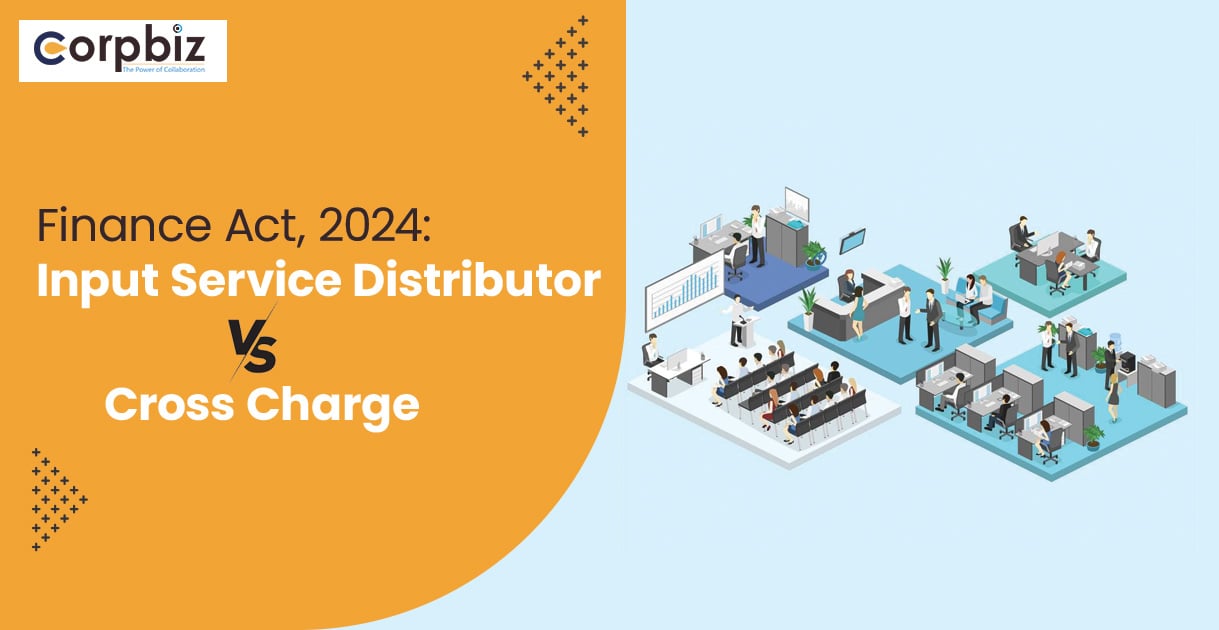
The Finance Act of 2024 has introduced several key changes in India’s taxation framework, significantly impacting how businesses account for input tax credits under the Goods and Services Tax (GST). Among the mechanisms in focus are the Input Service Distributor (ISD) and cross charge systems, essential for businesses with multiple branches or units. Understanding these two mechanisms is crucial to ensuring compliance with GST laws while maximizing the utilization of input tax credits.
The distinction between ISD and Cross Charge often confuses taxpayers, especially in large organizations where services are shared across multiple branches. While both systems aim to facilitate the smooth functioning of multi-unit businesses under a common GST framework, they operate differently regarding invoicing, tax liabilities, and the movement of input tax credits. This article delves into the differences between ISD and Cross Charge mechanisms, clarifying when and how each should be used, particularly in light of updates brought by the Finance Act 2024.
Know about Cross Charging
GST Cross Charging occurs when a business with multiple units supplies one of its units. In such scenarios, despite being part of the same company in theory, they are considered separate entities due to their distinct registrations. This treatment is mainly used when allocating Input Tax Credits among various company branches. Below are some points to consider regarding cross-charging in GST transactions:
- The Indian GST tax system does not have a distinct definition for cross-charging.
- The transfer of goods or services within the same business is classified as “deemed as supply,” meaning it is regarded as a transaction subject to GST.
- It is a crucial concept for individuals who have several GST registrations and
- It enables the supplying department to recoup expenses, even if treated as distinct entities.
Ensure proper GST registration for all your business units to simplify cross-charging and efficiently allocate Input Tax Credits to streamline inter-branch transactions by staying compliant and maximizing tax benefits.
Understanding Input Service Distribution (ISD)
Input Service Distribution (ISD) in GST transactions enables businesses to share the advantage of input tax credit for all input services one unit receives with other units belonging to the same entity. The input tax credit benefits entrepreneurs as it decreases the overall tax obligation.
According to the GST law, multi-unit businesses with offices in different states must obtain multiple GST registrations. When these various business divisions are provided with identical service inputs, allocating the ITC becomes challenging. Therefore, the distribution of input services enables the headquarters to allocate ITC proportions based on the contributions made by each unit. Below are the main characteristics of Input Service Distribution under GST.
- A distinct registration for Input Service Distributor is required as per section 20 of the Central Goods and Services Tax Act, 2017.
- The process of input service distribution enables the transfer of ITC among different business units via a pre-established system.
- It’s more useful for businesses that have centralised billing systems.
Key Differences Between Cross Charging & Input Service Distribution
The ideas of cross-charging versus input service distribution appear quite similar upon initial observation. Both of these ideas revolve around the main advantage of reducing taxes by utilizing input tax credits. Still, the distinctions between cross charge and input service distribution differ in multiple ways. Below are the main distinctions between cross-charging and input service distribution in GST.
| Point of Difference | Input Service Distributor (ISD) | Cross Charge |
| Nature of Transaction | Transfer of Input Tax Credit (ITC) in services within a business from a third party. | GST is applicable to purchases made between different business units for goods or services. |
| Applicability | On services offered by third parties to various units of a business. | On transfer of goods and services between different units of the same business |
| Inclusions | ISD includes solely services | Cross Charge is called upon for goods as well as services. |
| Definition | Input Service Distributor refers to a specific office with powers to divide the proportions among various business units with the same PAN. This definition of ISD is provided in Section 2(61) of the CGST Act, 2017. | The GST law of India does not have a particular definition for cross-charging. However, specific sections of the CGST Act 2017 invoke the concept. |
| Registration | Registration is required to become an ISD. | Registration is not needed for cross charge. |
| ITC Availment Process | The ITC Availability Process uses the proportionate distribution formula outlined in Section 20 in conjunction with Rule 39. | The method of accessing cross charge is done via Section 15 of the CGST Act. |
| GST Return Compliance | Compliance with GST returns is required for Input Service Distributors (ISD) through GSTR 6 and GSTR 6A. | There is no requirement for GST return compliance. |
| Essential Feature | It is simply a procedure for allocating credit for input services. | It provides a reimbursement of expenses. |
| Underlying Concept | No services are provided. | Goods and services are provided by one business unit to another. |
| Record Keeping | It involves issuing a specific ISD invoice to distribute every ITC among branches according to the rules. | All cross charge transactions in GST must have a regular GST invoice. |
| Example | If a company’s main office installs a standard security system for all its branches, it can be classified as an ISD office and allocate ITC benefits fairly among all branches. This aids in decreasing each branch’s total tax responsibilities. | The main office covers the cost of internet services for various company branches. This office can now cross charge the branches for their portion of the services provided. |
Application and Scenarios of Cross Charging vs ISD in GST Transactions
Although the ITC distribution concepts share a fundamental similarity, differences in application and specific scenarios arise when comparing cross charge and input service distribution in GST transactions. The distinction between using ISD and cross charge is evident in specific situations.
Scenarios for application of Cross Charge
- Business units within organisations with multiple GST registrations and branches benefit from shared expenses when they do not have separate cost centres.
- Applicable to a wide range of expenses for products and services purchased by the main office for all branches.
Scenarios for Application of ISD
- Ideal for companies where the main office offers specific services or covers expenses for services such as HR or legal requirements for its satellite locations. Particularly when these satellite offices lack an external source of these services.
- Its application is extremely restricted regarding the services a third party provides to the company.
Accurate GST return filing ensures compliance, whether through cross charging for inter-branch expenses or ISD for distributing input tax credits to stay compliant by correctly reporting these transactions based on our business structure.
Cross Charge or ISD: Which application should you select?
The decision between cross-charging and ISD for ITC distribution depends on the type of expense and the business structure. Consider these factors to determine the best fit for your company:
Expense category
The cross charge will be applied if the cost is connected to products and services. Nevertheless, ISD can be implemented if the cost is solely related to input services.
Organizational Framework
Cross-charging is the preferred method for companies without separate cost centres. ISD is ideal when there is no outward supply from different branches.
Compliance
In GST, outward supply in cross charge can result in additional compliance complexities during the cross charge process. ISD has a more straightforward compliance mandate.
Administrative Burden
Before deciding on suitability, identify which process will be better for your administrative team. If a company has numerous branches nationwide, registering as an ISD simplifies the distribution of ITC benefits to all branches.
What are the Advantages of Cross Charging?
Because taxation is inherently complicated, each proposed concept to aid entrepreneurs has advantages and disadvantages. First, let’s examine the advantages and difficulties of cross-charging in GST transactions.
- The process ensures that all branches involved in expenses can benefit from claiming ITC.
- This procedure maintains clear visibility and openness regarding the services and goods used by each branch within a year. This removes the potential for conflicts within the different departments.
- Guarantees that the distribution of the ITC aligns with GST regulations to ensure compliance for your organization.
- It offers greater potential for advantages as it can be used for products and services.
- The act of cross-charging in GST ultimately results in saving costs for your company.
- It is more advantageous when the transaction’s nature is easily recognizable and
- It can seamlessly integrate with your typical accounting procedures.
Know the Disadvantages of Cross Charging
Let’s discuss some of the disadvantages of cross charging:
- Cross-charging includes generating invoices, gathering GST, and submitting necessary returns.
- This approach may increase administrative expenses if an organisation has many branches.
- It cannot be easy to establish the appropriate value of services for distributing ITC.
- GST transactions that include cross-charging may result in additional complications and heightened scrutiny from tax authorities due to outward supply.
- This approach is not appropriate for obtaining services from third-party providers.
Advantages and Disadvantages of the Input Service Distributor
Similar to cross-charging, ISD has its own advantages and disadvantages. These factors are important when searching for the most suitable method for your business. Let’s examine the benefits and drawbacks of ISD.
Advantages of the Input Service Distributor
- Creating individual GST invoices or collecting tax on distributed ITC is unnecessary during the ISD process, resulting in a decreased compliance burden.
- It grants authority to the ISD office to oversee the distribution of ITC.
- A structured procedure exists to ensure equitable distribution via the ISD.
- Simpler and attracts less scrutiny when there is no need for outward supplies from different units.
Disadvantages of Input Service Distributor
- Its use is restricted to input services a third party provides.
- ISD has extra registration requirements.
- Proper documentation is required to support the ISD’s distribution of ITC.
- You cannot use the ITC received under the Reverse Charge Mechanism; the central unit must utilize it.
Position Post Amendment by Finance Act, 2024
The Finance Act 2024 introduced key amendments that impact tax compliance, restructuring the provisions around GST, cross charging and ITC distribution. Below are the post amendments by the Finance Act, 2024:
Amendment by Finance Act, 2024
The Finance Act of 2024 has significantly changed the rules governing Input Service Distributors (ISDs) under the GST regime. It has expanded the scope of ISD to include invoices for services subject to reverse charge and made ISD mandatory for businesses with multiple registered entities.
- Definition of ISD: The definition of ISD has been amended to allow for the distribution of ITC for invoices related to reverse charge services.
- Mandatory ISD: The Finance Act has replaced the word “may” with “shall” in Section 20 of the CGST Act, making the appointment of an ISD mandatory.
- ISD for RCM Payments: Section 20(1) of the CGST Act has been amended to allow ISD to distribute ITC for payments made under reverse charge.
Applicability of Cross Charge and ISD Post Amendment
It can be determined based on the Circular No. 199/11/2023-GST dated 17-07-2023.
When is the cross charge to be done?
- Per Entry 2 on Schedule I, goods or services provided between separate entities are subject to GST, even if given without payment.
- A cross charge is incurred when goods or services are provided to separate individuals.
- Cross-charging refers to internal transactions between the headquarters and separate individuals.
When is credit to be distributed through ISD?
According to section 2(61) of the CGST Act, ISD refers to a supplier’s office that receives invoices for input services to distribute them to its separate recipients.
- ISD is utilized when the head office receives invoices for input services related to multiple individuals.
- ISD is used for goods bought from outside suppliers, and bills are sent to the central office.
External Services and Internally Generated Services
For clarity, transactions between distinct entities can be categorized as follows:
External services at entity level: Services procured from external suppliers. It includes:
- Audit fees
- Fees of income tax consultants
- Advocate fees
- Advertisement services
- Banking services
Internal transactions: Activities performed by the head office to benefit its branches, divisions, or units. It includes:
- IT, HR & admin support
- Payroll processing
- Salary of CEO, CFO & top management
Way Forward
Once the amendments to Section 2(61) and Section 20 of the CGST Act are notified, businesses must implement ISD and cross charge.
- Identify Services: Businesses with multiple registrations should identify which services to cross charge and which to route through an ISD.
- ISD Registration: Obtain an ISD registration at the earliest.
- Vendor Intimation: Inform vendors supplying services to be distributed through an ISD of the ISD registration number.
- Vendor Registration: Regular GST registration should not be given to vendors for services distributed through an ISD.
- System and Documentation: Modify ERP systems and documentation to accommodate ISD and cross charge requirements.
Final Thoughts
The amendments by the Finance Act 2024 provide clarity and strengthen the GST compliance framework, particularly for businesses operating across multiple locations. By formalizing the ISD and Cross Charge mechanisms and providing clear guidelines for documentation, invoicing, and valuation, these changes aim to ensure businesses comply with the GST regime without ambiguity.
Staying informed of these changes is critical for businesses to efficiently manage their input tax credits and avoid unnecessary penalties or legal challenges. By understanding the key differences between ISD and Cross Charge and the procedural requirements under the Finance Act of 2024, businesses can ensure a smooth and compliant GST regime within their operations.
Ready to streamline your GST compliance? Visit our website Corpbiz.io and discover how the latest Finance Act 2024 updates to optimize your Input services distribution and cross charge strategies.
Frequently Asked Questions
What is the Finance Act of 2024?
The Finance Act of 2024 is the legislation enacted by the Indian Parliament to outline the country's financial policies, including tax amendments and changes to indirect taxes like GST, which may impact businesses and individuals.
What is an Input Service Distributor (ISD)?
An ISD is a business entity or office that receives invoices for input services and distributes the input tax credit to other branches or units under the same PAN. The ISD mechanism helps businesses allocate input tax credits to units engaged in taxable supplies.
What is the Cross Charge mechanism?
Cross charge refers to a situation where different units or branches of the same legal entity (which have separate GST registrations) provide services to each other. The supplying unit raises an invoice, and GST is levied on the services provided to the receiving unit.
When should a business use ISD instead of Cross Charge?
Use of ISD: ISD is suitable if the business has received services centrally and wants to distribute the input tax credit to multiple branches. It is appropriate when no service is provided between branches, but credit needs to be allocated.
Use of Cross Charge: If one branch or unit services another branch, GST should be charged on the value of the service provided between branchesHow does ISD work under the Finance Act 2024?
An ISD can distribute the input tax credit related to services across branches based on their turnover. The Finance Act of 2024 emphasizes compliance in maintaining proper documentation and proportionate credit distribution to ensure no credit misuse.