

According to studies by the US EPA (Environmental Protection Agency), only about 5 to 6% of the plastic waste generated each year in the USA is recyclable. The rest cannot be reused or recycled and, hence, end up in trash dumping sites.
EPR is a revolution in sustainable manufacturing practices. It aims to extend producers’ responsibility beyond the consumption phase. Currently, producers design and market their products so that most people buy them, with little emphasis on sustainability or recyclability. EPR aims to change this ideology by moving more towards sustainability.
Marketing efforts should also be directed towards making consumers understand the environmental concerns of single-use items and the lack of proper recycling facilities. This blog dives deeper into EPR, emphasizing, that in 2024, EPR will be not only the producer’s responsibility but every person’s responsibility.
Understanding of EPR
EPR stands for Extended Producer Responsibility. However, it’s more than that in the current scenario. It also refers to every person’s responsibility that showcases the importance of EPR for producers and brand owners and beyond that as well. It is a policy coined because of impending environmental issues, the main one being disposed products and packaging materials that cannot be recycled. Around 400 million tonnes of plastic waste is generated annually, and only around 20% can be recycled. The rest goes to dumps, where it pollutes the surrounding environment and introduces microplastics into the earth and water.
According to various studies, every human has traces of microplastics in their body as of 2024. The problem is that severe. EPR aims to shift this environmental concern onto producers. The main goal of EPR is to make the producers care more about what happens to their products after they have been used or disposed of. EPR encourages the recyclability of products and promotes using decomposable packaging and materials that don’t harm the natural resources that come into contact with it.
As a waste management policy, EPR excels in controlling a problem at the source. If producers make goods sustainable and recyclable, consumers must move towards sustainability. However, transform waste into responsibility by registering for EPR and lead the charge towards sustainable products that protect our planet for future generations.
Know the Key Features of EPR
Below are the key features of EPR:
· Focus on End-of-Life Usage
EPR forces producers to think about their products’ disposal, recycling, and treatment after their useful life to the consumer has ended. This includes providing clear instructions for sustainable disposal, making products and their packaging components recyclable, and incurring all the financial and logistical responsibilities of greener practices.
· Sustainable Design
EPR policies push producers to focus more on sustainable design. Sustainable design refers to designing products while considering their environmental impact. It promotes the usage of renewable resources and enforces recyclability to reduce environmental impact.
· Marketing Towards Sustainability
Marketing is crucial in promoting the benefits of EPR and making consumers conscious of their decisions and their environmental impact. Consumers should be educated on how greener and more sustainable products are more useful in the long term and can lead to financial and environmental benefits, as sustainable products can be reused and recycled.
· Regulatory Framework
The truth is that producers do not have enough motivation from their products’ environmental concerns. A strong regulatory framework that supports EPR and forces producers to think about and implement sustainable practices means setting up a system where consumers must also think about their environmental impact. If producers and consumers agree on greener practices, the entire ecosystem can be reformed to be much greener.
What is a Circular Economy?
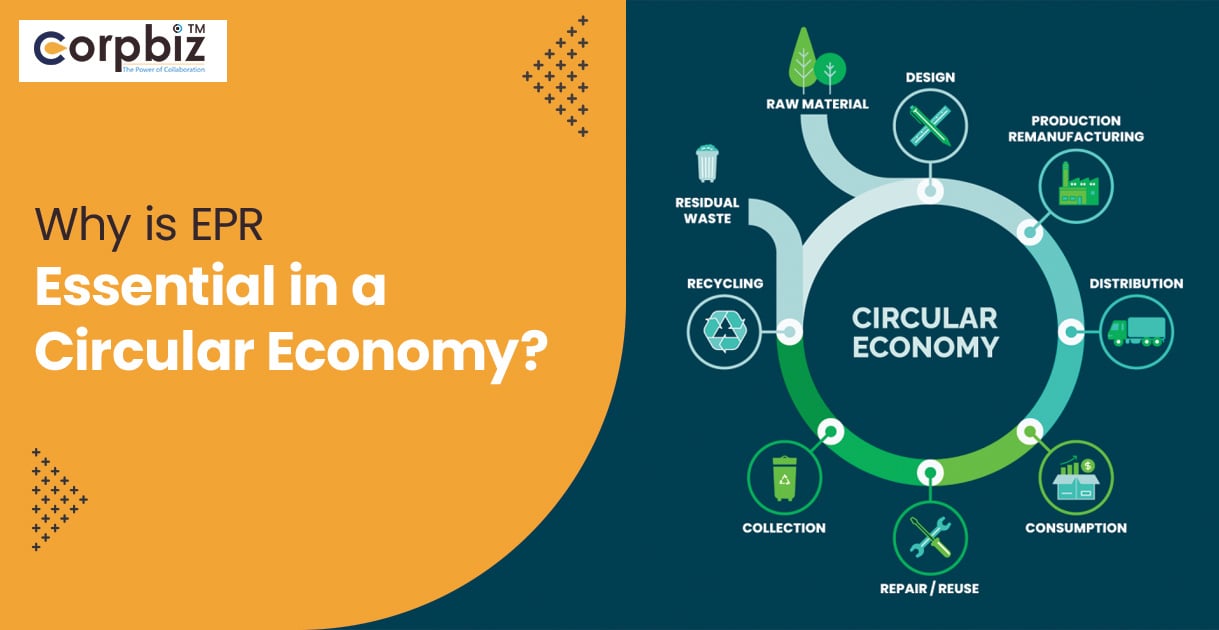
A circular economy is an economic model that focuses a lot on sustainability. Instead of the traditional’ purchase-use-throw’ model, the circular economy model emphasizes reusability, recyclability, and remanufacturing of products. By using products that have reached the end of their consumption cycle to make newer products or simply reusing them, a loop is set up to ensure that any product is used for multiple use cycles, not just one. This is the reason why this model is called a circular economic model.
What are the Key Principles of a Circular Economy?
Below are the key principles of a circular economy:
· Reduction of Waste
A circular economy prioritizes using materials and products multiple times. Hence, reducing waste is a core principle. Sustainable design practices, recycling used products, and using renewable fuel sources are some of the main methods for reducing waste.
· Processing Materials Again
A circular economy demands measures to process used materials and get them ready for use in production again. Upcycling and recycling are the main ways to do this. For example, many waste products that cannot be used to make consumer goods can be used to make art and decor pieces (upcycling). Similarly, old metal cans can be melted to form new cans (recycling).
· Green Regulations
An economy moving to a newer and greener model cannot happen without proper regulatory help. For example, the European Union’s Waste Framework Directive (2008/98/EC) sets the foundation for waste management and recycling in the EU. By 2020, the directive required member states to recycle 50% of household waste and 70% of construction and demolition waste. New targets for 2030 include recycling 60% of municipal waste and 70% of packaging waste.
Embrace the circular economy revolution by securing your EPR authorization for e-waste now and help transform waste into endless possibilities for a greener future.
Why is Shared Responsibility Important?
Now that we have read about EPR and the Circular Economy, we can connect the two concepts and really understand how EPR is a requirement for the creation of the circular economy. Without the producer’s efforts to make products recyclable, consumers cannot hope to contribute to a greener economy. Similarly, if the producer produces recyclable and reusable products, but the consumer doesn’t recycle or reuse them, then the benefits of a greener economy are also lost.
Now, what ties efforts from the ends are the regulations put in place by the government. An economy cannot rely on the environmental consciousness of the producers and consumers and cannot expect that all players will be equally conscious. This brings us to the role of the government. The government and its regulations ensure that producers and consumers have rules to follow that lead towards sustainability.
For producers, such rules include minimum percentage requirements for recycled packaging, a cap on carbon footprint, etc. For example, in Germany, Producers are responsible for meeting certain recycling quotas for the materials they use. In 2022, the recycling targets were:
- 90% for glass
- 80% for paper and cardboard
- 63% for plastics
For consumers, such rules might include a strict recycling and waste disposal system, mandatory household waste production, etc. Let’s dive deeper into the individual roles of producers, consumers, and the government to understand how EPR is no longer just Extended Producer’s Responsibility but stands for ‘Every Person’s Responsibility’ in a circular economy.
Talk To Expert

Why is EPR Essential in a Circular Economy?
(4.8)


Role of Producers in a Circular Economy
In a circular economy, producers are the foundation of sustainable change. Producers can promote EPR much better than anyone else by being mindful of their decisions. Their decisions, from material sourcing to product design, dictate the entire lifecycle of goods and influence how resources are used and reused.
Production is the source of all consumption, so EPR (Every Person’s Responsibility) has to start with EPR (Extended Producer’s Responsibility). The main responsibilities of producers in a circular economy are:
· Eco-Design
Producers should prioritize eco-friendly designs that allow products to be easily repaired, disassembled, and recycled. A product that can be repaired easily prevents purchasing a newer one when it breaks. This minimizes waste and extends product lifecycles. For example, Fairphone has become a leader in sustainable electronics by creating phones with replaceable parts. No other modern smartphone company focuses on repairability as they all want to sell more electronics.
· Sustainable Sourcing
Producers need to shift towards using renewable and recycled materials. This helps reduce dependence on finite resources and lowers carbon footprint. When the same resources are used repeatedly, natural resources have time to regenerate, and ecosystems face reduced pressure to support humans.
· Extended Producer Responsibility (EPR) Programmes
EPR laws hold producers accountable for a product’s full life, from production to disposal. Producers must create programmes to take back their products to fuel recycling endeavours. For example, Apple offers a take-back program allowing consumers to trade their old devices for credit towards a new purchase. If the device is not eligible for trade-in, Apple ensures it is recycled responsibly.
· Green Marketing
Producers should clearly state the benefits of the greener initiatives in their marketing campaigns. They should encourage and awaken users to the benefits of recycling and how their efforts can make a difference.
Producers can significantly impact the creation of a truly circular economy by taking full responsibility for their products’ lifecycles. According to the Ellen MacArthur Foundation, circular economy initiatives could save businesses up to $1 trillion annually by 2025.
Read more Blogs: EPR for Plastic Recycling: Reasons and Solutions
Role of Consumers in a Circular Economy
Consumers are an essential component of a circular economy. Their buying decisions, behaviour, and mindset shape market demand and determine the success of circular business models. Their demand ultimately influences producer decisions if they can create a demand for recyclable and repairable products that will be produced. Keeping that in mind, these are the main responsibilities of consumers in a circular economy:
· Sustainable Purchasing
By choosing durable, repairable, and recyclable products, consumers can influence producers to adopt more circular practices. Demand creates supply, and demand for sustainability is every consumer’s responsibility.
The rise of the second-hand economy, including platforms like Quickr and OLX, is a clear example of how consumer choices shift industries. The second-hand clothing market is projected to grow to $77 billion by 2025, outpacing fast fashion.
· Mindful Waste Disposal
A significant part of consumers’ role is how they dispose of products. Even if the products are recyclable and/or reusable, they can still be waste if consumers dispose of them incorrectly. Proper recycling and waste sorting reduce contamination in recycling streams and ensure that valuable materials are recovered.
In the UK, improper sorting sends about 2.5 million tons of household recyclables to landfills annually. Educating oneself on local recycling rules is crucial to overcoming this challenge. Japan is one such country that has strict waste disposal norms.
· Advocating for Change
Consumers have the power to demand more from companies. By supporting eco-friendly companies and boycotting those contributing to waste, such as the new norm of phones being impossible to repair, consumers can force industries to shift toward greener production. Participation in initiatives like Zero Waste and buy-back schemes also supports the reuse and recycling of products. Creating noise around these topics is ultimately what can create change.
As consumers embrace these responsibilities, they create change. This change ultimately functions as the grease for a smoothly functioning circular economy. Environmentally conscious consumers create environmentally conscious companies.
Understand the Role of Government in a Circular Economy
Governments are the key enablers in building the regulatory infrastructure, physical infrastructure, and policies that enable a circular economy to thrive. They act as the interface between consumers and producers and enforce green norms that allow a circular economy to develop. Without strong governance, achieving large-scale circularity is challenging.
· Policy Frameworks
Governments establish laws and regulations that enforce circular economy practices and force producers and consumers to be conscious of their decisions’ environmental impact. For instance, the EU Circular Economy Action Plan includes comprehensive regulations that target product life extension, promote eco-design, and aim to halve residual waste by 2030.
National recycling targets, like Germany’s 67% recycling rate, demonstrate how robust legislation can drive progress. Once these norms are enforced, producers must abide by them; otherwise, they will face heavy fines.
· Incentives for Businesses
Governments can provide financial incentives for businesses to adopt circular practices. These incentives may be tax breaks, subsidies, or grants for companies that invest in recycling infrastructure, sustainable materials, or green innovation.
China’s Circular Economy Promotion Law offers companies tax deductions if they meet certain sustainability standards. These incentives are another way of forcing companies to abide by greener laws, as they offer extrinsic, non-monetary motivation to go green.
· Public Awareness and Infrastructure
Public education campaigns help change consumer behaviour. Governments can promote awareness about recycling and circular economy practices by modifying school curricula, advocating for greenery in public spaces, and using media.
Additionally, governments need to make it easier for citizens to recycle, compost, and reuse. Countries like Sweden have implemented highly efficient waste-to-energy systems, converting over 99% of household waste into energy and dramatically reducing landfill use.
· Enforcement of EPR
Governments must strictly enforce EPR laws, ensuring producers are accountable for the waste they create. These laws push companies to redesign products to make them more sustainable and create more sustainable business practices for waste management and material sourcing, helping to reduce waste generation at the source.
Governments ensure that a circular economy can flourish and that all stakeholders can effectively contribute to its creation by setting clear guidelines, providing the necessary infrastructure, and educating the public.
Conclusion
Exploration of EPR policies is only done at a level where they seem ornamental and, in an effort to seem environmentally conscious. The world needs a united effort to implement these policies at scale. Cooperation breeds coercion; hence, when countries start following these policies, others must follow.
Another important aspect of EPR policies is that they counteract capitalism. Making products repairable, reusable, and recyclable only leads to lesser sales of new products in the long run. This is why companies do not want to move towards sustainability directly; instead, they opt for CSR activities and controlling pollution to show how environmentally conscious they are.
Visit our website https://corpbiz.io/ and join the movement for a sustainable future and embrace extended producer responsibility because a greener plant is every person’s responsibility.
Frequently Asked Questions
What is EPR?
EPR stands for ‘Extended Producer Responsibility’. It is an environmentally conscious set of policies and measures designed to promote sustainability and reduce environmental impact by making the producers more recyclable, reusable, and repairable products so that they do not end their usable life in a landfill.
Is there an EPR law in India?
Key EPR regulations in India are the Plastic Waste Management Rules, 2016 (amended in 2022), E-Waste Management Rules, 2016 (amended in 2022), and Battery Waste Management Rules, 2022. This is a small step, but in the right direction.
Why is EPR important?
EPR is important as producers are the first step in a product's consumption cycle. If sustainable changes are made at this step, they are automatically passed on to the consumer. For example, if phones are made more repairable, users can use them for longer, and e-waste is considerably reduced.
What is a Circular Economy?
A circular economy specializes in reusing and recycling products at the end of their usable life. This ensures that materials enter a cycle where more use is generated from each natural resource, reducing the pressure on our environment.
What are the benefits of a circular economy?
A circular economy has several benefits, such as reduced environmental impact, increased efficiency, and less waste generation.
What are the biggest challenges to EPR?
The biggest challenges to EPR policies are cost and implementation. The cost is high because redesigning products to be recyclable and reusable is a huge cost for companies, and setting up recycling facilities at scales is a huge cost to the government. Similarly, implementing these policies at scale is tough because they seem counterintuitive to profit maximization, so adoption is fairly low in capitalistic markets.
Read more Blogs: A Guide on EPR Registration for E-waste Producers