


Aluminium is a multifaceted, lightweight, silvery white metal. It is one of the most abundant and reasonably priced metals on Earth. Due to its easily accessible and reasonably priced nature, it is used in several industries, including transportation, construction, aerospace, and packaging. India is the world’s second largest producer of aluminium.
The Aluminium and Aluminium Alloy Products (Quality Control) Order, 2025 was introduced by the Government of India in order to meet specific quality standards. Quality is an important element in aluminium because it directly impacts durability, safety, and performance. This order aims to enhance product quality, protect the public interest,t and standardize the production of aluminium products in the country. In this blog, we will understand what Aluminium and Aluminium Alloy Products (Quality Control) Order, 2025, is, why it was introduced, who needs to follow it, and other pertinent details.
What is the Aluminium and Aluminium Alloy Products (Quality Control) Order, 2025?
On May 5, 2025, India’s Department for Promotion of Industry and Internal Trade (DPIIT) under the Ministry of Commerce and Industry (MoC&I) has issued an amendment to the quality control order titled the “Aluminium and Aluminium Alloy Products (Quality Control) Order, 2025” to enhance product quality and safety. This will come into force on October 01, 2025.
This new order will bring new provisions related to standards, certification and enforcement of quality controls by replacing the Aluminium and Aluminium Alloy Products (Quality Control) Order, 2024. Bureau of Indian Standards (BIS) is the National Standard Body of India, responsible for the harmonious development of the activities for standardization, marking and quality certification of goods. As per the new order, the goods specified must pass the relevant Indian standards and be BIS certified. The updated order consists of four major clauses, referred to as Order 1 to 4.
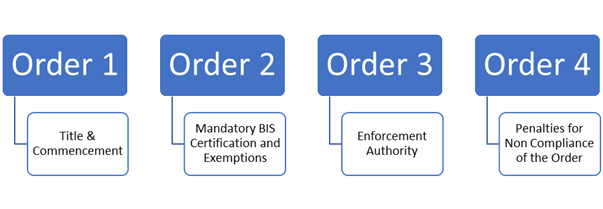
Order 1: Title & Commencement
In this clause, the name and effective date of the order are specified. The official name of the order is “Aluminium and Aluminium Alloy Products (Quality Control) Order, 2025”. It will be effective from October 01, 2025.
Order 2: Mandatory BIS Certification and Exemptions
Order 2 states the key features of Aluminium and Aluminium Alloy Products (Quality Control) Order, 2025. The key features mentioned in this clause are given below: –
- Quality Standards Must Be Followed: Any Aluminium or Aluminium alloy products listed in the order must meet the Indian quality standards as well as have the ISI mark from the Bureau of Indian Standards (BIS) as per Scheme-I of Schedule-II of the BIS (Conformity Assessment) Regulations, 2018.
- Export & Research Based Products Are Not Included: The products that are exclusively manufactured for exports are not included in this clause. Moreover, imports for small quantities of goods (up to 200 kgs) for research and development are also exempt but these goods cannot be sold and must be scrapped after R&D use.
- Dates of Implementation for Various Businesses: Large Enterprises must have to comply with these standards from October 01, 2025, while Micro, Small and Medium Enterprises (MSMEs) have extra time to adhere with these standards.
Talk To Expert

The Aluminium and Aluminium Alloy Products (Quality Control) Order, 2025
(4.8)


Order 3: Enforcement Authority
Order 3 states about the enforcement authority, i.e., who will enforce the rules. Bureau of Indian Standards (BIS) is the certifying and enforcing authority for the Aluminium and Aluminium Alloy Products (Quality Control) Order, 2025. BIS will be in charge of checking whether companies are following the rules and taking action if there are any violations in order. In addition to this, it describes the exemptions and compliance timelines for different enterprises.
Order 4: Penalties for Non-Compliance with the Order
As per the Bureau of Indian Standards Act 2016, if any individual or company is found to be violating the provisions of this order, they can be punished. The punishment can be of any kind, penalties or legal action, depending upon the nature of the violation.
Key Objectives of Aluminium and Aluminium Alloy Products (Quality Control) Order, 2025
The primary and foremost objective of the Aluminium and Aluminium Alloy Products (Quality Control) Order, 2025 is to make sure that all Aluminium and Aluminium alloy products produced and sold in India must meet specific quality standards and have BIS certification. Other key objectives are:
- Protecting consumer and Business interests: It will safeguard consumers and businesses by ensuring that all products are reliable and durable.
- Promoting National Standards: This clause seeks to implement uniformity in the quality of Aluminium and Aluminium alloy products by bringing them into line with national standards.
- Ensuring Smooth Trade: If the product quality meets international standards, then the trade will undoubtedly expand.
- Promoting Innovation: The government of India has established clear guidelines through this order, which will ensure standard quality and encourage innovation in the Aluminium sector.
Benefits & Significance of the Aluminium Industry
According to Industry Research Reports, the Indian Aluminium Market was valued at USD 17.5 billion in 2024 and expected to reach USD 35 billion by 2035 at a CAGR of 6.5%. Aluminium is one of the most significant materials used in industries like construction, automotive, and packaging, all of which are expanding, and also driving the industry’s growth. In India, both the public and private sectors are investing heavily in technology, research and production. The importance of this industry can be estimated by its demand and contribution.
- Contribution to Indian Economy: In India, the Aluminium industry contributes significantly to the national economy, promoting exports, generating employment and fostering industrial growth.
- Application in diverse sectors: Aluminium is used in a number of applications like construction materials, packaging, vehicle parts, electrical conductors, and many more. Because of its corrosion resistant property and lightweight, it is the first choice in this modern era.
- Huge Export Potential: India is one of the largest manufacturers and exporters of Aluminium. To maintain international competitiveness, ensuring the quality of Aluminium products through BIS registration is crucial.
- Environmental Benefits: Aluminium is an eco-friendly material as it is 100% recyclable. Only 5% of the energy is required to make new Aluminium via the recycling process.
Impact on Different Stakeholders of the Aluminium and Aluminium Alloy Products (Quality Control) Order, 2025
The Aluminium and Aluminium Alloy Products (Quality Control) Order, 2025 plays a crucial role in India’s regulatory framework and impacts various stakeholders by ensuring product safety, quality and compliance.
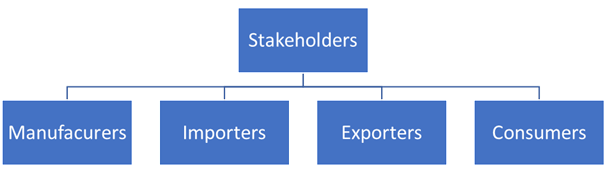
Here is a brief overview of the impact of the above orders on various stakeholders in brief:
Manufacturers
Benefits:
- The product’s credibility will increase as BIS certification mandates rigorous testing to ensure that the products meet specific safety and performance standards.
- Certified products are easily acceptable in both domestic and international markets.
- The brand reputation of companies will increase in the eyes of consumers because of BIS mark.
Challenges
- It can be expensive to obtain and maintain certification, especially for MSMEs.
- BIS certificate lacks international recognition of certifications like CE or ISO/
Importers
Benefits
- Importers have to make sure that the product meets the Indian standard, which will help in maintaining market integrity.
- Certified products often face fewer delays at customs.
Challenges
- It is a mandatory certification, and non-compliance can result in legal penalties.
Exporters
Benefits
- BIS certified products are recognized as high-quality products that helps in building trust with international buyers
- Compliance with BIS standards can simplify negotiations and agreements in international trade
Challenges
- Exporters may still require other international certifications (e.g., CE, ISO) to meet specific foreign market requirements.
Read more: How to Get BIS ISI Certification for Aluminium and Aluminium Alloy Bars?
Consumers
Benefits
- They will get quality products
- The BIS mark aids customers in making wise purchases.
Scope of Goods Covered Under the Aluminium and Aluminium Alloy Products (Quality Control) Order, 2025
As per the Aluminium and Aluminium Alloy Products (Quality Control) Order, 2025, the items made up of Aluminium and Aluminium alloys listed in the table below must meet certain Indian standards to ensure a smooth transition towards enhanced product quality and regulatory compliance.
| S. No. | Goods or Articles | Indian Standard (IS) | Title of Indian Standard | Date of Implementation (General Enterprises) | Date of Implementation (Small Enterprises) | Date of Implementation (Micro Enterprises) |
| 1 | Aluminium alloy tubes for irrigation purposes – welded tubes | IS 7092 (Part 1):1992 | Aluminium alloy tubes for irrigation purposes – welded tubes | 1st October, 2025 | 1st January, 2026 | 1st April, 2026 |
| 2 | Aluminium alloy tubes for irrigation purposes – extruded tubes | IS 7092 (Part 2):1987 | Aluminium alloy tubes for irrigation purposes – extruded tubes | 1st October, 2025 | 1st January, 2026 | 1st April, 2026 |
| 3 | EC grade aluminium rod produced by continuous casting and rolling | IS 5485:1997 | EC grade aluminium rod produced by continuous casting and rolling | 1st October, 2025 | 1st January, 2026 | 1st April, 2026 |
| 4 | Wrought aluminium and aluminium alloy bars, rods and sections (for general engineering purposes) | IS 733:1983 | Wrought aluminium and aluminium alloy bars, rods and sections (for general engineering purposes) | 1st October, 2025 | 1st January, 2026 | 1st April, 2026 |
| 5 | Wrought aluminium and aluminium alloys, forging stock and forgings for general engineering purposes | IS 734:1975 | Wrought aluminium and aluminium alloys, forging stock and forgings for general engineering purposes | 1st October, 2025 | 1st January, 2026 | 1st April, 2026 |
| 6 | Wrought aluminium and aluminium alloy plate for general engineering purposes | IS 736:1986 | Wrought aluminium and aluminium alloy plate for general engineering purposes | 1st October, 2025 | 1st January, 2026 | 1st April, 2026 |
| 7 | Wrought aluminium and aluminium alloy sheets and strip for general engineering purposes | IS 737:2008 | Wrought aluminium and aluminium alloy sheets and strip for general engineering purposes | 1st October, 2025 | 1st January, 2026 | 1st April, 2026 |
| 8 | Wrought aluminium and aluminium alloy wire for general engineering purposes | IS 739:1992 | Wrought aluminium and aluminium alloy wire for general engineering purposes | 1st October, 2025 | 1st January, 2026 | 1st April, 2026 |
| 9 | Wrought aluminium and aluminium alloy rivet stock for general engineering purposes | IS 740:1977 | Wrought aluminium and aluminium alloy rivet stock for general engineering purposes | 1st October, 2025 | 1st January, 2026 | 1st April, 2026 |
| 10 | Wrought aluminium and aluminium alloy bars, rods, tubes, sections, plates and sheets for electrical applications | IS 5082:1998 | Wrought aluminium and aluminium alloy bars, rods, tubes, sections, plates and sheets for electrical applications | 1st October, 2025 | 1st January, 2026 | 1st April, 2026 |
| 11 | Aluminium and aluminium alloy foil for pharmaceutical packaging | IS 16011:2012 | Aluminium and aluminium alloy foil for pharmaceutical packaging | 1st October, 2025 | 1st January, 2026 | 1st April, 2026 |
| 12 | Aluminium composite panel | IS 17682:2021 | Aluminium composite panel | 1st October, 2025 | 1st January, 2026 | 1st April, 2026 |
| 13 | Wrought aluminium and aluminium alloys – extruded round tube and hollow section for general engineering purposes | IS 1285:2002 | Wrought aluminium and aluminium alloys – extruded round tube and hollow section for general engineering purposes | 1st October, 2025 | 1st January, 2026 | 1st April, 2026 |
| 14 | Wrought aluminium wire for electrical purposes | IS 2067:1975 | Wrought aluminium wire for electrical purposes | 1st October, 2025 | 1st January, 2026 | 1st April, 2026 |
| 15 | Wrought aluminium and aluminium alloys for manufacture of utensils | IS 21:1992 | Wrought aluminium and aluminium alloys for manufacture of utensils | 1st October, 2025 | 1st January, 2026 | 1st April, 2026 |
| 16 | Corrugated aluminium sheet | IS 1254:2007 | Corrugated aluminium sheet | 1st October, 2025 | 1st January, 2026 | 1st April, 2026 |
| 17 | Aluminium alloy forging stock and forgings (alloy 24343) for aerospace applications | IS 7902:2001 | Aluminium alloy forging stock and forgings (alloy 24343) for aerospace applications | 1st October, 2025 | 1st January, 2026 | 1st April, 2026 |
Source: Ministry of Commerce and Industry, Government of India – The Aluminium and Aluminium Alloy Products (Quality Control) Order, 2025.
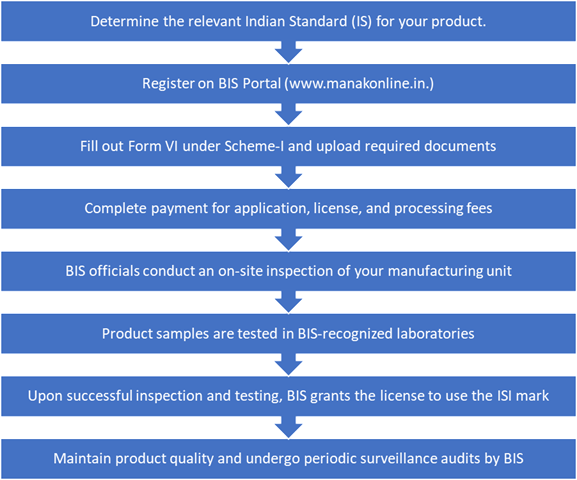
BIS Certification Process Flow for Aluminium & Aluminium Alloy Products
Businesses that produce Aluminium and Aluminium alloy products need to follow the given procedure in order to receive the BIS accreditation: –
Conclusion
The Ministry of Commerce and Industry (MoC&I) of India has taken a significant step towards ensuring the quality and uniformity of Aluminium products produced and sold in India through the Aluminium and Aluminium Alloy Products (Quality Control) Order, 2025. The government seeks to promote fair business practices, protect consumer interests and improve the global competitiveness of Indian Aluminium products.
Businesses must adhere to this order. Otherwise, they will face legal actions and penalties. In short, this order will play a crucial role in facilitating sustainability, quality driven production practices and strengthening the Aluminium industry in India.
To get expert assistance in BIS certification for Aluminium and Aluminium Alloy Products, visit https://corpbiz.io/.
FAQs
What is the prime objective of the Aluminium and Aluminium Alloy Products Order, 2025?
The key objective of the Aluminium and Aluminium Alloy Products Order, 2025 is to establish uniformity in the quality of Aluminium products made and sold in India. It strives to ensure that Aluminium and Aluminium Alloy Products stay in line with the highest quality standards. In addition to this, it safeguards the interests of businesses as well as consumers. Also, it ensures the availability of durable as well as trusted products. Furthermore, it facilitates healthy trading practices by bringing Indian products in line with global standards.
What are the key features of the Aluminium and Aluminium Alloy Products Order, 2025?
The key features of the Aluminium and Aluminium Alloy Products Order, 2025 are mentioned below-
– Mandatory Use of the BIS Standard Mark
– Exemptions for Export and Research
– Implementation Dates for Enterprises
– Certification and EnforcementWhat is the export potential of India in the Aluminium Industry?
India has established itself as one of the leading producers and exporters of Aluminium. Currently, India is rated as the 2nd largest producer of Aluminium globally. The expected output is 4.5 million tonnes every year. Getting the BIS registration done is crucial to staying compliant.
Is Aluminium Business profitable in India?
Considering the demand for aluminium and aluminium products in the Indian and global markets, we can say that the Aluminium business is highly profitable and lucrative in India.
Why is BIS Certification essential for Aluminium product-based businesses?
BIS Certification is essential for Aluminium product-based businesses as it ensures legal compliance, helps win consumer trust, and market competitiveness.
Read more: Certification Required for Carbon & Low Alloy Steel Billets