

V-belts are very important in the transmission of power by mechanical means through pulleys. They find their applications in industrial machinery, automotive engines, and agricultural equipment. Therefore, the quality and reliability of V-Belts are essential for the smooth running of all machinery. A few certifications exist to regulate their quality, more so in India, where the Bureau of Indian Standards has established specific standards that must be met.
The three most important certifications that V-Belts must comply with while manufacturing in India are IS 2494 Part 1:1994, IS 2494 Part 2:1993, and IS 14261:1995. Understanding these certifications is essential for the manufacturer, supplier, and consumer, as it will help them know the requirements to follow.
Understanding V-Belts and their Application
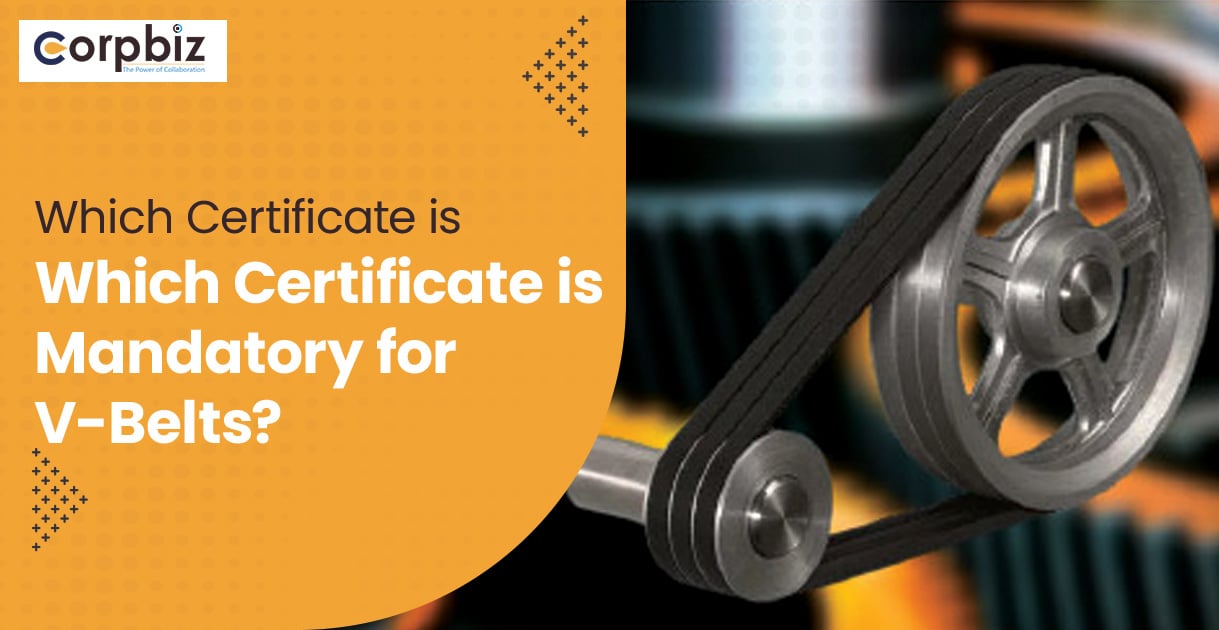
V-belts are a class of belts used in power transmission. They are designed to fit into the grooves of pulleys for efficient mechanical energy transfer. Because of the friction between the belt and the pulley groove, the belt does not slip, and they are very effective in several scenarios.
V-Belt Applications
The V-Belts find an extensive range of applications in the following sectors:
- Automotive: For alternator driving, water pumps, air conditioning compressors, and power steering.
- Industrial Machinery: This is used in conveyor systems, fans, and compressors.
- Agrichemicals-Agricultural Equipment: This implements machinery such as harvesters and threshers.
- Home Appliances: Washing machines, dryers, and vacuum cleaners.
The fact that V-Belts are being massively used in various industries recognises the importance of their quality and reliability by standardised certifications.
Importance of Certification for V-Belts under BIS
For V-Belts, BIS certification covers all aspects of performance, durability, and safety criteria. In most applications, a V-belt failure results in colossal losses due to expensive downtime, possible safety hazards, and financial losses. In addition to being required by the law, the BIS certificate is a symbol of confidence and trust for businesses and customers.
IS 2494 Part 1:1994-Standard for Endless V-Belts
IS 2494 Part 1:1994 is the Indian Standard that specifies the requirements for endless V-Belts, primarily used in general engineering and industrial applications. An “endless” V-belt is manufactured in a continuous loop with no seams or joints, providing superior strength and durability.
Also Read: An In-depth Guide on BIS QCO for Ropes and Cordages
Key Specifications
The standard covers various aspects, including:
- Dimensions: The Standard defines the acceptable cross-sectional shape and length dimensions for V-belts.
- Material composition: The materials used should conform to specific standards of tensile strength, flexibility, and wear and tear.
- Performance Testing: V-Belts should be thoroughly tested to sustain operational stresses without compromising performance.
IS 2494 Part 1:1994 provides all the requirements a manufacturer must meet to be accorded the BIS certification for endless V-Belts. Thus, reliability, long life, and suitability of V-Belts for critical applications are guaranteed, thereby curtailing risks of mechanical failure and further improving machinery efficiency.
Talk To Expert

Which Certificate is Mandatory for V-Belts?
(4.8)


IS 2494 Part 2:1993 Standard for V-Belts for Industrial Purposes
IS 2494 Part 2:1993 is the Standard for V-Belts used for Industrial Machinery. Industrial machinery operates under very severe and erratic conditions. Because of this demand, the V-belt types used must be capable of withstanding such demands on performance and durability.
Manufacturing V-Belts for industrial purposes shall be according to IS 2494 Part 2:1993. A certification conforming to this Standard would prove that the belts are strong enough to bear the arduous effects of industrial operations, thereby enhancing the reliability and life of industrial machinery.
IS 14261:1995 Standard for Endless Narrow Belt for Industrial Purpose
IS 14261:1995 is an Indian Standard that specifies dimensions, materials, craftsmanship and transmission capacities for endless V-belts. It outlines elastomeric material, polyester reinforcement and coating applied to the outer fabric that makes the V-belt. Strict quality control procedures must be followed during manufacturing to guarantee that V-Belts have no issues.
The Standard also specifies the value for cross-section dimensions. It highlights how crucial matching belts are in preventing load imbalance in multi-belt dives and helps users choose and apply belts correctly; recommendations for transmitting capabilities and suggestions for coding V-Belts will be included.
The manufacturer shall certify the endless V-Belts according to the IS 14261:1995. Certification to this Standard is essential when high-power transmission and flexibility in operation come into place, among others, for automotive engines and high-performance industrial machinery. It ensures that belts are both reliable and efficient under the demands exerted by the operating environment.
Process for Obtaining Certification for V-Belts under BIS
Obtaining BIS certification for V-Belts is an in-depth procedure ensuring that only products of strategic standards make it into the market. The process of how acquiring a certificate is as follows:
STEP 1. Initial Application and Documentation
The certification process commences when all details of the V-Belts manufactured, their technical specifications, the manufacturing process, and the constituents used in the products are submitted to the Bureau of Indian Standards. The manufacturer also has to furnish a number of documents showing that appropriate quality control has been used so that every step of the production maintains strict standards. Documents to be submitted Include:
- Product specifications and design information.
- Quality control procedures.
- Material Safety Data Sheets.
- Previous test reports, when possible.
STEP 2. Product Testing and Evaluation
After submitting the application form, the manufacturers shall submit the V-belt samples to the BIS for testing. The same samples will then undergo tests in a BIS-recognised laboratory to check their conformity with prescribed standards such as IS 2494 Part 1:1994, IS 2494 Part 2:1993, and IS 14261:1995. Performance parameters generally testify to tensile strength, dimensional accuracy, resistance to wear, and operational durability. Key Testing Criteria are as follows:
- Dimensional Accuracy: The V-belt should be able to give specifications for size or shape.
- Tensile Strength: The belt’s pulling force is capable of withstanding.
- Heat Resistance: The Test was performed on the belt to investigate its resistive action in high-temperature conditions.
- Flexibility: The ability of the belt to bend without cracking.
STEP 3. Quality Control Audits and Inspections
The BIS issues certification only after conducting its preliminary audit of the manufacturer’s production facility. This is just an assurance that the particular company’s manufacturing process and quality review system can continuously produce V-Belts within the desired specification limits. BIS inspectors audit the entire manufacturing process, from incoming raw materials to the final assembly of products.
They also review the manufacturer’s quality assurance procedures to verify conformance to the requirements for safety and performance. A manufacturer shall establish that it has appropriate systems and procedures in place for the detection and correction of defects or deficiencies and the maintenance of product quality. Certification is mainly based on the results of this audit.
Ensure your manufacturing process meets BIS standards with a thorough manufacturing audit to guarantee compliance and quality from raw material to final assembly.
STEP 4. Grant of Certification and Issuance of License
After successful product testing and auditing of the facility, BIS licenses the manufacturer to use the BIS certification mark on their V-Belts. The mark indicates that the product has met all the requirements of the relevant Indian standards.
It usually has a validity period within which the manufacturer can produce and sell the certified V-Belts. However, their standards should be continuously maintained to the levels for which the certification was granted.
STEP 5. Certification Mark
The BIS mark is a sign of quality and compliance. It shall appear conspicuously on the product and its package.
STEP 6. Ongoing Compliance and Surveillance
Certification is not the end. BIS prescribes continuous surveillance against a granted certification. This comprises periodic auditing of the manufacturing facility and random sampling from the market. Periodic inspections will ensure that the criteria for continuing compliance are met. Quality verification will also take place by randomly sampling products from the market.
A license would be extensively reviewed before renewal. If the manufacturer is found non-compliant at any level, BIS has the right to suspend or cancel the certificate. Therefore, it becomes of high importance for firms to keep their production processes at optimal levels at all times.
Streamline your V-Belt production with seamless BIS Registration and secure your license today for ongoing compliance and market trust.
List of Tests for the Certification Process for V-Belts
Several tests required while acquiring the certificate for V-Belts are as follows:
Tests for IS 2494 Part 1:1994
- Material Testing
- Dimension Testing
- Length and Tolerance Tests for V-belt
Tests for IS 2494 Part 2:1993
- Material Testing
- Dimension Testing
- Tensile related Test
- Electric Resistance Test
- Length and Tolerance Tests for V-belt
- Fire Resistance Test
Tests for IS 14261:1995
- Length Measurement and Tolerance Test
- Cross-Section Dimensions
Related Article: Which Certification is Required for Steeplechase Hurdles?
Essential Documents Required for Certification for V-Belts
To acquire ISI/BIS Certification, you must submit certain essential documents. The list of documents is as follows:
- First Application Form V: This form will contain the primary factory and information related to the product category.
- ISI/BIS Application fee: A copy of Remittance/Payment Advice.
- Test Report: A Copy of a test report done within a month by the Internal Laboratory indicating product compliance with the relevant Indian Standard.
- Address Proof: Address Proof of Factory units such as Factory licenses or Tax Registration documents in the name of the manufacturer showing their scope.
- Trademark Registration: If available, a Photocopy of Trademark Registration.
- Certification from Regulatory Agencies: Certificates from the concerned regulatory agencies for manufacturing.
- Product Drawings: Product Drawing as applicable of the current manufacturing capacity.
- Details of the Raw Materials: This will include the component’s name, the supplier’s name, and the component’s quality certificate.
- Machine Details: Machine Details will include its names, the names of the manufacturers, manufacturing capacity and the quantities.
Impact of BIS Certification on Market and Consumers
The impact of BIS Certification on the Market and Consumers are as follows:
· Market Implications
BIS will ensure improvement in the market related to the production of V-Belts. Because of this fact, most industries will give preference to certified products since they guarantee their quality and reliability. This certification maintains Indian manufacturers in the competitive circle not only in the domestic markets but also in the international markets since the standards set by BIS are well known to them.
· Consumer Confidence
For consumers, the BIS certification of V-Belts ensures safety and durability and guarantees the product’s performance as expected. This becomes important in industries where a failure of a V-belt can result in costly downtime or even create safety risks.
To Wrap Up
Ultimately, the three imperative BIS certifications, which are statutory for V-Belts, include IS 2494 Part 1:1994, IS 2494 Part 2:1993, and IS 14261:1995. All three of these are significant in reflecting the quality and reliability of this vital component in various applications.
Firms will necessarily have to conform to such standards to get certification and consequently assure consumers and industries about the performance and safety of the product. Each of these certifications is followed to maintain the quality of the products and for greater safety and efficiency in general industrial, agricultural, and automotive industries.
Ensure the highest standards for your V-Belts with mandatory BIS Registration by visiting our website Corpbiz to secure your compliance today to guarantee performance and safety.
Frequently Asked Questions
What role do V-Belts play in industrial settings?
Power transmission in various industries, such as automotive, industrial machinery, and agricultural equipment, depends heavily on V-Belts. Their dependability and quality are essential to the operation of machines because they guarantee the efficient and seamless transfer of mechanical energy.
Which certification are required in India for V-Belts?
The main certifications needed in India for V-Belts are IS 14261:1995, IS 2494 Part 1:1994, and IS 2494 Part 2:1993. The Bureau of Indian Standards (BIS) established these certifications to guarantee the safety, longevity, and quality of V-Belts.
What is covered by the IS 2494 Part 1:1994 certification?
IS 2494 Part 1:1994 covers the standards for endless V-Belts used in general engineering and industrial applications. It specifies the specifications for dimensions, material composition, and performance testing to guarantee the dependability and longevity of V-Belts.
Why is BIS certification necessary for V-Belts?
BIS certification is significant because it guarantees that V-Belts fulfil the necessary standards for performance, durability, and safety. In addition to being required by law, it fosters consumer, supplier, and manufacturer trust by ensuring that the goods are dependable and of the highest calibre.
What is the list of steps to be involved in the certification procedure?
There are multiple crucial steps in the certification process:
Application Submission
Assessment
Sampling and Testing
Certification Grant
Surveillance and Re-certificationWhat documents are needed to apply for certification?
Manufacturers must provide documents to apply for certification, including:
· Application Form V provides factory and product details.
· Verification that the application cost was paid.
· A recent product compliance test result from an internal laboratory.
· Factory's address proof.
· If available, trademark registration.
· Regulatory agency certificates.
· Product drawings, including information on the raw ingredients and production equipment.What effects does BIS certification have on customers and the market?
BIS certification increases market competitiveness by certifying that V-Belts adhere to strict quality standards. It also guarantees the product's safety, dependability, and anticipated performance and lowers the possibility of equipment breakdowns and downtime, increasing customer confidence.