

Demand for high-quality steel products has been increasing, especially carbon and low alloy steel billets, to produce various materials in industries such as defence, construction, and manufacturing. Billets play a very important role in the manufacturing of products like construction materials and military hardware. Thus, their quality is very important to ensure safety, durability, and performance.
In this regard, the benchmarks of quality and certification are set by the Indian Standards Institute, better known as ISI, and the Bureau of Indian Standards, BIS. This blog will cover the importance of ISI/BIS certification for carbon and low alloy steel billets, their certification process, and benefits to the manufacturer and the end-user. We will go deep into the details of IS 14698:1999 and understand the challenges and solutions while acquiring the same certification.
Understanding Carbon and Low Alloy Steel Billets
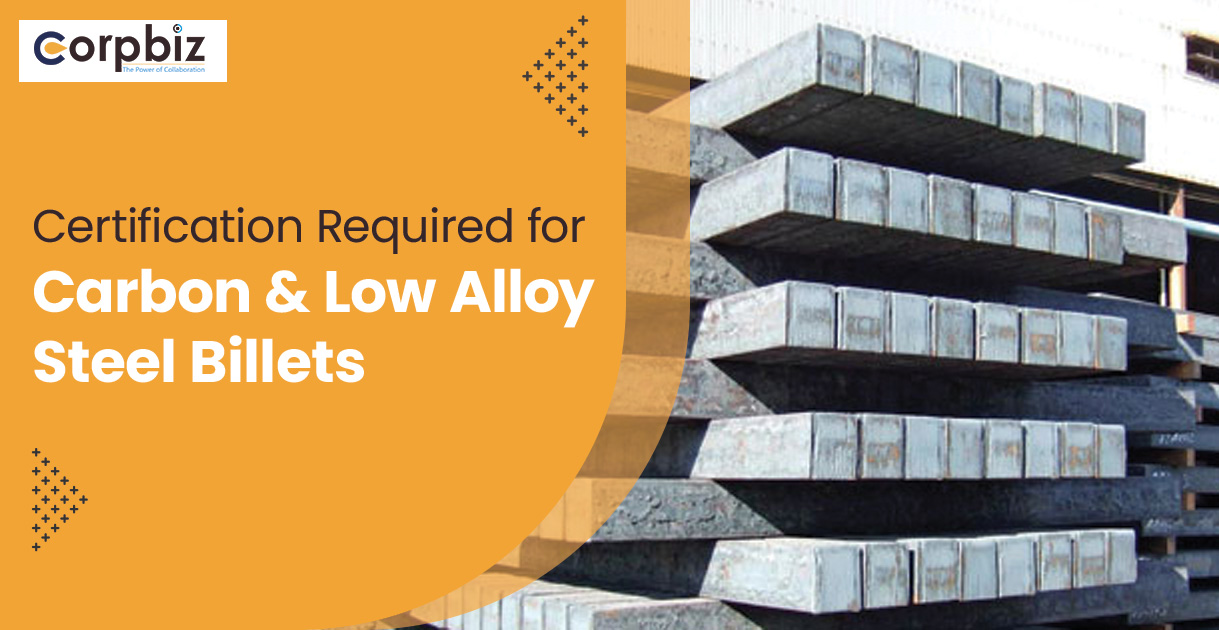
Steel billets are semi-finished products usually cast into rectangular or square form. They generally serve as raw materials used to produce bars, rods, and wires associated with many steel products. In particular, carbon and low-alloy steel billets are developed to provide enhanced mechanical properties, making them suitable for highly demanding applications requiring the required strength and toughness.
Role of Certification for Carbon and Low-Alloyed Steel Billets
BIS is the National Standards Body of India, which develops and publishes Indian Standards, implements conformity Assessment Schemes, recognizes and runs laboratories for conformity assessment, implements hallmarking, works for consumer empowerment and conducts capacity-building programs on quality assurance.
Applicants must set up the lab. The complete testing facility will be in their factory premises. After all the formalities are ready, the application, along with complete testing facility details, calibration, and other supportive documents, must be forwarded to the Bureau of Indian Standards.
After scrutinizing the documents, the BIS officers will visit the factory to check the in-house testing facilities and manufacturing machinery according to the process flow chart. During the inspection, the manufacturer must offer a sample, and after successfully completing the inspection, the BIS officer will seal the sample for testing in the independent lab. BIS will issue the license after getting a satisfactory report from the lab.
Read Our Article: State Wise GST Collection for July 2024
Importance of BIS for Carbon & Low Alloy Steel Billets
It has been an important standard for manufacturers needing to produce billets for domestic and competitive global markets. Conformity with IS 14698:1999 also means that the types of billets produced will be safe for use in high-stress environments, particularly within the defence sector where material integrity is paramount.
Quality Assurance
Certification under BIS will ensure that the Carbon and low-alloy Steel Billets fulfil the high standards of quality given by BIS, such as the chemical and mechanical properties and other critical factors that will ensure the reliability of the products to consumers. It is very important in industries where the failure of materials may lead to catastrophic results, such as defence and construction.
Market Competitiveness
A manufacturer of a BIS-certified product in the market will have an added advantage, as consumption of such a product would largely rely on certification, especially in government and defence contracts.
Regulatory Compliance
Compliance with BIS standards ensures that manufacturers meet the legal requirements set by the government, which may lead to legal issues and penalties.
Environmental Impact
Most of the certified products meet higher standards on environmental requirements, resulting in reduced ecological footprints. However, with expert environmental advisory, this impact is minimized even further.
Economic Gains
The manufacturer can lower the returns and complaints by ensuring consistent quality, thus reducing the costs related to those in the long run.
IS 14698:1999 Standard for Carbon and Low Alloy Steel Billets
IS 14698:1999 is an important Indian Standard that specifies the requirements for carbon and low alloy steel billets, blooms, and slabs. It ensures that semi-finished steel products used for defence and against various industries are of the highest quality and safety. This standard covers the following areas:
Chemical Composition
This defines the acceptable limits for elements like carbon, manganese, phosphorus, sulfur, etc. These elements should be controlled to a certain degree to produce the desired mechanical properties in the steel.
Mechanical Properties
The billets shall have a minimum of the following mechanical properties, namely tensile strength, yield strength, and elongation so that they can withstand the various stresses to which they are used in operation without failure.
Testing and Inspection
This includes all the testing methods employed, including chemical analysis and mechanical tests, to check compliance with indicated standards. These kinds of tests ensure the quality the billets have attained before further processing or use in a critical application.
Dimensional Tolerances
The basic idea is to work out acceptable tolerances for the dimensions of the billets, ensuring that they might be further processed into finished products. Accurate dimensions shall be established at this stage because there should not be problems at subsequent stages of manufacture.
Surface Quality
This requirement for surface finish ensures that a billet is free of flaws related to cracks, inclusions, or laps. High-quality surfaces are imperative in applications like defence, in which tiny defects are known to trigger catastrophic failures.
Implications of Non-Compliance with IS 14698:1999
Non-compliance with IS 14698:1999 is a severe issue for manufacturers and end-users. Some key implications are as follows:
Legal Repercussions
Any manufacturer producing billets that do not meet the standard faces a possible lawsuit, fine, or even penalties. Non-complying products can lead to the withdrawal of licenses and bans on distribution.
Market Access
Non-compliant products cannot access certain markets. It particularly applies to defence and government contracts, where certification is mandatory.
Safety Risks
Non-compliant billets in high-end applications like defence could translate into material failure, which could result in catastrophic consequences, be it malfunctioning equipment or structural collapses.
Damage to Reputation
Failure to meet the standard may result in reputational damage to a manufacturer, which may further negatively impact future business and customer or partner confidence.
Financial Losses
Non-compliance may lead to costly recalls, re-manufacturing, and scrap, adversely affecting the company’s financial health. Considering the above, it is essential that every manufacturer strictly follow this standard, IS 14698:1999, and that the products made adhere to specified requirements to avoid such risks. Some of the important measures for adherence to the above are regular audits, quality control measures, and employee training.
Certification Process for Carbon and Low Alloy Steel Billets
The BIS certification for manufacturers of Carbon & Low alloy Steel Billets is required to make an application under BIS. Once they submit all the detailed documents concerning the product specifications, manufacturing, and quality control measures, the certification process is facilitated by assuring compliance with the standards specified by BIS.
1. Application Form V
It must be a completely filled application form with the correct details of the manufacturer and its product.
2. Business License
A copy of a valid business registration certificate or license.
3. Product Specifications
The carbon and low-alloy steel billets shall be described and specified in detail in terms of the raw materials and manufacturing processes.
4. Quality Control Documents
The measures of quality control that have been implemented, such as quality manuals, process flow charts, and inspection procedures.
5. Test Reports
The laboratory test reports from BIS-accredited labs reflect compliance with Indian standards.
6. Factory Layout
This is the layout of the production factory, pointing out sections that will be concerned with the production of the Carbon & Low alloy Steel Billets.
7. Process Flow Chart
This is an elaborate flow chart showing the entire manufacturing procedure, from the procurement of raw materials to the inspection of the finished product.
8. Calibration Certificate
Equipment calibration certificates used for testing and measurement are used during manufacturing processes.
9. Sample Products
Samples of the Carbon & Low alloy Steel Billets for physical inspection and testing by BIS officers.
10. Audit Reports
Earlier audit reports (if any) showing compliance with BIS standards.
11. Employee Details
Information regarding the key personnel involved in the respective production and quality control departments.
12. Declaration Forms
Declarations related to the product’s safety, conformance to standards and use of hazardous material.
Conclusion
The BIS certification assures that the quality of Carbon & Low alloy Steel Billets in India meets set norms, harnesses safety in use, and meets regulatory requirements. Apart from guaranteeing the product’s reliability in the consumers’ minds, it also provides a competitive edge to the manufacturers in the market because their products are made according to national standards.
Maintaining the high standards of industries where carbon-low alloy steel billets play a critical role in construction materials and military hardware is necessary. Ensure your Carbon & Low Alloy Steel Billets meet the highest industry standards. Visit https://corpbiz.io/ for seamless BIS Certification for Carbon & Alloy Steel Billets.
Frequently Asked Questions (FAQs)
Why is Certification important for Carbon & Low alloy Steel Billets?
The Bureau of Indian Standards (BIS) certification is regarded as a quality and safety certification. It ensures that carbon-low alloy Steel Billets comply with relevant Indian standards and becomes crucial in assuring product reliability and market competitiveness beyond mere compliance with regulatory requirements.
What is IS 14698:1999 important?
IS 14698:1999 covers the requirements for Carbon and Low-Alloy Steel Billets regarding their chemical composition and mechanical properties, testing and inspection methods, dimensional tolerances, and surface quality. This standard guarantees that the billets will be safe and reliable enough for such critical applications.
What are the steps for getting certification for Steel Billets?
It involves several steps, such as submitting an application form with detailed product specifications, setting up an in-house testing facility, factory inspection by BIS officers, sample billets for testing, and compliance with all applicable standards. Once the applicant completes the certification, the accredited certification bodies shall issue the certification under the Scheme.
What could be the consequences of not adhering to IS 14698:1999?
Non-compliance may lead to legal consequences such as fines or withdrawn certification, increased market access limitations, particularly for defence and government contracts, and substantial safety risks. Moreover, this will hurt a manufacturer's reputation, leading to financial losses due to the recall or re-manufacturing of the defective products.
How does a manufacturer benefit by obtaining BIS certification?
BIS certification has several benefits, such as product quality, competitiveness in the marketplace, and compliance with existing legal and environmental norms. It helps reduce the product return or complaint rate, lowering long-term costs and leading to better financial results overall.
What are the challenges in obtaining certification for Carbon & Low Alloy Steel Billets?
Yes, the certification process is rigid and sometimes challenging, especially for small manufacturers. These will include challenges in meeting the cost of setting up testing facilities, staying updated with the changing standards, and passing the stringent testing requirements. However, these challenges are put forth for maintaining high industry standards.
Read Our Article: Certification Required for Stainless Steel Bars and Flats