

While the world faces this challenge of climate change, the transition to renewable energy has become a global priority. India, the world’s largest democracy and fastest-growing big economy, is a worldwide leader in this transition journey toward sustainable energy.
With ambitious targets and robust policies, besides international cooperation, India’s journey on renewable energy acts as a template for other emerging economies striving for sustainability. This blog will demonstrate how various renewable energy strategies, policies, and successes in India could provide lessons for other countries seeking to transition from fossil fuels toward clean energy.
India’s Contribution to Global Sustainability
India’s fast-changing energy landscape is rapidly transforming, knitted with ambitious renewable energy targets. According to Union Minister of New and Renewable Energy Pralhad Joshi, India’s journey toward renewable energy would be a model for other emerging economies on their journey toward sustainability.
In brief, India’s status as a developing nation adds to its leadership in clean energy and underlines its pivotal role in global climate concerns.
With a relatively low share of global per capita carbon emissions, the sheer population and growing economy make India a vital player in the fight against climate change. India has pledged to reach net zero in carbon emissions by 2070.
The country’s emphasis on renewable energy, wind, hydro, and bioenergy is at this core. It aims to reach a capacity of 500 GW in non-fossil fuel energy before 2030 and is, hence, the target that can inspire other developing nations into similar renewable energy expansions. Below are some of the key points:
- India pledged to reach net-zero carbon emissions by 2070.
- Non-fossil fuel energy total installed capacity of 500 GW by 2030.
- In India, the progress towards renewable energy is supported by a sound policy framework backed by international partnerships and foreign investments.
Empower your business with impactful ESG strategies to leverage India’s renewable energy success to drive sustainability and attract global investment.
Talk To Expert

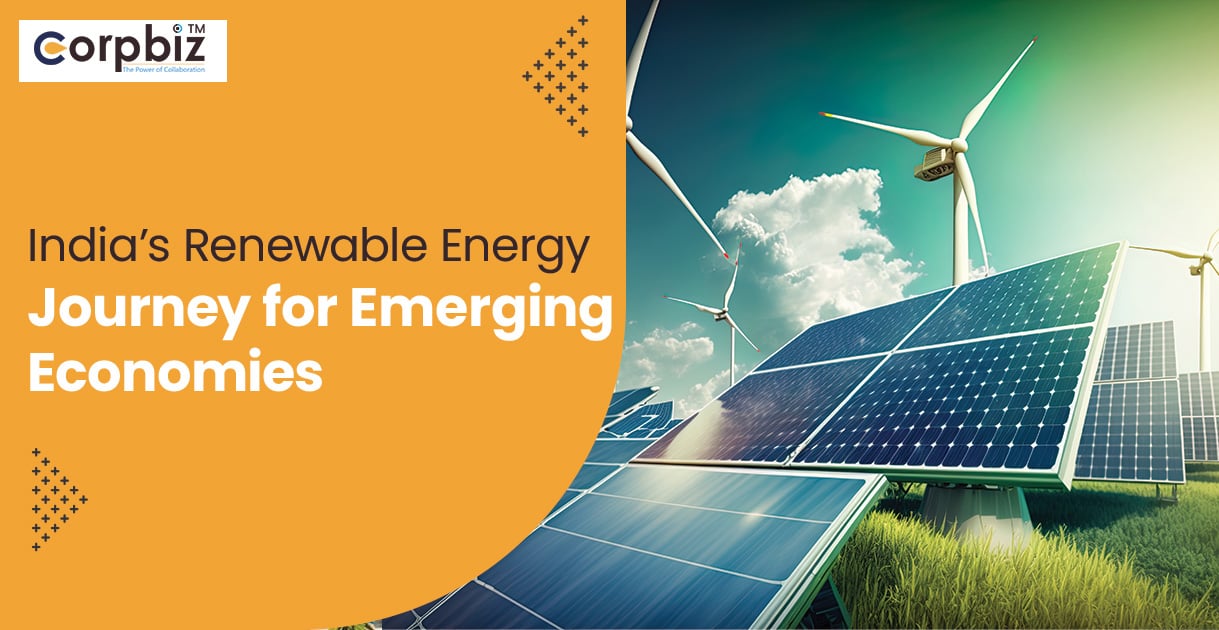
India’s Renewable Energy Journey for Emerging Economies
(4.8)


Policy Frameworks Driving India’s Renewable Energy Journey
A broad policy umbrella for developing clean energy keeps India’s transition to renewable energy sources in place. With enabling legislation and investment encouragement backed by international agreements, India is laying a sound foundation for meeting its energy challenge. These policies can be important lessons for other developing nations.
National Action Plan on Climate Change (NAPCC)
The NAPCC is one of the foundational policies that make India sketch its map towards renewable energy. It comprises eight national missions. Two of these focus entirely on renewable energy, such as the National Solar Mission and the National Mission for Enhanced Energy Efficiency, which also applies to energy end-use efficiency.
- National Solar Mission
This Mission was introduced in 2010 to advance the growth and promotion of solar energy in all parts of the country. A target of one hundred GW of solar energy capacity was also set by 2022. On that count, a lot of progress has been made in India.
The installed capacity of solar photovoltaics stood at 85.47 GW as of 2023. This success put India in the top ranks of the world’s solar energy producers, and the Solar Mission continues to expand, targeting more installations and innovations in solar technologies.
- National Mission for Enhanced Energy Efficiency (NMEEE)
NMEEE is an abbreviated form of National Mission for Enhanced Energy Efficiency. The mission works on the planning of reducing the consumption of energy, which in turn results in higher energy efficiency in the industries. This mission helps India reduce its overall carbon footprint by incentivizing energy-saving measures for the different sectors by promoting clean technologies and boosting economic growth.
International Solar Alliance (ISA)
Until recently, India has been at the forefront of solar energy initiatives worldwide, along with France, by founding the International Solar Alliance in 2015. The ISA is an organization that promotes the path of solar energy for developing nations, particularly those with abundant sunlight. It is a major pillar of India’s international clean energy diplomacy.
Through ISA, India helps other growing economies tap into their solar potential through financial and technological support, capacity-building programs, and access to research and development. This is how India leads the way in international cooperation and how emerging economies can come together to achieve their goals.
National Green Hydrogen Mission
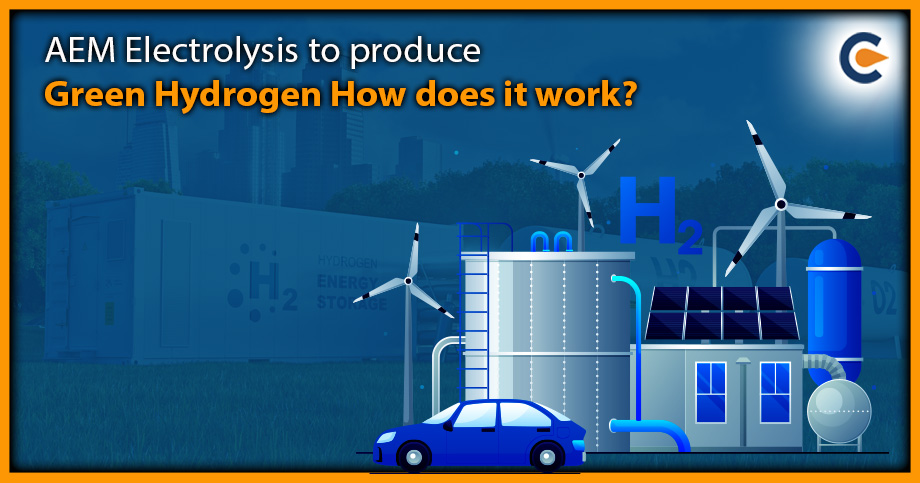
India’s ambitions extend beyond solar and wind to encompass biomethane, ethanol, and hydrogen. In 2023, the Centre rolled out the National Green Hydrogen Mission as part of the broad strategy to decarbonize the economy. Green hydrogen generated through renewable sources of energy like solar and wind energy is expected to achieve significant use in the decarbonization of heavy industries like steel, cement, and chemicals.
The National Green Hydrogen Mission is envisioned as an action plan that positions India as a global hub for green hydrogen production and exports. In this process, India is diversifying its renewable energy portfolio and inviting other nations to invest in this clean fuel source. Businesses in the environmental domain are moving towards green hydrogen plant setups to maximize profits.
FDI) in the Renewable Energy Sector
It is worth noting that acquiring renewable energy sources is a priority for the government. Therefore, India has created a favourable environment for foreign investment in the renewable energy sector. The government has allowed 100% Foreign Direct Investment (FDI) without an approval route in solar, wind, and other renewable energy. This has also made it inviting to foreign capital, expertise, and collaboration, enhancing the country’s spread of renewable energy initiatives.
· State level Initiatives
It has been noted that institutional strategies and partnerships at the state level characterize India’s renewable energy journey. States like Gujarat, Rajasthan, Tamil Nadu and Karnataka have led the way in solar and wind power installations.
For instance, Wind Farms and Solar parks in Gujarat are some of the most outstanding ones in the world. They enable countries to utilize their states, which are willing to contribute actively to the clean energy transition. Thus, we focus on how decentralized governance can improve the country’s clean energy status.
Tap into India’s booming renewable energy sector to launch your renewable energy business with 100% FDI and partner with top states driving solar and wind innovations.
Key Lessons for the Other Emerging Economies
A strong national policy framework and an equally supportive state intervening structure are fundamental to exploring opportunities for responding to risks associated with expanding renewable energy. International partnerships can hasten indigenous uptake by providing knowledge, technology and finances.
Achievements in Renewable Energies in India for Emerging Economies
The progress that has taken place in India regarding renewable energy stands as a case study and is a testimony to what is achievable if the right mix of political will, economic investment, and innovative initiatives are brought together. Key achievements for other developing countries that can draw inspiration from this section include:
· Solar Energy Leadership
Solar energy has been nothing short of a transformational success in India. With an aggregate installed solar capacity of 85.47 GW, India currently slots among the top five globally with high installation volumes. With over 2.2 GW of capacity, the Bhadla Solar Park is the largest in India and stands as a testament to India’s solar energy.
Further, India is a pioneer in decentralized solar projects and other small-scale applications, including rooftop solar, which have mushroomed in urban and rural areas.
Other emerging economies with abundant sunlight could replicate this. For instance, countries in Africa, Southeast Asia, and Latin America have much to learn from India and how its solar policies and partnerships have guided faster clean energy transitions.
· Wind Energy Expansion
India also has adequate development in wind energy resources, with a harnessing capacity of 46.65 GW installed by 2023. The estimate is that the wind energy resource potential of the country is concentrated in states such as Tamil Nadu, Gujarat, and Karnataka, which makes them a hub for the development of wind power within the country.
India’s investment in offshore wind energy is another promising area that can initially be considered a blueprint for coastal nations. India’s accumulation of experience in building wind energy infrastructure and attracting investment offers valuable lessons that other strong wind resource emerging economies can derive.
· Hybrid Energy Projects
India benefits from hybrid energy projects that integrate solar and wind power, recognizing its advantages. These hybrid projects produce much more reliable electricity due to the use of different times of day for electricity-producing sources, such as the sun shining during the day, winds in the evenings, and windy seasons.
They also reduce the land requirement, a primary concern in countries with little land to accommodate large-scale renewable energy plants. Other developing nations rich in solar and wind resources can also deploy these massively.
· Electrification and Energy Access
Renewable energy schemes in India have greatly extended electric power in remote and neglected areas. In this regard, the Saubhagya Scheme, also known as Pradhan Mantri Sahaj Bijli Har Ghar Yojana, has brought electricity to millions of homes nationwide, mostly based on renewable energy. In particular, the solar mini-grid and solar off-grid electrification solution for rural areas can be a blueprint for other developing countries looking to achieve universal energy access.
Boost your renewable energy projects with BEE Registration to gain a competitive edge and align with India’s leading sustainability efforts.
Read more Blogs – Casting light on Viable Business Models for Renewable Energy Companies
Conclusion
India’s renewable energy journey is a beacon for ambition, innovation, and international cooperation. As ambitions were set high, with supportive policy frameworks and in league with other nations, India rose to lead in clean energy globally. For other developing economies, the Indian experience beacons specific valued lessons in navigating these complex paths toward sustainability.
Transitioning to renewable energy is thus not only an environmental imperative but also an economic opportunity for developing nations. Investment in renewable energy reduces dependency on fossil fuels, creates green jobs, and increases energy security in countries. India set an excellent example of how emerging economies can seize their future to protect successive sustainable, prosperous generations.
Join India’s renewable revolution by visiting our Corpbiz website to discover how your business can thrive in the clean energy landscape and explore our expert services today.
Frequently Asked Questions
Why is India's renewable energy journey important?
India's journey to reach a position in renewable energy is important, as it can explain the road for a big developing country intending to adopt clean energy while progressing economically. At the same time, it serves as an example for other countries facing similar challenges in transitioning to sustainable energy. For example, an emerging economy like India scales up renewable energy solutions, balances fossil fuel dependence, and implements policies that can be considered forward-thinking.
What are India's major renewable energy goals?
India has set the following ambitious targets for renewable energy:
· 500 GW of energy capacity from non-fossil fuel sources by 2030.
· Reduce emissions intensity by 45% by 2030 compared to 2005 levels.
· Net Zero carbon emissions by 2070.
These involve targets for diversifying renewable energy sources—solar, wind, and hydropower—to move toward building a green energy future.How is India working toward its targets of renewable energy?
India's strategy encompasses:
· National Action Plan on Climate Change: The National Action Plan on Climate Change (NAPCC) is a robust policy framework.
· International partnerships: for instance, the International Solar Alliance – ISA.
· FDI Policies: that promote and encourage investments in renewable energy.
· State-level programs: to encourage solar and wind power use in states with high renewable potential.
· Developing new technologies that would help diversify energy sources, such as green hydrogen.What is the International Solar Alliance?
ISA is an alliance of countries initiated by India and France in 2015 to promote the rapid adoption of solar energy globally, especially in developing countries. It supports its member states through financial and technical assistance and capacity-building resource support to establish solar power projects. The ISA thus represents India's commitment to taking on a leading role at the international level in the transition to solar energy.
What are the major renewable energy sources in India?
Harnessing by India of renewable resources is focused on several sources:
· Solar energy: Solar energy is the fastest-growing renewable resource, with over 85.47 GW in installed capacity in the country.
· Wind: With 46.65 GW of installed capacity, wind energy is the other major contributor to the renewable energy mix in India.
· Hybrid energy projects combine solar and wind power into a more rapidly available and reliable energy supply.How does India plan to address renewable energy access for its rural people?
Several such initiatives have also been demonstrated in India, ensuring renewable energy access in under-served areas. Programs like the Saubhagya Scheme have targeted the electrification of rural housing, and almost all the regions contain decentralized renewable energy systems like mini-grid solar and off-grid solutions.
Read more Blogs – Intellectual Property Rights and the Indian Renewable Energy Industry