

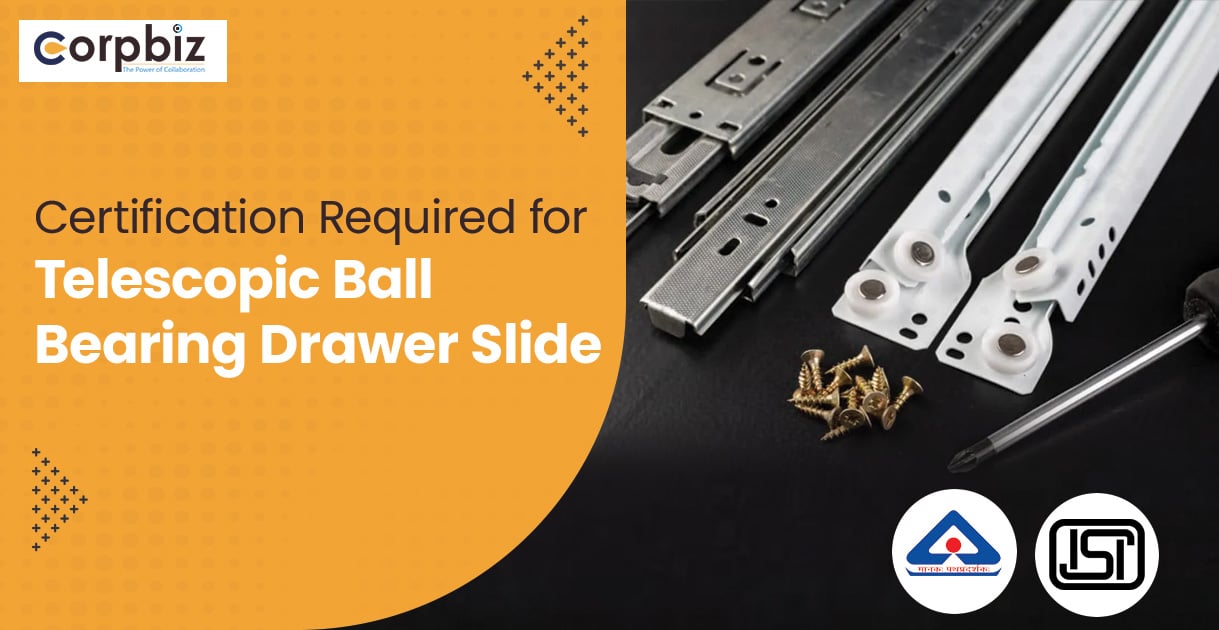
The furniture industry is fast growing due to rapid urbanisation, lifestyle changes, and consumer preferences. Drawer slides, especially telescopic ball bearing drawer slides, are some of the most fundamental parts that provide modern furniture with ease in functionality and durability.
Quality and reliability are the most important when it comes to these slides for smooth functioning, making furniture last long, and safety. Considering this, BIS introduced the IS 17954:2023 standard that laid down requirements for telescopic ball bearing drawer slides. This blog details IS 17954:2023, the certification process, and elucidates its importance to the manufacturer, consumer, and furniture industry in general.
Understanding Telescopic Ball Bearing Drawer Slides
Telescopic ball bearing drawer slide mechanisms are those that make drawer pull-out and push-in easy. They contain segments that extend and retract, so they are called “telescopic.” The ball bearings within the whole slide reduce friction, resulting in smoothness and stability in the movement. They find application in many kinds of furniture, ranging from kitchen cabinets to office desks and storage units.
What is the Importance of Quality in Drawer Slides?
The quality of drawer slides is important for several reasons:
- Durability: High-quality slides are resistant to degradation resulting from frequent usage.
- Smooth Operation: These allow smooth operation in drawing and closing drawers, improving user experience.
- Load Bearing Capacity: Good-quality slides can bear heavier masses without bending and breaking.
- Safety: Poorly fabricated slides can result in accidents, which might include a drawer falling out or getting stuck.
IS 17954:2023 for Telescopic Ball Bearing Drawer Slide
The Bureau of Indian Standards developed the IS 17954:2023 standard to ensure that telescopic ball bearing drawer slides meet the minimum specified quality and safety benchmarks. This standard falls under BIS’s broader mandate to regulate and standardise a host of consumer protection products and institutionalise industry best practices.
What are the Key Provisions of IS 17954:2023?
IS 17954:2023 deals with the provisions associated with the design, manufacture, and performance of drawer slides in various aspects. Some of the important provisions include the following:
- Material Requirements: Specify the materials to be used in the fabrication of the slides, which should be a range of durable and tough materials.
- Performance Tests: Indicate the performance testing methods to be used on the slides, especially in relation to the bearing capacity, which allows the shield against weathering.
- Dimensional Accuracy: This refers to the details on the range of acceptable deviations from the standard that must be observed in furniture manufacturing to fit in with regular furniture designs.
- Safety Standards: The criteria aim to ensure that the slides are not dangerously constructed, with sharp edges or weak structures.
Why is 17954:2023 Matters?
Some of the key factors that make the introduction of IS 17954:2023 important include:
- Consumer Protection: Consumer protection ascertains that consumers only get products with a certain quality threshold, reducing the risk of consumers buying low-quality or unsafe drawer slides.
- Industry Standardisation: It helps standardise the production process, leading to consistency in quality across the industry.
- Global Competitiveness: Adherence to a recognised standard will enhance the global competitiveness of Indian manufacturers since buyers require products with such certifications.
Procedure to Obtain Certification for Telescopic Ball Bearing Drawer Slide
BIS registration for telescopic ball bearing drawer slides used in various furniture industries generally involves a few steps of evaluation and testing at different stages. Below is the breakdown of the same:
STEP 1. Application Submission
The current BIS regulation for the issue of certification to an applicant manufacturer requires the applicant to submit an application to the BIS together with the documents, which must be accompanied by full details of the product, manufactured particulars, and system description detailing the quality control procedure to be adopted.
STEP 2. Test Samples
BIS requires that sample drawer slides be dispatched for testing. The samples are then subjected to multiple tests according to the IS 17954:202 standard, which includes tests for load capacity, endurance, and corrosion resistance.
STEP 3. Inspection of the Factory
In addition to testing the product samples, BIS may inspect the manufacturing facility to ensure the manufacturing process meets the required standards of the code. This includes checking the raw materials used, the machinery employed, and the quality control procedures in place.
STEP 4. Issue of Certificate
Based on the results from the tests on product samples and the factory inspection, BIS would issue the IS 17954:2023 certificate to the manufacturer. The certificate so issued would be valid for some time, and before its expiry, the manufacturer would have to approach for its renewal.
STEP 5. Periodic Surveillance by BIS
Obtaining certification is just the start. To be covered under the certification’s validity, the manufacturers have to adhere to the standards stipulated under IS 17954:2023. The BIS may also conduct periodic inspections and retesting of the products to ensure continued compliance.
Documents for Telescopic Ball Bearing Drawer Slide
To acquire ISI/BIS Certification, you must submit certain essential documents. The list of documents is as follows:
- Application Form V will contain the primary factory and information related to the product category.
- A copy of the BIS Application fee
- A Copy of a test report
- Address Proof of Factory units
- Trademark Registration
- Certificates from the concerned regulatory agencies
- Product Drawing
- Details of the Raw Materials
- Machine Details
Challenges in the Certification Process
While the certification process is quite important in ensuring that the quality level of all products is maintained, it does pose a number of challenges for the manufacturers, and some of them are as follows:
Cost Implications
Obtaining and maintaining certification can be costly. Some of the costs include testing and inspection fees, modification of the manufacturing process to meet the standard, and continuous costs related to maintaining compliance.
Time-Consuming Process
The certification process can also be pretty time-consuming, as is the case when a manufacturer’s products do not meet standards upon the first attempt. It takes time to redesign or improve the product involved, conduct retesting, and probably conduct additional factory inspections.
Technical Expertise
Fulfilling all the provisions set forth by IS 17954:2023 may involve updated technical knowledge on material science, engineering, and quality control considerations. Smaller manufacturers may be forced to either invest in training or hire experts to meet the standards.
Benefits of IS 17954:2023 Certification
Despite the challenges, the following is ensured by the benefits accruing from the certification of IS 17954:2023:
Better Market Reputation
Certification is a mark of quality and reliability that enhances the manufacturer’s reputation in the competitive field. The consumer bases his trust in products bearing the BIS certification mark.
Entry into New Markets
Certification opens up new avenues for market opportunities domestically and internationally. Most buyers, particularly in regulated economies, demand that products be certified by accredited certification bodies according to recognised standards.
Reduced Liability
Adherence to a recognised standard by the manufacturer potentially reduces his liability in case an accident occurs involving the product. The certification indicates that the manufacturer has taken all measures to ensure product safety and quality.
Confidence in Consumer
Besides the certification of IS 17954:2023, consumers are assured that purchased products have undergone stringent testing and that their safety and quality are ensured. This is well-assured to achieve customer satisfaction and loyalty.
Impact on the Furniture Industry
Several impacts on the Furniture Industry are as follows:
Improvement in Driving Quality
IS 17954:2023 also aims to drive quality improvement across the furniture industry. As more manufacturers get their products certified, the general quality of drawer slides will improve in the market, benefiting consumers and also improving the acceptance of Indian furniture products globally.
Promoting Innovation
Producers may be required to innovate materials, designs, and manufacturing processes as this exacting standard prescribes. This could mean new, improved drawer slides with better performance and longevity.
Promote Fair Competition
IS 17954:2023 ensures fair competition in the industry by setting a clear benchmark of quality. Manufacturers that invest in quality by adhering to standards receive greater market share, while those compromising on poor quality probably cannot compete.
To Wrap Up
IS 17954:2023 represents a big leap forward in the furniture industry in India. It lays down quality and safety guidelines, ensuring consumers that the telescopic ball bearing drawer slides they get are reliable and durable. Certification is a challenge but also a great chance for manufacturing companies. It poses a challenge because of the high standards they have to meet, but it is an opportunity to open new markets and increase their prestige; it triggers an innovative spirit.
Standards such as IS 17954:2023 will continue to drive the future of furniture manufacturing in an ever-changing industry. By facilitating quality, safety, and innovation, we will contribute to a global health industry that addresses consumers’ needs. Manufacturers, consumers, and all stakeholders will benefit from the wide acceptance of this standard.
Visit Corpbiz and secure a BIS Certificate for your business and build your credibility in the industry.
Frequently Asked Questions
What is IS 17954:2023?
The Bureau of Indian Standards (BIS) established IS 17954:2023 to specify the standards for telescopic ball bearing drawer slides, focusing on quality, safety, and performance.
Why is IS 17954:2023 certification necessary?
Certification assures that the drawer slides fulfil minimal quality and safety standards, protecting consumers while improving the product's dependability and durability.
What are the main provisions of IS 17954:2023?
Material criteria, performance tests, dimensional accuracy, and safety norms are essential to ensure high-quality and safe drawer slides.
What are the steps involved in the certification procedure?
There are multiple crucial steps in the certification process:
· Application Submission
· Assessment
· Sampling and Testing
· Certification Grant
· Surveillance and Re-certificationWhat documents are needed to apply for certification in IS 17954:2023?
Manufacturers must provide several documents to apply for IS 17954:2023 certification, including:
· Application Form V provides factory and product details.
· Verification that the application cost was paid.
· A recent product compliance test result from an internal laboratory.
· Factory's address proof.
· If available, trademark registration.
· Regulatory agency certificates.
· Product drawings, including information on the raw ingredients and production equipment.What problems manufacturers encounter during the certification process?
Manufacturers may face problems such as high costs, time-consuming procedures, and a need for technical competence to achieve the demanding IS 17954:2023.
How does the IS 17954:2023 certification benefit manufacturers?
Certification promotes market reputation, creates new market prospects, lowers liability, and boosts consumer confidence in the product's quality and safety.
What effects does IS 17954:2023 have on the furniture sector?
By establishing precise quality standards, the standard fosters innovation encourages quality improvement and guarantees fair competition within the sector.
What does the BIS's periodic surveillance mean once certification is obtained?
Frequent monitoring guarantees that producers comply with the specifications, preserving the product's long-term quality and safety.
In what ways does IS 17954:2023 help manufacturers compete globally?
Since consumers frequently demand that products be certified by recognised agencies, Indian businesses can compete globally by adhering to this acknowledged standard.
Read Our Article: Certificate is Mandatory for V-Belts