

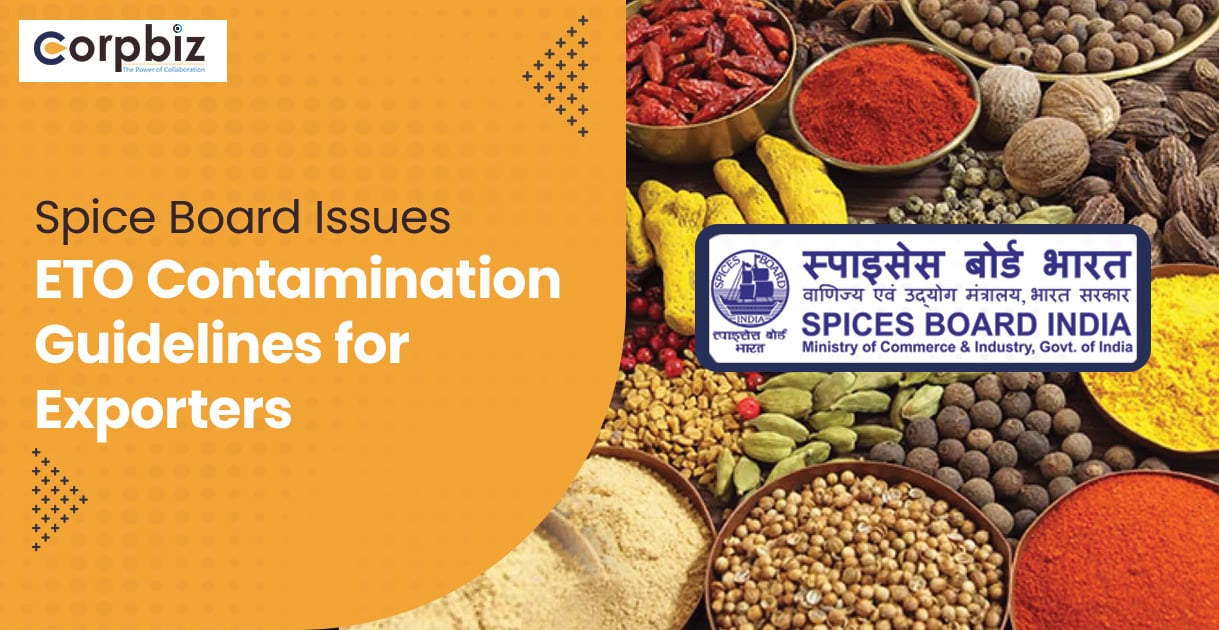
With worries about ethylene oxide (ETO) pollution in Indian spice products increasing, the Spices Board has released comprehensive recommendations targeted at exporters. These nine-page rules include strict instructions on avoiding this carcinogenic ingredient in spices that will be sold in foreign markets.
Exporters are required by the recently developed recommendations to refrain from using ethylene oxide as a fumigating or sterilizing agent at any point in the production process. They must also ensure that suppliers of packaging, storage facilities, transporters, and other supply chain participants don’t use this dangerous chemical. This post will discuss how the Spice Board formulates guidelines for exporters to prevent ETO contamination.
Throwing Light on the Spices Board of India
The main goal of the government-run Spices Board of India, which was founded in 1954, is to control and promote the export of Indian spices. In this article, we shall examine the Board’s functions and their effects on the Indian spice trade.
One of the main goals of the Spices Board of India is to encourage the export of Indian spices. The board promotes Indian spices in foreign markets, attends international trade shows and exhibitions, and provides technical support to exporters. By encouraging their export, the board contributes to securing a larger market share and raising the demand for Indian spices globally.
One of the other primary responsibilities of the Spices Board of India is to ensure the quality of exported Indian spices. The board regularly inspects packaging and spice processing facilities to ensure the exported spices satisfy the necessary quality requirements. It prevents Indian spices from being exported in poor quality and preserves their reputation as premium products.
Spice growers and processors can also receive technical support from the Spices Board of India. This involves disseminating knowledge about the newest innovations and industry best practices for cultivating, processing, and packaging spices. To help increase the yield and quality of Indian spices, the board also trains farmers and processors on using this technology.
Contribution of Spice Board to Empower Spice Business Owners
The Spices Board of India contributes to the growth of the domestic space sector and facilitates and oversees the export of Indian spices. The board offers financial support to farmers and processors with the cost of equipment, seeds, and other inputs. The board also conducts research and development to create fresh and enhanced spice types that boost industrial productivity and competitiveness.
The Spices Board of India also creates new markets for Indian spices. The board finds these markets and encourages their export to these regions. This lessens reliance on a small number of important markets and helps to diversify the markets for Indian spices.
Spice Board Registration is crucial for businesses aiming to export Indian spices, ensuring access to global markets and maintaining high-quality standards in compliance with the Board’s regulations. Secure your spice board registration to leverage international trade opportunities.
Why was the Spices Board of India Introduced?
The Indian Spices Board was founded in 1954 to foster the country’s spice trade expansion and guarantee its competitiveness in the international market. Its introduction addressed the issues the Indian spice industry faced, namely poor-quality control, insufficient marketing and promotion of Indian spices, and a lack of collaboration among stakeholders.
Before the formation of the Spice Board, the Indian spice business was fragmented and lacked a cohesive voice in the international market. The board was established to unite all industry participants farmers, processors, exporters, and traders under one overarching body to advance the sector’s expansion and competitiveness.
One of the Spice Board’s primary goals was to enhance the quality of Indian spices and ensure they adhered to worldwide quality standards. To accomplish this, the board implemented various measures, such as conducting routine inspections of spice packaging and processing facilities and offering technical support to farmers and processors regarding optimal methods for producing processing, and packaging spices.
Additionally, the Spice Board sought to expand Indian spice exports and open up new international markets. To do this, the board promoted the export of Indian spices to current markets and carried out market research to find new markets for Indian spices. This lessened reliance on a few critical countries and helped diversify the markets for Indian spices.
The Spices Board of India was instrumental in providing financial support to growers and processors and spearheading the expansion of the Indian spice sector. This included providing loans and subsidies to help pay for the procurement of machinery, seeds, and other inputs and offering technical support on the newest innovations and industry best practices for producing spices.
What is ETO?
Colourless and widely utilized in industry, ethylene oxide (EtO or EO) is employed in manufacturing textiles, personal hygiene products, medical equipment, cosmetics, and spices, among other things. One of the well-known methods for sterilizing medical equipment is ethylene oxide (EtO), which is essential for avoiding infection in patients undergoing surgery and other medical treatments.
Hundreds of thousands of hospitals, medical, and laboratory procedures rely on ethylene oxide (ETO) to sterilize tools and equipment to shield millions of patients from the dangers of infectious diseases brought on by bacteria, viruses, and fungi. ETO sterilization is most of these products’ most efficient and successful method and frequently the only practical method. Many essential medical technologies and devices that would otherwise be damaged and rendered useless by other sterilization methods can be sterilized thanks to ethylene oxide’s thorough yet delicate nature (EtO).
Talk To Expert

Spice Board’s ETO Contamination Guidelines for Exporters
(4.8)


Overview of Spice Board Guidelines for Exporters
Amid quality concerns raised by certain nations regarding these items, the Spices Board has released extensive instructions for exporters to prevent the contamination of products transported from India with the carcinogenic chemical ethylene oxide (EtO). The standards state that exporters must ensure that transporters, storage/warehouses, and packing materials suppliers do not use them at any point while sterilizing or fumigating spices.
It stated that exporters must take appropriate precautions to guarantee that spices and spice products are free of EtO and its metabolites at every stage of the supply chain. In their danger analysis, critical control points, and food safety plan in their food safety management system, they would classify this chemical as dangerous and include essential control points to prevent EtO.
“Exporters must conduct EtO contamination tests on raw materials, processing aids, packing materials, and final items. The nine-page guidelines stated that exporters “must perform a root cause analysis and implement appropriate preventive control measures to avoid future recurrence and maintain such records on instances of EtO detection, at any stage of the supply chain.”
They are urged to employ alternative sterilizing techniques, such as steam sterilization, irradiation, and other techniques endorsed by the Food Safety Authority, FSSAI. These regulations were announced against the backdrop of popular brands MDH and Everest being banned from sale in Hong Kong and Singapore due to the carcinogenic ingredient ethylene oxide in their goods. A required recall from shelves resulted from this.
It further said that if spices, herbs, and their parent plants are known to contain microbiological contamination that is not expected to be reduced to acceptable levels by standard processing, sorting, or preparation methods, the establishment will not accept them.
It added that raw materials will be inspected (for foreign odour, matter and appearance, and visible mould contamination), cleaned if necessary, and sorted before processing. “Additional care must be made to reject herbs and spices that exhibit mould growth or pest damage to reduce the risk of mycotoxins such as aflatoxins,” it stated.
Appropriate steps should be taken at every processing level to prevent the cross-contamination of spices and herbs through direct or indirect contact with possibly contaminated material.
Processed raw materials that pose a risk should be kept physically apart from places used for preparing or storing finished goods, such as different rooms.
When packaging, follow the rules and use non-porous bags or containers to protect the herbs and spices from contamination, moisture, and rat and insect infestation.
It is advised that fresh, undamaged bags or containers be used to pack food that comes into contact with them. Spices and herbs, such as dried chilli peppers, should not be doused with water to avoid breaking during packing. Mould and microbial infections could grow as a result, it said.
It also stated that products must be dried to a safe moisture level before being bulk transported to prevent mould growth and other pathogens. Additionally, vehicles used for transportation must be odour-free, dry, and free of infestation to prevent cross-contamination with previously transported goods.
Additionally, it is recommended that care be taken to protect the product from dampness and water during transit and to ensure that no debris or vermin contaminates it. If the bags get wet, the spices absorb moisture quickly, which causes the moisture content to rise significantly. When necessary, calibrated devices should monitor the temperature and humidity of products that must be transported over extended periods.
What are the Residue Limits for ETO?
The Spices Board has also made the Maximum Residue Limits (MRL) for ETO allowed in significant markets, including the EU, UK, US, Singapore, Switzerland, and Turkey, available in the guidelines. The WHO and FAO’s international standard-setting agency, CODEX, have not established species-specific MRLs.
Indian missions overseas have informed the Spices Board that several importing countries have recalled or rejected spices exported from India through Singapore and Hong Kong because the amount of ETO present was higher than allowed. The Board has established a set of rules on reducing ETO contamination in spices exported from India, following in-depth discussions with the Indian spice sector, according to a circular sent on Tuesday to all export organizations.
According to a Global Trade Research Initiative (GTRI) study, quality issues may endanger more than half of India’s spice exports. Complaints have been raised about the quality of the provided spices by well-known Indian companies MDH and Everest spices in reports from the US, Hong Kong, Singapore, Australia, and Malé. The stakes are high, as India shipped spices worth over $692.5 million to these nations in the fiscal year 2024, according to GTRI co-founder Ajay Srivastava.
“FSANZ is working with our international counterparts to understand the issue with federal, state, and territory food enforcement agencies to determine if further action is required in Australia (e.g. a food recall),” the organization said in response to Business Line’s email.” There haven’t been any recalls announced in Australia yet,” it continued.
Impact of Spice Board on Exporter
The GTRI analysis calculated that the overall potential loss to India’s spice exports would be 58.8% if China and the EU, the two main customers for Indian spices, also adopted more excellent monitoring. The guidelines also suggested precautions against microbiological cross-contamination, suitable packaging, cautious transportation to protect from any unfavourable environmental elements outside, and careful handling of test sample preparation.
Stats Related to Spice Export
India accounted for 12% of the world’s spice exports in 2023–24, with USD 4.25 billion in total spice exports. Chilli powder was the most popular spice in India, with 1.3 billion USD in exports. Cumin came in second with USD 550 million, turmeric with USD 220 million, cardamom with USD 130 million, mixed spices with USD 110 million, and spice oils and oleoresins with USD 1 billion.
Other noteworthy exports included asafoetida, saffron, anise, nutmeg, clove, mace, and cinnamon. The global spice trade will be valued at USD 35 billion in 2023. China is the world’s largest exporter, with $8 billion in exports in 2023.
According to data from the economic research tank GTRI, the top exports include coriander and cumin seeds (USD 800 million), fresh and dried garlic (USD 1.6 billion), ginger, turmeric, and chilli powder (USD 2.4 billion). To commence your spice business in India, you must proceed with FSSAI registration and GST registration to minimize the scope for penalties.
Conclusion
To identify ETO contamination in raw materials, processing aids, packing materials, and finished goods, exporters must have strict testing processes. Whenever ETO is detected, it is imperative to do a comprehensive root cause investigation and put preventive measures in place to ensure that it doesn’t happen again. Exporters are urged to use alternate sterilization techniques, such as steam sterilization and irradiation, to reduce the danger of contamination, as long as the food regulator, FSSAI, has approved them.
To guarantee the safety of Indian spices in international markets, compliance with the Spice Board’s rules on preventing ETO contamination is essential. Exporters can preserve market access, improve the standing of India’s spice business, and safeguard consumer health by implementing best practices and alternate sterilization techniques.
Ensure your spice exports meet global standards and avoid costly recalls, visit our website Corpbiz for expert compliance and quality assurance solutions. Take action now to secure your market access and protect your brand!
Frequently Asked Questions
What is ethylene oxide (ETO)?
Ethylene oxide (ETO) is a flammable, colourless gas used as a sterilizing agent.
Why is it a concern in spice exports?
When mishandled, ETO can contaminate food items and is recognized as carcinogenic. Because of health concerns, several nations have restricted or outright prohibited the use of ETO in food products.
Why did the Spices Board formulate these guidelines?
In response to concerns expressed by several nations about ETO contamination in Indian spice products, the Spices Board released rules. These regulations seek to safeguard Indian spice exports and avert further prohibitions.
What are the consequences of non-compliance with these guidelines?
Noncompliance can result in trade restrictions, product bans, and harm to the reputation of Indian spice exports.
How does ETO contamination occur in spices?
When spices are sterilized using a chemical to kill bacteria, fungi, and other microbes, contamination with ETO can occur. Contamination may result from improper handling or failure to remove leftover ETO following sterilization.
What are the high health risks associated with ETO contamination?
Exposure to ETO has been associated with significant health hazards, such as cancer, adverse effects on reproduction, and other chronic disorders. Therefore, worldwide food safety authorities rigorously restrict its presence in food goods, including spices.
Which countries have raised concerns about ETO contamination?
Several nations, including US and EU members, have expressed concerns regarding ETO contamination in Indian spice shipments. Their severe limitations on permissible ETO residual levels result in more stringent import surveillance.
Read Our Article: FSSAI Introduces Instant License Registration