

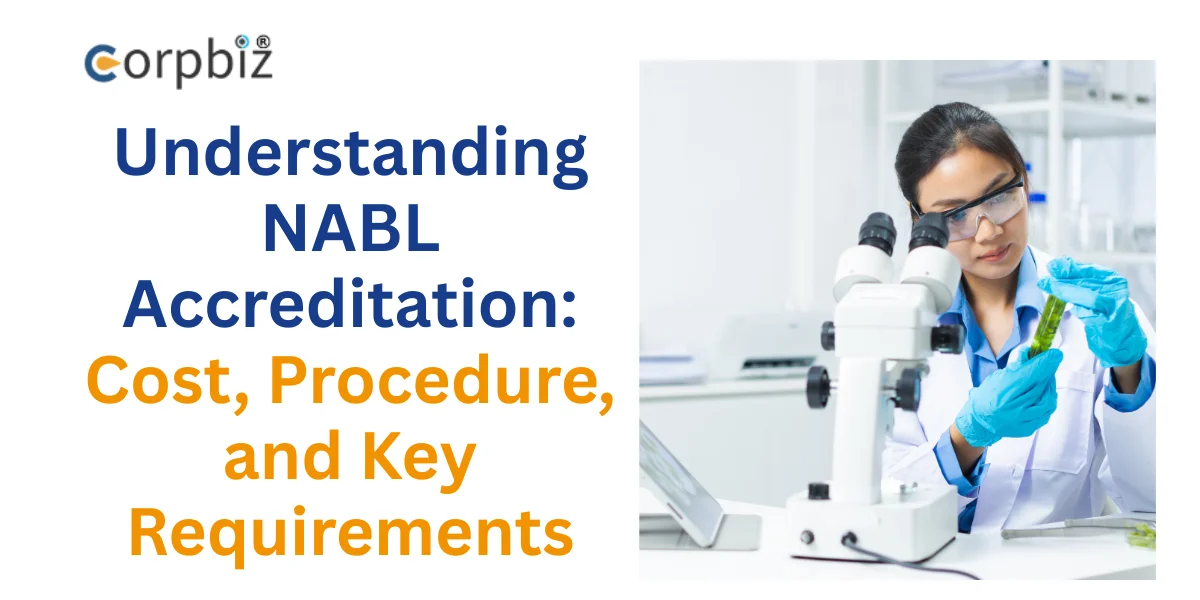
Reliable testing is necessary in sectors such as Healthcare, pharmaceutical, food testing, manufacturing, calibration lab, and research laboratories. Many important decisions are based on lab reports.
If the report is wrong, then many problems can arise. Product recall can occur. Legal issues can arise. Customer trust can decrease. Sometimes regulatory problems also arise.
This is why the demand for NABL accreditation has increased a lot. In India, it is considered a trusted standard of laboratory quality. “NABL-accredited laboratory” means that the lab is working by maintaining proper quality and safety.
In this article, you will learn about NABL accreditation, the process, cost, required documents, and the benefits.
NABL Accreditation in Brief
The full form of NABL is National Accreditation Board for Testing and Calibration Laboratories. It is an official accreditation body of India. NABL works under the Quality Council of India (QCI). It is also affiliated with the Ministry of Commerce and Industry.
The NABL accreditation verifies whether a laboratory is technically competent or not. NABL checks whether the lab can properly perform testing, calibration, or medical diagnosis.
A NABL-accredited laboratory usually follows the following:
- Proper quality management system
- Accurate reporting process
- Skilled technical staff
- Equipment calibration and maintenance
NABL accreditation is valid for 2 years. But surveillance audits are conducted every year. This verifies whether the laboratory is still following the standards properly. NABL accreditation is also accepted at the international level. NABL is a member of ILAC and the APAC MRA.
Importance
- Increases customer trust
- Increases the value of the laboratory
- Easier to obtain government approval
- International acceptance is gained
- Business reputation is improved
Talk To Expert

Get Expert Assistance for NABL Accreditation Today
(4.8)


Services Provided by NABL (2026)
NABL accredits the following types of conformity assessment bodies:
| Category | Standard | Program Started |
| Testing & Calibration Laboratories | ISO/IEC 17025:2017 | 1982 |
| Medical Testing Laboratories | ISO 15189:2022 | 1998 |
| Proficiency Testing Providers (PTP) | ISO/IEC 17043:2023 | 2011 |
| Reference Material Producers (RMP) | ISO 17034:2016 | 2014 |
| Biobanks | ISO 20387:2018 | Not under ILAC MRA |
NABL has removed the reference to ISO 15189:2012 and now exclusively requires ISO 15189:2022 for medical laboratories.
Types of Laboratories Covered Under NABL
NABL accredits many types of laboratories. There are different categories according to the work of the lab.
These labs test different products or materials.
For example:
- Chemical testing labs
- Biological testing labs
- Electrical testing labs
- Environmental testing labs
These types of labs are used more in manufacturing and the food industries.
These labs check the accuracy of machines and instruments.
For example:
- Mechanical calibration
- Thermal calibration
- Fluid flow calibration
These labs are needed in the industry to determine whether the machines are working properly or not.
These labs work in the healthcare sector.
For example:
- Pathology labs
- Diagnostic centers
- Molecular diagnostic labs
These help with disease diagnosis.
NABL also accredits some other special laboratory programs.
For example:
- Biobanks
- Drinking water testing labs
- Soil testing laboratories
It is now compulsory for medical laboratories to follow the ISO 15189:2022 standard. The old ISO 15189:2012 is no longer accepted.
Applicable Standards
The same standard is not used for all laboratories. Different standards are applied according to the work of the lab.
ISO/IEC 17025 for Testing & Calibration Labs
ISO/IEC 17025 is mainly used for testing and calibration laboratories. This standard checks the technical quality of the lab, such as:
- Technical competence
- Method validation
- Calibration accuracy
- Measurement traceability
- Reliable testing process
ISO 17025 NABL accreditation is very common in manufacturing, engineering, research, and environmental testing sectors.
ISO 15189 for Medical Laboratories
ISO 15189 has been developed for medical laboratories. It helps improve diagnostic quality.
This standard mainly focuses on:
- Correct diagnosis
- Patient safety
- Proper sample handling
- Accurate reporting
The demand for diagnostic laboratories in India has now increased a lot. Therefore, the importance of ISO 15189 NABL accreditation has also increased significantly.
What are the Key Benefits of Getting Accredited with NABL?
NABL accreditation helps in increasing the quality and trust of the laboratory. Some of its important benefits are given below.
- Improved Accuracy and Reliability
NABL-accredited labs follow standard processes. This reduces testing errors. The results are more accurate and reliable.
- Better Customer Confidence
Patients, companies, and government authorities generally trust NABL-accredited labs more. This increases customer confidence.
- Regulatory Compliance
Maintaining proper compliance is very important in many industries. NABL accreditation helps follow government and industry rules.
- International Recognition
NABL accreditation is also accepted at the international level. Due to ILAC and APAC recognition, reports are also accepted in many foreign countries.
- Competitive Advantage
NABL-accredited labs get a different value in the market. Business reputation improves. Benefits are also available in many tenders and contracts.
- Better Internal Processes
NABL accreditation improves the workflow of the lab. The documentation system improves. Work can be done in a more organized manner.
- Reduced Retesting Costs
Accurate testing reduces the need for repeated testing. This saves both time and operational costs.
Read more – Role of NABL Accredited Labs in BEE Registration
What are the Essentials for NABL Accreditation?
1. Eligibility Criteria
A Conformity Assessment Body (CAB) must meet the following requirements for NABL accreditation:
| Requirement | Detail |
| Legal Status | Engaged in laboratory testing, calibration, or R&D activities |
| Quality Manual | Documented quality manual aligned with ISO/IEC 17025:2017 or ISO 15189:2022 |
| Quality Manager | Must undergo a minimum of 4-day internal audit and management system training |
| Internal Audit | At least one complete internal audit before the application |
| Management Review | At least one management review covering all standard agenda points |
| Proficiency Testing | Satisfactory participation (Z-score < 2) in the PT program by an accredited PT provider before application |
| Consultant Disclosure | Must disclose consultant/advisor name if engaged |
2. Management System Requirements
The laboratory must have a proper documentation system.
For example:
- Quality Manual
- SOPs
- Record control system
All documents must be maintained properly. In addition, the ID number, authority, and retention period of the document must also be mentioned. It is also very important to follow the processes written in the Quality Manual.
3. Technical Competence Requirements
| Area | Requirement |
| Personnel | Qualified and competent staff with documented training records. |
| Equipment | All instruments must be calibrated by NABL-accredited calibration laboratories |
| Method Validation | Validated testing/calibration methods with documented procedures |
| Measurement Uncertainty | Estimation and expression of measurement uncertainty |
| Metrological Traceability | Traceability to national/international standards per NABL |
| Environmental Controls | Temperature, humidity, and storage conditions as per SOPs |
4. Quality Assurance Requirements
- Internal Quality Control (IQC) including Levy-Jennings Chart for Medical Labs.
- Participation in External Quality Assessment Scheme (EQAS).
- Inter-laboratory comparison for analytes without a formal PT program.
- The laboratory must properly monitor IQC and EQA deviations.
If any issue is found, then the corrective action must be properly documented. This helps maintain quality.
Documentation Checklist
Proper documentation is very important during NABL accreditation. The approval process becomes much faster if the documents are prepared properly.
Below is a checklist of important documents:
- Quality Manual
- SOPs (Standard Operating Procedures)
- Calibration certificates
- Staff qualification records
- Internal audit reports
- CAPA records
- Method validation records
- Management review reports
- PT participation reports
These documents help prove the quality system and technical process of the laboratory. The assessment may be delayed when the documentation is incomplete. So, it is better to maintain the documents properly from the beginning.
Step-by-Step Process of Getting Accredited with NABL
Step 1: Gap Analysis
First, the current system of the laboratory is checked. Here, it is seen where NABL compliance is missing.
Step 2: Documentation Preparation
Important documents are prepared in this step.
For example:
- Quality Manual
- SOPs
- Forms and records
Step 3: Staff Training
Lab staff are trained in NABL standards and procedures. This helps employees understand the process better.
Step 4: System Implementation
The QMS is applied to the entire laboratory operation at this stage. Proper procedures are followed in daily work.
Step 5: Application Submission
Once all the preparations are complete, the application must be submitted through the NABL portal.
Different forms are used for different labs.
For example:
- NABL 151 – Testing Laboratories
- NABL 152 – Calibration Laboratories
- NABL 153 – Medical Laboratories
Step 6: Document Review
NABL reviews the submitted documents. Corrections are requested if any document is missing of if any issue in found.
Step 7: Pre-Assessment
This is an optional step. However, it is very useful for first-time applicants. It can identify problems before the final audit.
Step 8: Final On-Site Assessment
At this stage, NABL assessors visit the laboratory.
Here, the following checks are made:
- Technical audit
- Staff competency
- Equipment verification
- Testing process
Step 9: Closure of non-conformities
Any issue found during the assessment must be corrected. Then the proof must be submitted.
Step 10: Accreditation Approval
Once all the requirements are completed, NABL issues the final certificate.
NABL Accreditation Cost in India (2026 Fee Structure)
NABL is a self-financing organization. Therefore, various fees are charged for the accreditation process. Application fee, assessment fee, and other charges are applied as per the latest fee structure of 2026.
| Laboratory Type | Application Fee |
| Testing Laboratories (except Forensic, Software/IT, Integrated Assessment) | ₹11,000 for 1 product group/discipline |
| Forensic Laboratories | ₹44,000 for 1 product group |
| Software & IT System Testing Labs | ₹44,000 for 1 product group |
| Laboratories under Integrated Assessment (FSSAI, APEDA, etc.) | ₹25,000 for 1 product group |
| Medical Imaging (MI-CAB) – 1 modality | ₹11,000 |
| Calibration – Mechanical (1 group) | ₹11,000 |
| Calibration – Electro-Technical (all parameters) | ₹33,000 |
| Calibration – Thermal/Fluid Flow/Optical/Radiological | ₹22,000 |
| Calibration – Medical Devices (up to 2 groups) | ₹50,000 |
| Calibration – Chemical Metrology (Air Quality) | ₹22,000 |
| Proficiency Testing Providers (1 sub-discipline) | ₹25,000 |
| Reference Material Producers (1 category, up to 2 sub-categories) | ₹25,000 |
Other Expenses
There are other costs besides the application fee.
For example:
- Assessment charges
- Equipment calibration costs
- Infrastructure upgrades
- PT participation charges
- Staff training expenses
Common Challenges
Many laboratories face some common problems during NABL accreditation. Approval can be delayed due to these issues.
- Poor Documentation
Sometimes documents are incomplete. SOPs or records are not maintained properly.
- Lack of Staff Awareness
Sometimes the staff does not know the NABL procedures well. This causes problems during the audit.
- Calibration Delays
Compliance issues arise when machine calibration is not done on time.
- Weak Audit Systems
It becomes difficult to identify mistakes when an internal audit is not done properly.
- Delayed Corrective Actions
Corrective action needs to be taken quickly when an issue is found after assessment. Delays slow down the accreditation process.
- PT Participation Issues
Many labs cannot complete proficiency testing properly. This makes it difficult to prove technical competency.
All these problems can lead to repeated assessments. So, proper planning and monitoring from the beginning is very important.
How Can Corpbiz Help Companies with NABL Accreditation and Compliance?
Corpbiz helps laboratories and businesses simplify the NABL accreditation process. Many laboratories face documentation, audit, or compliance issues due to a lack of proper guidance. We help to make this process smoother with expert support.
Corpbiz Services Include:
- NABL accreditation consultancy
- Documentation support
- SOP preparation
- Internal audit support
- Staff training guidance
- Compliance monitoring
- Application filing assistance
- Mock audits
- Corrective action support
Expert consultancy reduces documentation errors and helps in audit preparation. This reduces the chance of approval delay. With proper guidance, the laboratory can complete the entire process more easily.
Conclusion
NABL accreditation helps prove the quality and reliability of the laboratory. It increases customer trust, maintains international credibility, and ensures better compliance.
Currently, the demand for NABL accreditation has increased in the healthcare, food testing, pharmaceutical, and manufacturing sectors. So, it can be considered a good investment for long-term business growth.
Corpbiz helps simplify the NABL accreditation process with expert consultancy and end-to-end support. We also provide support in company registration, ISO certification, and other legal compliance services. So, contact us today for hassle-free compliance.
Helpful Questions About NABL Accreditation
What is NABL accreditation?
NABL accreditation is an official approval for the quality check of a laboratory. It means that the lab is working by following proper rules. A NABL-accredited lab usually provides accurate testing and a reliable report. It is very important in healthcare, food testing, and the pharmaceutical sectors. It also helps in increasing the trust and reputation of the lab.
Is NABL accreditation mandatory in India?
NABL accreditation is not compulsory for all laboratories. It is voluntary. But many companies and government departments prefer NABL-accredited labs. It is also required for tender or approvals in some industries. So, many laboratories are taking NABL accreditation for business growth.
How long does NABL accreditation take?
NABL accreditation usually takes 6 to 12 months to complete. However, it depends on the preparation of the lab. If the documents and quality system are ready in advance, then it may take less time. The process is delayed when there is a documentation problem.
What is the validity of NABL accreditation?
NABL accreditation is usually valid for 2 years. However, surveillance audits are conducted every year. In this audit, it is checked whether the lab is still following proper standards or not. The accreditation can also be suspended when major issues are found.
How much does NABL accreditation cost?
The cost of NABL accreditation is not fixed. It depends on the size of the lab and the testing scope. The total cost can be around ₹3 lakh to ₹6 lakh for a small laboratory. This includes application fees, audit costs, calibration, and training expenses.
What documents are needed for NABL accreditation?
NABL accreditation requires some important documents. These include quality manuals, SOPs, calibration certificates, audit reports, and staff training records. In addition, method validation records and PT reports are also required. It is very important to maintain documents properly.
What is proficiency testing in NABL?
The testing accuracy of the laboratory is checked through proficiency testing, or PT. Here, the same sample is tested in different labs. Then the results are compared. This shows whether the lab is giving accurate results or not. PT participation is very important for NABL accreditation.
What happens if a lab fails the NABL assessment?
NABL shows some issues or non-conformity when the lab fails the assessment. Then the laboratory has to fix that problem. A review or reassessment may be conducted after corrective action is taken. If all the issues are fixed, then accreditation can be obtained.
Does NABL accreditation help in international acceptance?
Yes, NABL accreditation is also helpful at the international level. NABL is a member of ILAC and APAC. So, reports of NABL-accredited labs are accepted in many foreign countries. This is useful for exporting business and international projects.
How can Corpbiz help with NABL accreditation?
Corpbiz provides guidance and support in the NABL accreditation process. We help with documentation, SOP preparation, audit support, and application filing. We also provide support in ISO certification, FSSAI registration, and other compliance services. It makes the accreditation process much easier.