


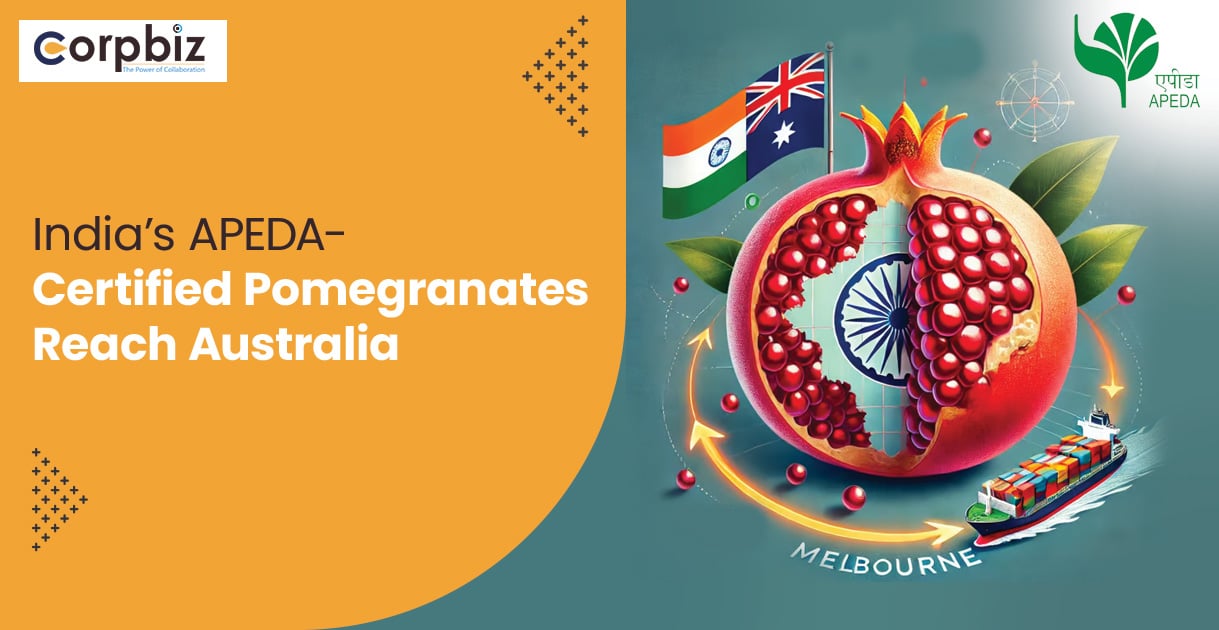
The export of pomegranate from Mumbai to Melbourne, Australia, on August 31, 2024, marked an important milestone for India’s agri-export sector. The Agricultural and Processed Food Products Export Development Authority (APEDA) facilitated the consignment and began a new chapter in India’s global agricultural footprint.
Pomegranates’ bright red colour, distinctive flavour, and multiple health benefits drew international attention. The First consignment was showcased at Fine Food Australia 2024, further boosting the visibility of Indian agricultural products on a global platform.
This blog will explain the importance of this event, the elaborate export process, and what it means to open a new route to Indian farmers. We will also discuss the role of APEDA, the challenges it faces during exports, and how India’s agricultural sector can spread into other international markets.
India’s Voyage into the Australian Market
Although India has long been a significant exporter of farm produce, access to the Australian market for pomegranates came after years of negotiation over quality and safety. The market for Indian pomegranates was finally opened in 2020, marking the fruitful start of a relationship between the two nations in the horticulture sector.
However, the export process did not fully occur until 2024 after the work plan and Standard Operating Procedures were signed in February 2024. The work plan below defines what must be done to satisfy India’s biosecurity requirements regarding pest management, packaging, and irradiation treatment. Since Australia has the most stringent phytosanitary thresholds compared to most other countries, India’s adherence to these regulations was highly connected with delivering the fruits to Melbourne without any biosecurity issues.
APEDA’s Role in the Export Process
The decent quantity of pomegranates exported was not an isolated effort. Full credit should go to APEDA, which was pivotal in facilitating the entire process, from working closely with the farmers to arranging logistics and ensuring that all quality standards were met. The role of APEDA was very important in establishing EPF specifically for pomegranates, removing supply chain bottlenecks, and ensuring smooth operations.
APEDA’s mandate is to promote exports and develop an integrated approach to enhancing Indian exports in collaboration with various stakeholders, such as the Department of Commerce, the Department of Agriculture, state governments, and leading exporters.
Talk To Expert

India’s APEDA-certified Pomegranates Reach Australia
(4.8)


Opening New Streams of Revenues for Indian Farmers
This export of pomegranates to the Australian market will be a significant boost to Indian farmers, especially those from Maharashtra, Gujarat, Karnataka, Rajasthan, and Andhra Pradesh, which is the main area for pomegranate cultivation. India is the second largest producer of horticulture crops, and the increasing demand for this fruit on world markets promises new revenue streams for farmers.
Benefits to Indian Farmers
Through export to international markets like Australia, Indian farmers gain a better market price for the fruit. Besides, the farmers get incentives to invest in better farming practices, quality control, and packaging, boosting farmers’ earnings. Further, APEDA ensures the profits from such export benefits down to the grassroots level by working directly with exporters/packhouses sourcing pomegranates from local farms.
For instance, Kay Bee Exports, a top-notch exporter from Mumbai, dispatched the maiden consignment. The fruits were procured directly from farms operated by Kay Bee Exports to ensure that the fruits of this successful export reached the farmers involved in cultivation. The 1.1 MT (336 boxes) consignment was processed and packed in an Australia-approved packhouse at Ahmednagar, Maharashtra. This structure ensures that the fruits delivered are as fresh as possible and meet the stringent Australian import standards.
Read more Blogs: Why APEDA Registration is Mandatory for the Export of Agricultural Products?
Ensuring Quality and Compliance
Pomegranates must undergo several checks and treatments before they can meet the high standards of the Australian market. The consignment exported to Melbourne was treated for irradiation at the Maharashtra State Agricultural Marketing Board’s (MSAMB) Integrated Food Centre (IFC) in Vashi, Navi Mumbai. This is an important part of the SOP, ensuring that the fruits are free from pests and safe for consumption.
Australian biosecurity standards are among the world’s most stringent. The major quarantine pests of concern include fruit flies, scales, mites, and thrips. Indian exporters follow multi-layered systems for controlling pests from the farm to packaging, transportation, and export. Some of the key measures include:
- Orchard Management: The registered orchard should be under continuous monitoring and proper pest control regularly to avoid any fruit infestation.
- Packing Houses: All pomegranates to be exported to Australia must be prepared in packing houses that are duly registered and follow strict hygiene and pest control measures.
- Cold Treatment: Pre-shipment cold treatment is another alternative which helps eradicate pests without affecting the quality of the fruit.
- Irradiation: Similar to the first consignment, irradiation is widely accepted as a treatment that assures the product’s phytosanitary integrity.
However, ensure your agricultural exports meet global standards with APEDA Registration to elevate your quality and compliance for international markets today.
Fine Food Australia 2024: India Steps Up for Pomegranates
The successful shipment of pomegranates to Melbourne was in the spotlight at Fine Food Australia 2024, an international trade exhibition offering a meeting place for the leading players of the food industry. The pomegranates were also featured at the APEDA India Pavilion, which gave global visibility to the fruit and showcased India’s agricultural prowess.
Besides boosting India’s reputation as a dependable exporter, this type of exposure on global platforms will also boost the country’s diversified basket of fresh fruits and vegetables, which are already in great demand in many parts of the world.
Challenges and Avenues to the Future
Exporting pomegranates to Australia was indeed a feather in the cap. Still, it spoke volumes about the issues that farmers and exporters in the country face when attempting to tap international markets.
· Meeting Stringent Quality Standards
Strict import regulations in Australia necessitated India’s adoption of novel practices for consistency over packages, from pest controls to packaging. Each step had to be closely monitored to ensure fruits complied with Australia’s required biosecurity standards. This can be a pretty resource-intensive process that entails constant collaboration by farmers, exporters, and government bodies like APEDA.
· Supply Chain Bottlenecks
Setting up the Export Promotion Forums by APEDA will resolve some bottlenecks in the supply chain that eventually hamper exports. This kind of forum brings different stakeholders together and ensures that the problems in logistics, storage, and transportation are resolved as soon as possible.
· Global Competition
Though India is the second-largest producer of pomegranates, it faces intense competition from countries like Spain, Turkey, and Israel, which send high-quality pomegranates to other countries. For India to remain in the market and increase its market share, the government must continuously innovate and focus on quality enhancement.
· Guide to Future Exports
This export of pomegranates to Australia showed India at its best, meeting this global demand with high quality. But that is not all. APEDA is already at work on protocols for the sea that could allow exports of other perishable fruits to distant markets while retaining their freshness and nutritional value.
Exploring New Markets
This success in Australia has opened the door for Indian pomegranates to enter other unexploited markets. India exports pomegranates to several countries, including the UAE, Bangladesh, Nepal, and the Netherlands. In the financial year 2023-24 alone, India exported 72,011 metric tons of pomegranates worth USD 69.08 million.
Growth in these new markets, like Australia, is necessary for sustaining this trend. India should encourage sustainable farming methods with the increasing global demand for organic and sustainable produce. APEDA’s concentration on Geographical Indication (GI) tagged agro-products is in the right direction; it is all about promoting natural and organic farming, which could give Indian products a competitive edge in international markets.
Read more blogs: Products Listed Under APEDA Act
Conclusion
This First consignment of Indian pomegranates to Melbourne ushers a new beginning for Indian agriculture. This proves India’s capability to fulfil international standards and opens the doors for farmers into more lucrative markets. The facilitation by APEDA and collaboration with various stakeholders constitute a base for future successes in the global market.
As India continues to expand, the focus must be on quality, sustainability, and innovation. Give them the proper infrastructure support, and the Indian farmers will vie with the best in the market, taking Indian agriculture to the world in all its richness.
Harvest new horizons for your agricultural business. Visit our Corpbiz website to join the journey with APEDA and let your produce shine on the global stage.
Frequently Asked Questions
What is the significance of the first consignment of Indian pomegranates to Australia?
The opening consignment of Indian pomegranates from Mumbai to Melbourne in August 2024 was a significant landmark for the agricultural export sector. It demonstrated India's ability to fulfil international quality standards while opening up a lucrative market for Indian farmers, especially for the pomegranate farmers of Maharashtra, Gujarat, Karnataka, Rajasthan, and Andhra Pradesh.
What role did APEDA play in successfully exporting pomegranates?
APEDA facilitated the export of the fruit while ensuring it passed Australia's tough biosecurity requirements. It coordinated with farmers, exporters, and government bodies to ensure the smooth processing of exports. It also created EPFs for pomegranates, which ensured the removal of supply chain management bottlenecks and enhanced fruit exports.
In what year did Australia give market access to Indian pomegranates?
Australia granted market access to Indian pomegranates in 2020. This has provided an opportunity for Indian farmers and exporters to initiate the exporting of pomegranates into the Australian market. In February 2024, a work plan and Standard Operating Procedures were signed, further streamlining the process.
What treatments are required for pomegranate export to Australia?
Various treatments and quality checks must be performed on pomegranates to ensure they meet the Australian biosecurity standards for exportation, including:
· Irradiation treatment to eliminate any potential pests.
· Phytosanitary inspections to ensure the produce is free of pests.
· Cold treatment or irradiation is used to ensure compliance further.
Moreover, pomegranate treatment can only be done in registered packhouses that achieve the required standards for packing and hygiene.How does this export benefit Indian farmers?
Opening the Australian market opens up new avenues of revenue and triggers better prices for Indian farmers. The export process, therefore, proved that through APEDA, with leading exporters, the benefits are allowed to trickle down to the grassroots. Farmers will, thus, be encouraged to adopt better farming practices to meet international standards, thereby improving the overall quality of their produce and income.
What were the key highlights of the consignment sent to Melbourne?
The consignment executed by Kay Bee Exports was 1.1 metric tons with 336 boxes. These pomegranates were packed at an Australia-approved facility in Ahmednagar, Maharashtra, following all the protocols required to maintain international quality standards. The consignment received irradiation treatment before it was cleared upon arrival in Melbourne.
How were Indian pomegranates projected in the international arena after export?
A host of this consignment was on view at Fine Food Australia 2024, held in Melbourne at the APEDA India Pavilion. It was an international platform to showcase the worldwide demand for Indian pomegranates and prove that India can export quality agri-products.
Which other countries import Indian pomegranates?
In value terms, India exported 72,011 MT of pomegranates during the financial year 2023-24 to countries such as UAE, Bangladesh, Nepal, Netherlands, Saudi Arabia, Sri Lanka, Thailand, Bahrain, and Oman worth USD 69.08 million.
Read more blogs: APEDA Registration: Filing And Tracking