

In a strategic move to enhance safety and quality standards, India has revised its Quality Control Order (QCO) for commercial dispensing and vending appliances. The revised order, which becomes effective on October 17, 2024, replaces the 2023 regulation and makes it mandatory for all such appliances to conform to Indian Standard 302 (Part 2/Sec 75): 2018 and bear the ISI mark—a widely recognized mark of quality and safety under the Bureau of Indian Standards (BIS) licensing.
The new regulation ensures that all vending and dispensing equipment used in commercial spaces meet stringent safety and performance standards. Firms that fail to comply within the specified timeframes are likely to be penalized, including being fined and prosecuted under the Bureau of Indian Standards Act, 2016.
This blog will guide you through the compliance timelines, exemptions, benefits of BIS certification, the certification procedure, and the potential challenges businesses are likely to face.
Compliance Deadlines: When Does Your Business Need to Be Ready?
Having acknowledged the varied size of businesses in the manufacturing sector, the Government of India has introduced a phased compliance timeline based on the size of the business:
➢ Large Enterprises: Compliance deadline – April 1, 2025
➢ Small Businesses: Extended deadline – July 1, 2025
➢ Micro Enterprises: Longest extension – October 1, 2025
Businesses failing to meet these deadlines will face strict regulatory action, including fines and even a ban on sales of non-certified products within the Indian marketplace.
Talk To Expert

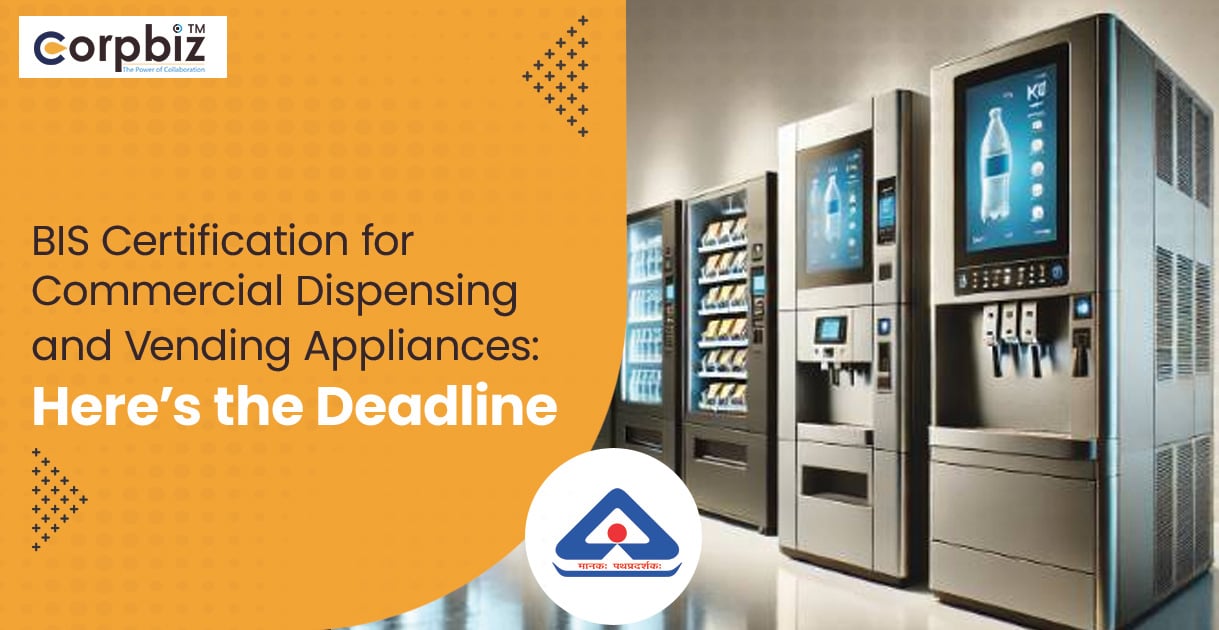
BIS Certification for Commercial Dispensing and Vending Appliances: Here’s the Deadline
(4.8)


Applicability of BIS Certification for Commercial Vending and Dispensing Machines
BIS certification is today applicable to a wide range of commercial vending and dispensing machines that are generally utilized in corporate offices, hospitality zones, healthcare facilities, shopping malls, and public areas. Some of the most affected categories include:
- Hot Drink Vending Machines – Used in offices, hotels, and public places.
- Cold Beverage Dispensers – Found at malls, food courts, and entertainment centers.
- Water Dispensers – Installed in offices, hospitals, schools, and airports.
- Snack and Food Vending Machines – Located in educational facilities, airports, and workplaces.
- Ice Dispensers – Used in restaurants, hotels, and hospitals.
- Juice Dispensers – Found in hotel breakfast buffets, event centers, and cafeterias.
Due to their heavy usage, these appliances are subject to stringent safety, performance, and energy efficiency standards, safeguarding consumers while reducing operating risks for businesses.
Exemptions and Special Provisions
The revised QCO acknowledges the need for flexibility in certain circumstances. As such, exemptions and special provisions apply to:
- Products Exclusively for Export:
Those manufacturers who produce appliances solely for export markets are exempt from BIS certification. The step promotes global trade by not allowing domestic regulations to become a drag on export competitiveness.
- Research & Development (R&D) Imports:
Firms conducting research can import 50 units annually without BIS certification. These units, however, shall not be sold and are to be disposed of post-testing.
While these exemptions give flexibility, manufacturers who sell in India must comply with BIS standards or face penalties.
Why BIS Certification is Crucial for Your Business?
BIS certification is a strategic advantage for manufacturers, distributors, and retailers rather than being just a regulatory requirement. Here’s why:
- Safeguards Consumer Safety:
Certified appliances are tested extensively to avoid electrical shock, overheating, and mechanical breakdown for the safety of users.
- Enhances Product Reliability:
BIS certification indicates durability and reproducible performance, giving customers confidence in the long-term reliability of a product.
- Grants Market Access:
Only ISI-marked appliances can be legally sold in India. Without certification, businesses are subject to market restrictions, recalls, and lawsuits.
- Boosts Brand Reputation:
ISI-marked products are seen as reliable and of better quality than their uncertified counterparts, and this makes the brands more competitive in a competitive marketplace.
- Reduces Legal and Financial Risks:
Non-compliance would lead to bans on products, hefty fines, and even litigation. Compliance with BIS protects businesses from legal problems.
- Encourages Global Competitiveness:
Certified appliances meet international safety standards, and expansion to the global market becomes more feasible and credible.
Step-by-Step Guide to Obtaining BIS Certification
Getting BIS certified can be a complex process, but breaking it down into key steps makes it easier:
STEP 1- Identify the Applicable Standard:
For vending and dispensing appliances for commercial use, the requirement is IS 302 (Part 2/Sec 75): 2018.
STEP 2- Choose the Suitable Certification Scheme:
Most manufacturers will fall under Scheme-I of the BIS Conformity Assessment Regulations, 2018.
STEP 3- Conduct Product Testing:
Your product must be tested by a laboratory recognized by BIS for conformity to safety and performance standards.
STEP 4- Submit Your Application:
You’ll need to provide:
- Laboratory test reports accredited by BIS
- Factory details and production processes
- Procedures for quality control in place
STEP 5- Factory Inspection:
BIS officials can visit your facility to assess:
- Manufacturing processes
- Quality control processes
- Raw material sourcing
STEP 6- Receive BIS Certification:
If your product meets all standards, BIS will issue the certification, and you can affix the ISI mark on your product.
Challenges Manufacturers Can Face
While BIS certification is compulsory, manufacturers may experience difficulties:
- High Compliance Costs:
For small and micro enterprises, certification can be expensive. The staggered deadlines, however, allow time for financial planning.
- Complex Documentation:
The application process requires detailed technical documentation, which can be intimidating. Working with regulatory experts simplifies this process.
- Time-Consuming Process:
Testing, inspection, and approval can take 6-8 weeks or more. Early preparation is necessary to avoid missing the compliance deadline.
Why Trust Corpbiz for BIS Certification?
BIS certification can be daunting to deal with. Therefore, Corpbiz ensures your commercial dispensing and wending appliances meet the latest BIS standards, including IS 302 (Part 2/Sec 75): 2018
➢ Personalized Consultation: Our experts will guide the manufacturers in choosing the right certification scheme.
➢ Accredited Lab Testing Support: We will help your business connect with BIS-approved laboratories
➢ Complete Documentation Support: From managing factory records and technical files to mitigating the risk of your application rejections, Corpbiz is there to guide you in every step.
➢ Factory Audit Preparation: Our team will prepare you for the BIS inspection, ensuring that your production processes and quality control measures pass on the first attempt.
➢ Handling Non-Conformity: In case any issue arises, you do not need to worry, as Corpbiz will help you in resolving the non-compliance issues promptly.
➢ Legal and Regulatory Support: We help you understand the penalties under the BIS Act, 2016 and ensure you avoid them by staying fully compliant.
➢ Extended Deadline Strategy: With the staggered deadlines for small and micro enterprises, Corpbiz plans a tailored compliance timeline to ensure you meet your industry-specific deadline.
➢ Cost-Efficient Solutions: We offer flexible pricing models, keeping certification affordable for businesses of all sizes, whether you’re a large manufacturer or a micro-enterprise.
➢ Post-Certification Support: Our service doesn’t end with certification; we assist with ISI mark usage guidelines, renewals, and compliance audits.
➢ Global Trade Advantage: For exporters, Corpbiz ensures BIS certification aligns with international safety norms, facilitating smoother global market entry.
➢ End-to-End Monitoring: From application filing to final license approval, we monitor every stage to ensure no delays or errors.
➢ Trusted by Industry Leaders: Corpbiz has a proven track record of helping top brands secure BIS certification for a range of commercial appliances, making us a trusted compliance partner.
To Wrap Up
The revised Quality Control Order (QCO) on commercial vending and dispensing machines is a game-changer for quality and safety assurance in India. Non-compliant companies are subjected to penalties, prosecution, and market prohibition.
To get ahead, manufacturers should initiate the process of BIS certification immediately to have a seamless transition prior to the April, July, and October 2025 deadlines.
If you’re unsure where to start, hiring compliance experts can make it easy, taking you through certification faster, more efficiently, and without unnecessary costs.
To protect your business from penalties, visit https://corpbiz.io/.
Frequently Asked Questions
What is the BIS certification requirement for commercial dispensing and vending appliances?
The Bureau of Indian Standards (BIS) has mandated that all commercial dispensing and vending appliances must comply with Indian Standard 302 (Part 2/Sec 75): 2018 and bear the ISI mark. This requirement ensures that these appliances meet strict safety, quality, and performance standards under the revised Quality Control Order (QCO), effective from October 17, 2024.
What are the compliance deadlines for different businesses?
The compliance deadlines are staggered based on business size:
– Large Enterprises: April 1, 2025
– Small Businesses: July 1, 2025
– Micro Enterprises: October 1, 2025
Non-compliance beyond these dates may result in fines, sales restrictions, and legal penalties.Are any businesses or products exempt from BIS certification?
Yes, there are exemptions under the revised QCO:
– Products Exclusively for Export are not required to obtain BIS certification.
– Research & Development (R&D) Imports can bring in up to 50 uncertified units per year for testing, provided they are not sold in India.What are the key benefits of obtaining BIS certification?
BIS certification offers multiple advantages, including:
– Ensuring consumer safety by preventing electrical and mechanical hazards.
– Enhancing product reliability with tested and certified quality.
– Granting market access, as only ISI-marked products can be legally sold in India.
– Boosting brand reputation and competitiveness in the marketplace.
– Reducing legal and financial risks by avoiding penalties and product recalls.What is the process to obtain BIS certification for vending and dispensing appliances?
The BIS certification process involves six key steps:
1. Identify the applicable standard (IS 302 (Part 2/Sec 75): 2018).
2. Choose the appropriate certification scheme (usually Scheme-l under BIS Conformity Assessment Regulations, 2018).
3. Conduct product testing at a BIS-recognized laboratory.
4. Submit an application with test reports, factory details, and quality control procedures.
5. Undergo a factory inspection by BIS officials.
6. Obtain BIS certification and affix the ISI mark to the product upon approval.
For assistance, Corpbiz provides end-to-end support to simplify the certification process.
Read our blog: Requirements of BIS Certification for the Food and Beverages Industry