

The startup ecosystem in India has grown very rapidly. India is currently one of the largest startup markets in the world. The number of DPIIT-recognized startups has also increased in the last few years. Due to funding, technology, digital adoption, and online business growth, new startups are being created almost every day.
The number of startup failures has also increased. Many startups are closing due to a lack of financial planning, despite having a good product. Many founders do not track cash flow properly. Some rely only on investor funding. So, if the business grows, the internal financial problems are not detected.
Investors will no longer only look at growth in 2026-2027. They are now paying more attention to profitability, cash runway, burn rate, and financial discipline. This is where MIS reports have become very important. MIS reporting helps founders understand the financial health of the business.
A VCFO can provide professional financial reporting and planning support to a startup at a comparatively low cost without a full-time CFO.
What is an MIS Report in a Startup?
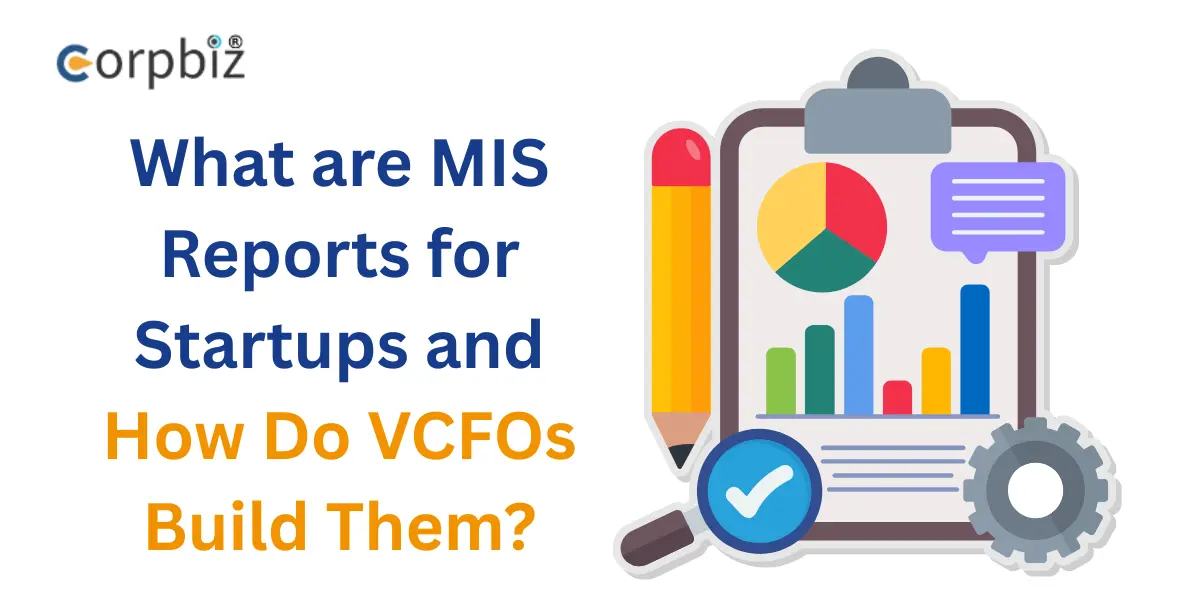
The full name of MIS is the Management Information System report. It is a report that shows the financial and operational data of a startup together. This report helps founders understand the real performance of the business.
A startup MIS report usually contains revenue, expenses, cash flow, burn rate, profit, customer metrics, and business KPIs. It shows the overall financial picture of the business in one place. So, the need to open separate spreadsheets and check data is reduced.
This report is usually used by:
- Founders
- Investors
- Board members
- Lenders
- VCFOs
Startups usually review MIS every month. This makes it easy to track monthly performance. The MIS reports also help a lot in future planning, hiring decisions, budgeting, and fundraising discussions. A clean MIS report also increases investor confidence.
Talk To Expert

Get Expert VCFO Support for Accurate MIS Reporting.
(4.8)


Why is Financial Visibility Important for Startups Today?
The startup funding market has become much more difficult than before. They now want to see the real numbers of the business. Especially, more questions are now asked about cash flow, profitability, burn rate, and runway.
Many startups fail due to a few common mistakes. For example:
1. Overspending
Many startups spend too much on hiring or marketing before their revenue is stable.
2. Ignoring Cash Flow
If they don’t have cash on hand, the business runs into problems.
3. Too Much Dependence on Funding
Many founders think that the next funding round will be easy. But if the funding is delayed, a big crisis will arise.
4. Lack of Financial Planning
If there is no proper budgeting and forecasting, founders cannot understand future risks in advance.
The MIS report is very useful here. It helps founders:
- Track burn rate
- Understand cash runway
- Monthly growth monitoring
- Prevent financial risk
Startups often run in a “flying blind” state without MIS. For example, a founder continues spending after seeing that there is money in the bank account, but after a few months, a sudden cash shortage starts. Then it becomes difficult to control.
Difference Between MIS Reports and Other Financial Reports
Many founders do not understand the difference between MIS reports and other financial reports. But each report has a different function. Some reports are mainly used for accounting, compliance, or investor updates.
The table below provides a simple comparison:
| Report Type | Purpose | Frequency | Main Audience |
| MIS Report | Business tracking and decision-making | Monthly | Founders, Investors |
| P&L Statement | Profit and loss calculation | Quarterly/Yearly | Accountant, Auditor |
| Balance Sheet | Assets and liabilities status | Yearly | Auditors, Lenders |
| Cash Flow Statement | Cash movement tracking | Monthly/Quarterly | Finance Team |
| Investor Report | Business update sharing | Monthly/Quarterly | Investors |
| Budget vs Actual Report | Planned vs actual performance comparison | Monthly | Founder, VCFO |
A good MIS report brings all this important data together in one place. So, founders can quickly understand the financial condition of the business. It helps to understand business.
Read more – How to Choose the Right Remote CFO Service Provider?
What are the Core Components of a Startup MIS Report?
Revenue Summary
The revenue summary is one of the most important parts of an MIS report. Here, the total income of the startup is tracked. Many businesses track revenue product-wise, customer-wise, or location-wise.
For SaaS startups, MRR (Monthly Recurring Revenue) and ARR (Annual Recurring Revenue) are very important metrics. They help in understanding future revenue stability.
It is also important to track net revenue here. Because looking at only gross sales does not give a true picture of the business. Actual revenue should be calculated by excluding refunds, discounts, and platform charges.
Expense Breakdown
In the expense breakdown section, all the expenses of the business are shown according to the categories. Generally, expenses are divided into two categories:
- Fixed expenses
- Variable expenses
Salary, office rent, software subscription, marketing cost, delivery expense, admin cost, etc., are tracked here. This helps founders understand where they are spending more time.
Burn Rate and Cash Runway
Burn rate means how much cash a startup is spending every month. “Runway” means how many more months the business can run with the available cash.
Suppose a startup has 10 crore and burns 10 lakh every month. Then the runway is about 10 months.
Currently, investors pay a lot of attention to the runway. Because a low runway means high funding pressure. Generally, an 18–24-month runway is considered healthy. Even if there is a startup funding delay, it is somewhat safe. The MIS report gives an early warning to founders if the burn rate suddenly increases.
Cash Flow Tracking
Many times, a business paper looks profitable, but there is no cash on hand. So, profit and cash flow are not the same thing.
The actual cash movement is tracked in the cash flow section. Here you can see how much money has come into the business and how much has gone out.
VCFO usually also creates a rolling cash flow forecast. This allows founders to understand in advance whether there may be a cash shortage in the future. This is a very useful planning tool for startups.
Startup KPIs and Unit Economics
Startup KPIs are very important in MIS reports. They help measure business performance.
Some common KPIs are:
- CAC (Customer Acquisition Cost): How much it costs to acquire a customer
- LTV (Lifetime Value): How much total revenue will come from a customer
- Churn Rate: How many customers leave the business
- Gross Margin: What is left after deducting direct costs from revenue
- AOV (Average Order Value): The average value of each order
- ARPU (Average Revenue Per User): The average revenue per user
Not all startups track the same KPIs. SaaS startups track churn and MRR more. On the other hand, e-commerce businesses track AOV and repeat orders more.
Budget vs Actual Analysis
This section compares planned performance and actual performance. Suppose the marketing budget was 5 lakhs, but the actual spend was 7 lakhs. This difference is called variance.
Variance analysis helps founders understand where there is overspending or underperformance. This improves future planning. It also helps maintain financial discipline.
Headcount and Salary Costs
The biggest expense of a startup is often employee salaries. So, tracking hiring costs is very important.
In the MIS report, department-wise employee cost and revenue vs. employee expense are compared. This easily catches unnecessary hiring.
Compliance and Statutory Status
Many startups ignore compliance while focusing on growth. GST, TDS, ROC filing, PF, and income tax status are tracked in the MIS report.
Why a VCFO Builds Your MIS Reports?
VCFO stands for Virtual Chief Financial Officer. It is a financial expert service that provides experienced financial leadership to startups without hiring a full-time CFO.
Many early-stage startups cannot afford a full-time CFO. Because an experienced CFO in India charges a huge amount per year. But VCFO offers the same kind of strategic support at a comparatively lower cost.
Full-Time CFO vs VCFO
- Full-Time CFO: ₹30 lakh–₹80 lakh annually
- VCFO Service: ₹15,000–₹100,000 monthly
So, many startups prefer VCFO services.
Why Do Startups Prefer VCFO Services?
VCFO doesn’t just handle accounting. They also help with the startup’s financial planning and business strategy.
A VCFO typically helps with:
- MIS reporting
- Budget planning
- Investor reporting
- Cash flow management
- Business forecasting
- Scenario analysis
- Cost control
- Financial strategy
The VCFO also helps create investor-ready reports during startup funding discussions.
Difference Between CA and VCFO
A CA mainly handles compliance and accounting work. For example:
- GST return filing
- Tax return
- Audit support
- ROC filing
VCFO works on business growth and strategy. They focus more on future planning, forecasting, and financial decision-making.
VCFO as a Financial Co-Pilot
Many founders do not come from a finance background. So, they have difficulty understanding numbers. VCFO acts as a financial co-pilot here.
They help founders understand:
- Where costs need to be reduced
- How much runway is left
- When should funding be raised
- Which business area is more profitable
This allows founders to make better decisions.
How a VCFO Builds an MIS Report Step by Step?
Step 1: Data Collection
The first step in creating an MIS report is data collection. VCFO collects data from various software and systems.
For example:
- Tally
- Zoho Books
- QuickBooks
- Banking systems
- CRM software
- Payroll tools
This brings financial and operational data together.
Step 2: Reconciliation and Validation
Then the collected data is verified. Bank statements and accounting records are matched.
If there is a duplicate entry, a wrong transaction, or missing data, it is corrected. This step is very important because the entire MIS report will be inaccurate if the data is wrong.
Step 3: Classification and Structuring
Then, revenue and expenses are divided into proper categories.
For example:
- Marketing cost
- Salary expense
- Software cost
- Admin expense
The VCFO reporting format is standardized so that the same structure can be followed every month.
Analysis and Variance Reporting
In this stage, the data for the current month is compared with the previous month and the budget. Unusual trends are easily detected with this. For example:
- Sudden expense increase
- Revenue drop
- Cash flow issue
The VCFO explains variance so that founders get a clear picture.
Management Commentary
MIS is not useful just by giving numbers. So, the VCFO explains the reason behind the numbers. They add business insights and recommended actions. This helps founders make decisions quickly.
Monthly MIS Review Meeting
Finally, the founder and VCFO held a monthly review meeting.
In this meeting, the following are discussed:
- Business performance
- Financial risks
- Cash runway
- Next month’s action plan
This helps a lot in improving the financial discipline of the startup.
How do MIS Reports Help During Fundraising and Investor Discussions?
Investors want to see proper financial reporting before investing in a startup. Just a business idea or growth story is no longer enough. Investors want to know the startup’s cash position, burn rate, revenue growth, and financial disciplines.
So, structured MIS reporting has become a very important part of fundraising. Many startups now create monthly board packs and investor MIS reports. These include financial summaries, KPI dashboards, cash runways, and growth metrics.
MIS reports are especially important in:
- Seed funding stage
- Series A funding
- Due diligence process
At the seed stage, investors want to see if the founder understands the numbers. Again, structured reporting becomes even more important at the Series A stage, because that’s when investors check detailed business performance.
During due diligence, 12–24 months of historical MIS data is usually requested. This allows investors to understand whether the startup is growing and how seriously the founder takes financial planning.
Consistent MIS reporting increases investor confidence. Clean and organized financial data makes a startup look more professional. It also helps in making funding discussions faster and smoother. Strong MIS reporting can also have a positive impact on startup valuation.
Types of MIS Reports for Different Startup Models
Not all startups have the same MIS reports. The reporting structure and KPIs vary according to the business model. An experienced VCFO usually customizes the MIS according to the startup industry.
SaaS Startups
Recurring revenue is very important for SaaS startups. So, the following metrics are usually tracked:
- MRR (Monthly Recurring Revenue)
- ARR (Annual Recurring Revenue)
- Churn rate
- Customer retention
- CAC payback period
These metrics help in understanding future revenue stability.
D2C and E-commerce Startups
Sales volume and customer behaviour are more important in e-commerce businesses.
Here are tracked:
- GMV (Gross Merchandise Value)
- Return rate
- Repeat purchases
- Average order value
- Marketing ROI
This helps you understand which marketing channel is more profitable.
B2B Service Startups
Client profitability and payment cycle are very important in B2B startups.
Typically tracked:
- Client-wise revenue
- Receivables aging
- Employee utilization
- Project profitability
Late payment risk is also closely monitored here.
Manufacturing Startups
The MIS of manufacturing startups is a little different.
The focus here is on:
- Inventory tracking
- Production cost
- Raw material expense
- Working capital management
This makes it easier to understand operational efficiency.
Marketplace Platforms
Marketplace follows a transaction-based business model.
Commonly tracked here are:
- Transaction value
- Take rate
- Seller growth
- Buyer activity
- Order frequency
These metrics help understand platform growth.
Read more – What is the role of a CFO in high-growth Businesses?
Latest MIS Reporting Trends in 2026–2027
Startup financial reporting has become much more modern in 2026–2027. Founders now want real-time financial visibility
Many startups are currently using live financial dashboards. This allows revenue, cash flow, expenses, and burn rate to be seen instantly.
AI-powered reporting and automation are also very popular now. AI tools are now helping with automatic categorization, anomaly detection, and forecasting. This reduces manual work and increases reporting speed.
Another big trend is predictive cash flow forecasting. This can identify future cash shortages or overspending risks in advance.
Many startups are now using cloud accounting systems. For example:
- RazorpayX
- Zoho Books
- QuickBooks
- Tally Prime
- BI dashboards
These tools can be integrated with banking, payroll, and CRM systems. So, data is automatically synced.
Modern startups no longer want to wait for month-end reports. Because delayed reporting leads to delayed decisions. Live reporting helps founders understand business performance in real-time. This improves both financial control and planning.
What are the Common MIS Reporting Mistakes Startups Should Avoid?
Many startups create MIS reports, but some common mistakes reduce the actual value of the report. It is very important to avoid these mistakes.
- Reporting Too Late
Many startups create MIS reports long after the end of the month. Then it is too late to make data decisions for the report.
- Tracking Vanity Metrics Only
Just tracking app downloads or social media followers does not give a true picture of the business’s financial picture.
- Inconsistent KPI Definitions
Calculating revenue one way one month and doing it differently the next month makes reporting unreliable.
- No Variance Analysis
Overspending is not easily detected if you do not compare the budget and actual performance.
- Ignoring Cash Flow
Just looking at profit is not enough. The actual cash position should also be monitored.
- Spreadsheet Dependency
Using only an Excel sheet without a proper system increases the chance of errors.
- Lack of Commentary
Founders do not get clear insight if the numbers are not explained.
- Ignoring Compliance Tracking
Legal risk increases if GST, TDS, or ROC filing is missed.
How Can Corpbiz Help Startups Build Strong Financial and Compliance Systems?
Corpbiz provides various professional services to simplify financial reporting and compliance management for startups. Many early-stage startups cannot build a proper finance team.
Our Services:
- VCFO services
- MIS reporting
- Financial planning
- GST registration
- Company incorporation
- ROC compliance
- Startup India registration
- Accounting and bookkeeping
- Tax compliance
- Payroll management
- Funding and due diligence support
Corpbiz also helps create investor-ready financial systems. We help startups maintain structured reporting. Clean financial records help increase investor confidence during fundraising.
Conclusion
A startup business does not only run on growth. Financial discipline and proper reporting are now equally important. So, MIS reporting is now not optional for startups but rather necessary.
Founders need to track regularly:
- Cash position
- Expenses
- Revenue growth
- Burn rate and runway
- Profitability
An MIS report helps to make faster and smarter decisions by bringing all this information in one place. This helps to understand business risks and improve financial planning.
A VCFO helps startups maintain structured reporting, forecasting, and financial control. This helps founders understand business numbers better.
Corpbiz helps startups build sustainable growth from the start with strong financial reporting, compliance management, and VCFO support.
Popular Queries About MIS Reports for Startups
What does MIS stand for in a startup?
The full name of MIS is Management Information System. So, it is a business report. Here, the startup's income, expenses, cash flow, and important business numbers are shown together. Founders can understand the status of the business by looking at this report. Investors also want to see this report many times.
Why do startups need MIS reports every month?
A lot of changes happen in a startup every month. Some sales increase, and some expenses increase. A monthly MIS report helps founders to easily understand the business. It shows how much cash is available, how much is being spent, and whether there is a profit. If there is a problem, it is caught early. So, the monthly MIS report is very useful.
What is included in a startup MIS report?
A startup MIS report usually contains revenue, expenses, cash flow, and business KPIs. It may also contain burn rate, runway, salary cost, and compliance details. Some startups also add customer data. The founder can understand the entire financial picture of the business in one place by looking at this report. So, there is less need to look at separate files.
What is the difference between MIS and accounting reports?
Accounting reports are mainly prepared for tax, audit, and compliance. But MIS reports are used for making business decisions. MIS reports not only contain accounts but also show business performance. This helps the founder understand where there is more spending or where growth is decreasing. So, accounting reports show the past, and MIS reports help in future planning.
How does a VCFO help startups?
VCFO helps in managing the financial planning of startups. They prepare MIS reports, monitor cash flow, and do budgeting. They also help prepare reports for investor meetings. Many founders do not understand finance very well. The VCFO then explains the numbers in a simple way to make business decisions.
How much does a VCFO service cost in India?
In India, the cost of VCFO services can generally range from ₹15,000 to ₹100,000 per month. If the startup is small, the cost is lower. If more reporting or funding support is required, the cost may increase. Still, it is much cheaper than hiring a full-time CFO. So, many startups choose VCFO services.
Which startups should use MIS reporting?
Almost all startups should use MIS reporting. SaaS, D2C, fintech, manufacturing, and service businesses can all use it. Even if the startup is small, financial tracking is important. If MIS reporting is done from the beginning, future planning becomes easier. You can also talk to investors professionally.
What software is commonly used for MIS reporting?
Many startups use Tally, Zoho Books, and QuickBooks for MIS reporting. Some also use Excel or Google Sheets. Large startups often use Power BI dashboards. It is easy to track revenue, expenses, and cash flow with this software. It keeps reporting fast and organized.
Can Corpbiz help with startup compliance and reporting?
Yes, Corpbiz provides reporting and compliance support for startups. We provide VCFO service, GST registration, ROC filing, and accounting support. We also help with Startup India registration and tax compliance. This makes financial management easier for founders. It also helps to maintain investor-ready reporting.
Read more – What are the Benefits of Virtual CFO with ERP?