

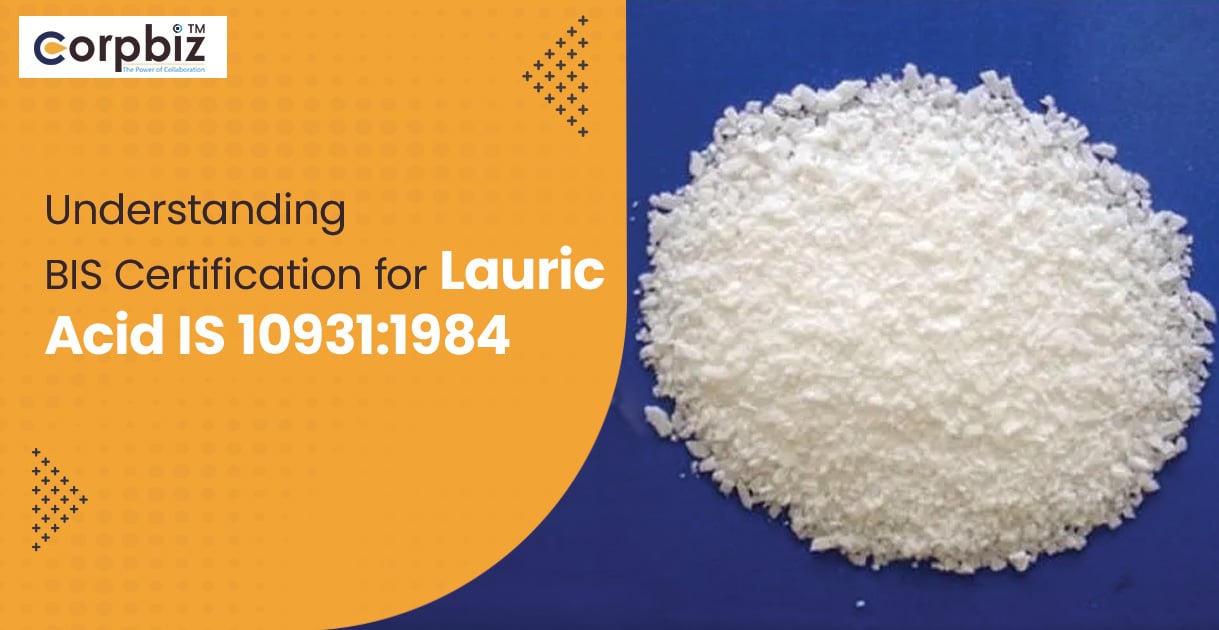
Compliance with national standards is no longer just a matter of regulation in today’s competitive manufacturing environment, it’s a strategic advantage. An example of a key standard in India is that of Lauric Acid, which is regulated by the Bureau of Indian Standards (BIS) under IS 10931:1984. For lauric acid manufacturers as well as traders, understanding what certification entails is essential to uphold legal compliance, ensure quality, and establish market trust.
This blog discusses the major aspects of BIS Certification for Lauric Acid, its applicability, test procedures, advantages, and its overall effect on manufacturers as well as consumers.
What is Lauric Acid and Why is It Regulated?
Lauric acid is a saturated medium-chain fatty acid found mainly in coconut oil and palm kernel oil. It is applied extensively in a variety of sectors—ranging from cosmetics and personal care to food processing and industrial applications. Due to its extensive use and versatility, ensuring the purity, safety, and consistency of lauric acid becomes a priority.
That’s where BIS Standard IS 10931:1984 come in. The standard establishes quality requirements, test procedures, and packing and marking requirements to ensure the lauric acid produced or sold in India complies with nationally recognized standards of safety and quality.
The Legal Backbone – IS 10931:1984
IS 10931:1984 outlines the specific requirements that lauric acid has to meet in order to be legally produced, traded, or sold in India. According to the BIS Conformity Assessment Scheme, the product is subject to mandatory certification. This implies that manufacturers are obligated by law to obtain BIS certification prior to marketing their product in the Indian marketplace.
In order to be compliant, the product has to bear the ISI mark, indicating it has been tested and certified as per the Indian Standard. Not only does the certification assure customers of the quality of the product, but it also safeguards companies from legal repercussions and reputational damage.
Talk To Expert

Understanding BIS Certification for Lauric Acid IS 10931:1984
(4.8)


The Manufacturing Process and Quality Requirements
Lauric acid has to be obtained by careful hydrolysis or splitting of lauric-rich oils such as coconut oil or palm kernel oil for a manufacturer to be eligible for certification under IS 10931:1984. The process entails separating fatty acids in a controlled and precise process to ascertain that the end product conforms to the purity standards laid down by BIS.
This is not merely a matter of technical correctness—it’s a matter of delivering a high-performing product that is safe for the end-user. Any deviation other than following the specified process or requirements can result in rejection of the certification or revocation of a granted license.
Mandatory Testing Requirements
The manufacturers are required to get their products tested prior to certification according to the prescribed methods under IS 10931:1984. The product is tested to confirm that it meets the quality standards. The key tests are:
- Test for Mineral Acidity: This checks for the absence of unwanted mineral acids that may impact usability and safety.
- Determination of Ash Content: Quantifies inorganic residue left after burning, indicating the level of purity of the acid.
These tests should be done in a BIS-recognized laboratory, either in-house or by a certified third-party lab. BIS auditors will also examine the manufacturer’s lab capabilities, production process controls, as well as documentation procedures during certification.
Packaging and Labeling Guidelines
Compliance is not limited to product formulation. IS 10931:1984 also stipulates instructions for packaging and marking. Lauric acid has to be packed in suitable containers that are properly sealed to avoid contamination or leakage. Each container needs to be labelled as follows:
- Name of the material
- Grade of the material
- Net mass
- Batch number or lot number
- Month and year of production
- Manufacturer’s name and trademark
- ISI mark (upon certification)
They assist in traceability, increase transparency, and notify buyers of the origin and compliance status of the product.
Steps to Obtain BIS Certification for Lauric Acid
The BIS certification process for Lauric Acid is methodical that entails the following steps:
- Application Submission:
The manufacturers are required to apply under the ISI Mark Scheme (Scheme I). The application must be accompanied by detailed information regarding the manufacturing process, quality control measures, and test reports.
2. Inspection of Manufacturing Unit:
BIS officials undertake a stringent inspection of the manufacturing unit. This ranges from assessing infrastructure, raw materials supplies, processing procedures, quality assurance mechanisms and the in-house test facilities.
3. Sample Testing:
The samples are tested in a lab approved by BIS. The findings should be as per the standards specified under IS 10931:1984.
4. Certification Grant:
Once all the requirements are met, a license is issued by BIS to permit the manufacturer to place the ISI mark on its product packaging.
5. Surveillance and Renewal:
After certification, periodic audits and tests are carried out by BIS to verify continued conformity. The license can be cancelled or suspended if the product does not conform to ongoing quality standards.
Why Product Testing Matters?
The key to BIS certification is reliable product testing. This is not a bureaucratic barrier, rather, it’s a key step that underscores a product’s quality, safety, and marketability. Here’s why testing is indispensable:
- Assures Quality: Ensures that the product is in conformance with performance and safety standards.
- Increases Market Trust: A tested product carries credibility in the eyes of customers, investors, and business associates.
- Facilitates Prototyping and Scale-Up: Testing during the initial stages achieves funding, IP protection, as well as support for mass production.
- Enhances Product Design: Identifies probable flaws and facilitates the improving durability under actual use.
- Compliance with Regulations: Demonstrates compliance with regulations, thereby minimizing the chance of recall or fine.
Whether you are targeting the domestic market or shipping from India, product testing validates your credibility and reduces business risk.
Benefits of BIS Certification for Lauric Acid
Apart from compliance, BIS registration for Lauric Acid offers several business advantages:
- Legal Protection:
Uncertified products may expose enterprises to penalties, product recall, or prohibition. Protection from such risks is offered by certification.
2. Brand Reputation:
An ISI mark on a product serves as a proof of quality. It generates consumer confidence and reinforces the brand image.
3. Market Access:
Certified products enjoy easier entry into government tenders, retail supply chains, as well as institutional buyers who tend to mandate BIS-approved products.
4. Customer Retention:
A consistent standard of quality supports in maintaining the trust within the existing customers and encourages repeat business.
5. Competitive Advantage:
Where multiple players exist, certification distinguishes a brand by demonstrating commitment to reliability and safety.
Risk of Non-Compliance
Violation of any standard outlined under IS 10931:1984 can result in serious repercussions:
- Legal Penalties: Fines and Sanctions by regulatory bodies.
- Loss of License: BIS may revoke certification for quality lapses.
- Market Bans: Exclusion from tenders or channels of distribution.
- Reputation Damage: Loss of business and consumer trust.
Conclusion
Trust in the realm of chemical and industrial manufacturing is built upon standards. BIS Certification of Lauric Acid, according to IS 10931:1984, is not just a legal checkbox but a badge of commitment to safety, quality, and responsibility.
Certification for manufacturers means market acceptance, business expansion, and regulatory peace of mind. For consumers and business associates, it means a product that they can rely upon.
If you produce or sell lauric acid in India, BIS certification is not optional, it’s mandatory. Investing in this step builds your brand, gains customers’ trust, and positions your product well to meet every standard that matters.
Visit https://corpbiz.io/ and secure BIS certification for Lauric Acid.
Frequently Asked Questions
What is BIS Certification for Lauric Acid, and why is it required?
BIS Certification for Lauric Acid under IS 10931:1984 is a mandatory requirement for manufacturers in India. It ensures that the product meets national safety and quality standards. The certification, granted by the Bureau of Indian Standards (BIS), also allows the use of the ISI mark on packaging, indicating legal compliance and market credibility.
What are the key tests conducted during BIS Certification for Lauric Acid?
Lauric acid must undergo mandatory testing, including:
● Test for Mineral Acidity to detect unwanted mineral acids.
● Determination of Ash Content to assess the purity level.
● These tests must be conducted in BIS-recognized labs to ensure the product meets the criteria outlined in IS 10931:1984.What are the packaging and labeling requirements under IS 10931:1984?
Lauric acid must be packed in sealed, contamination-proof containers. Each container must be labeled with:
● Product name and grade
● Net mass and batch/lot number
● Month and year of manufacture
● Manufacturer's name and trademark
● ISI mark (post-certification)What are the benefits of obtaining BIS Certification for Lauric Acid?
BIS Certification provides multiple advantages:
● Legal protection from regulatory penalties
● Enhanced brand reputation through the ISI mark
● Easier access to government tenders and retail chains
● Increased customer trust and market competitivenessWhat are the consequences of non-compliance with IS 10931:1984?
Non-compliance can lead to:
● Legal penalties and sanctions
● Revocation of BIS license
● Market bans or exclusion from tenders
● Damage to brand reputation and customer trust
Read Our Blog: Understanding BIS Certification for Baby Products in India