
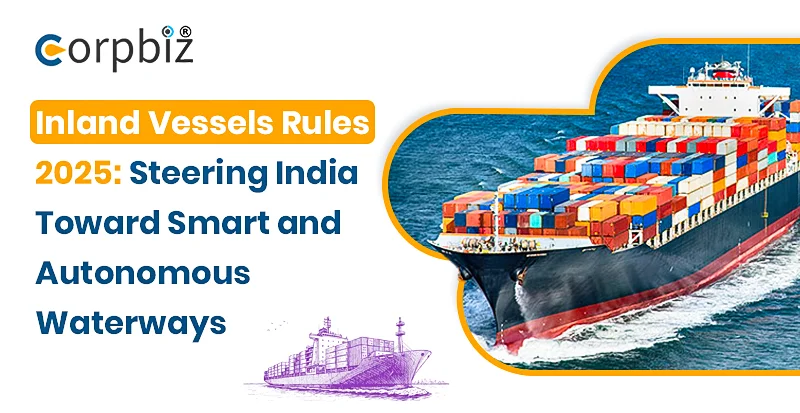
India’s inland waterways are emerging as an important mode of transport and trade. Transporting goods and passengers through rivers, canals, and inland waterways is much more cost-effective, environmentally friendly, and sustainable than roads and railways. According to the Inland Vessels Act, 2021 (Act), the government is now moving towards smart and automated ship technology to harness this potential more effectively.
These new generation ships are propelled with modern sensors, GPS, and automated control systems. This reduces human dependency and ensures safe and accurate navigation. The Inland Vessels Rules 2025 have emerged as an important legal step. These rules will govern the design, construction, operation, and certification process of automated and semi-automated ships operating on inland waterways. These rules also ensure every smart vessel follows the same safety and operational standards across the country. Environmental clearance is also crucial in this segment.
In this blog, we will discuss how the Inland Vessels Rules 2025 are pointing a new direction towards making India’s shipping system technology-driven and safe. It helps to make inland waterways a core part of modern transport.
What are the Inland Vessels Rules 2025?
The Inland Vessels Rules 2025 are draft rules made by the Ministry of Ports, Shipping & Waterways (MoPSW) under the Act. These are designed for special category vessels operating in the inland waterways of India. This category mainly includes two types of vessels-
1. Autonomous vessels: Fully automated vessels that do not have or have limited onboard crew and minimum manning and are controlled remotely.
2. Semi-autonomous vessels: Inland vessels that are controlled through advanced automation technology but have some crew present for supervision.
The main objective of these rules is to bring technology-based and smart shipping within a disciplined framework. Also, the Ministry of Ports, Shipping & Waterways (MoPSW) is responsible for implementing these rules. It is working to make the country’s inland shipping system compatible with international standards. The government hopes to create a coherent and safe policy framework for the smart shipping system of the future.
Talk To Expert

Inland Vessels Rules 2025 Talk to Corpbiz experts now.
(4.8)


Importance and significance of Inland Vessels Rules 2025
Have a look at the importance as well as significance of Inland Vessels Rules 2025-
1. Encouraging innovation and providing legal clarity
These rules provide a clear legal framework for the operation of automated and semi-automated ships. So, new opportunities will be created for technological innovation, and emerging ship technologies will come under a well-regulated system.
2. Increasing safety and reducing accidents
The rules have set specific standards for the stability, navigation, communication, and signaling systems of ships. This will reduce the risk of accidents and make the transportation of passengers and goods safer.
3. Ensuring consistency across states
Earlier, different rules were in force in different states, but now the same rules will be applicable in all states under a national framework. This will make interstate shipping easier and more efficient.
4. Increasing investor confidence and developing the IWT sector
Clear rules and a certification process will increase investor confidence. This will create more commercial opportunities in inland waterways and reduce transportation costs.
5. Alignment with international standards
The rules are consistent with international standards such as ISO, BIS, and International Classification Societies. This will bring India’s waterways up to global standards and make the export and logistics sector more competitive.
6. Facilitate Inter-state movement:
A Certificate of Fitness issued in one state will be valid in another state as well under this rule. This will be possible through the Jalayan/Navik database, thus facilitating the movement of vessels across state borders.
7. Future Technology Readiness: With the advancement of automation and robotics, these rules bring under control the management of unmanned or remotely operated vessels so that India’s inland waterways are future-ready.
Read more:- What Projects Require Environmental Clearance in India?
Scope and Applicability of the Inland Vessels Rules 2025
Inland Vessels Rules 2025 have set new standards for modern, automated, and technology-based vessels operating in the country’s inland waterways. The main areas of application are explained below in simple terms-
1. Special category vessels
Under rule 3 (1), these rules are mainly applicable to two types of vessels-
Fully Autonomous Vessels: They are operated remotely and do not require an onboard crew.
Semi-Autonomous Vessels: They operate on advanced automation systems but have some crew for supervision.
2. Dual Regulatory Framework
Under rule 3(2), these vessels will have to comply with additional rules related to automated technology in addition to the general Inland Vessel Rules. They will have to comply with the new automation standards in addition to complying with basic safety, design, and registration rules.
3. Design and Construction Standards
Rule 3(3)(a): It is mandatory to follow the Inland Vessels (Design & Construction) Rules, 2024, in the design and construction of vessels.
Rule 3(3) b: In the case of automation or other parts, the standards of BIS, ISO, or recognized classification societies should be followed.
Rule 3(3) c: The vessel owner has to declare in Form No. 1, mentioning the standards used.
This ensures the ship’s structure and technology are safe and reliable as per international standards.
4. Manning or Crew Requirements
Rule 3(4)(a): The designated authority shall determine the required crew strength through a risk-based assessment, taking into account the level of automation, area of operation (cargo/passenger/survey/other), type of voyage, and duration.
Rule 3(4)(b): As per the Inland Vessels (Manning) Rules, 2022, a semi-autonomous vessel shall have at least one master, one engine driver, and one G.P. rating.
Rule 3(4)(c): Fully autonomous vessels may be operated unmanned with the approval of the authority, but remote monitoring and shore-based support shall be mandatory.
Rule 3(4) (d-e): Existing rules require crew training and certification; if a crew is not available, real-time communication and surveillance must continue.
Survey and Certification Process
Rule 3(5): Each special class of ship will have to be designed and maintained under the supervision of a recognized classification society by Rule 4 of the Design & Construction Rules, 2024.
Rule 3(6) (c,d): A Certificate of Fitness will be issued only after complying with all the rules (design, construction, automation, navigation, and safety).
6. Thresholds and Transition period for existing versus new vessels
Rule 3(6)(a): Semi-autonomous or autonomous vessels in operation before the entry into force of this rule may continue to operate as before unless they are subject to significant changes.
Rule 3(6)(b): They must comply with the standards for stability, redundancy, communication and fail-safe systems within two years of the entry into force of this rule.
Rule 3(6)(c): New vessels must comply with all the rules in full from the outset. If they do not comply, no certificate will be issued.
Previously operating automatic or semi-automatic ships will have to comply with the new rules within a specified period. However, newly registered ships will have to fully comply with the rules from the beginning.
Interstate Recognition with Other Special Category Rules
Rule 3(7)(a): Where a vessel falls under more than one special category, all the relevant rules shall be complied with as far as possible.
Rule 4(3): Certificate of Fitness issued by the home state shall be valid in other states through the Jalyan/Navik database.
A fitness certificate issued in one state will be valid throughout the country. This process will be managed through a central database called Jalyan/NavIC so that all the information is digitally integrated.
Safety, Certification, and Inspection System for Inland Vessels Rules 2025
The Inland Vessels Rules 2025 have detailed provisions to make the safety and certification process of ships stronger and more transparent.
Read more:- Relevance of Social Impact Assessment (SIA) in Environmental Clearance
Rule 4(1): Safety equipment and load line requirements
Every vessel shall be equipped with safety equipment and safety devices suitable for its area of operation. The maximum carrying capacity of the vessel shall be determined according to certain criteria, such as the safety load line or load line limit, to ensure the ability to float and a safe journey. This carrying capacity information is mandatory to be mentioned in the Certificate of Fitness.
Rule 4(2): Appointment of Authorized Officer and Issue of Fitness Certificate
The State Government shall appoint an authorized officer to inspect, survey, and issue certificates for the implementation of this rule. The owner or operator of the vessel shall apply as per Form No. 2. If the officer is satisfied that the vessel complies with the safety, structure, stability, equipment and load line criteria, then issue a Certificate of Fitness as per Form No. 3.
Rule 4(2A): Conditions and Renewal of Certificate
A certificate may be issued subject to certain conditions, such as valid survey and insurance certificates, payment of required fees, and completion of the inspection and renewal process within the prescribed time. In case of multiple special categories, a combined Certificate of Fitness may be issued.
Rule 4(3): Inter-State Movement and Exchange of Information
A Certificate of Fitness issued by the home state shall be valid in other states if previously informed and the prescribed conditions are fulfilled. The Central Government shall ensure the exchange of information and interoperability of certificates between states through the Jalyan/NavIC central database.
Rule 4(4) and 4(5): Inspection by Surveyor and Penalty Action
The surveyor engaged may inspect the structure, components, or equipment of the vessel at any time. The owner or operator shall cooperate in the inspection and provide necessary information. If any irregularity is found, a notice for rectification shall be issued.
If rectification is not done within the mentioned time, the state government may suspend or cancel the Certificate of Fitness in writing. If the certificate is revoked, the vessel will not be able to operate until it is reauthorized.
The state maritime authority and MoPSW will jointly implement these processes to ensure uniform standards for inland waterway management across the country.
What are the Obligations and Responsibilities of Vessel Owners?
Every vessel owner or operator has to fulfil certain duties to ensure safe and orderly operation, according to the Inland Vessels Rules 2025.
Safe Operation
The vessel must always be operated in accordance with its Certificate of Fitness. It must operate within the prescribed standards and limitations so that passengers, cargo, and crew are all safe.
Preservation of necessary documents
Every vessel must have a certificate of registration, a survey report, insurance papers, a fitness certificate, and a pollution prevention permit. These documents must always be kept readily available for verification.
Real-time monitoring system
In the case of automatic or semi-automatic vessels, owners must ensure that the remote monitoring and communication system is always active. The movement, systems, and position of the vessel can be monitored in any situation.
Fault and accident reporting
If any fault occurs in the vessel’s equipment or navigation system, it must be reported to the authorities immediately, and prompt repair measures must be taken.
Penalties and Liability
As per Section 87, if an accident occurs due to non-compliance with the rules or careless operation, the owner or operator will be legally liable. If necessary, fines, license suspension, or criminal action may be taken.
These responsibilities ensure that every vessel on inland waterways is operated safely, legally, and responsibly.
Read more:– Importance of Environmental Clearance Process in Today’s India
Role of Technology in Modernizing Inland Water Transport
The Inland Vessels Rules 2025 have ushered in a new era in India’s inland waterways. Here, the transportation system is being made more efficient, safe, and sustainable through the use of technology.
Digital Technology and Automation
The new rules have given importance to the use of artificial intelligence (AI), sensors, GPS, and automatic navigation technology. These technologies will help in real-time monitoring of vessels, assessment of equipment condition, and early detection of possible faults.
Remote Monitoring Center
A remote operation center is being set up to ensure the safety and movement of automated vessels. These centers will provide 24-hour monitoring, guidance, and emergency response.
NavIC and Jalyan connectivity
All inland vessels in the country will be connected to the NavIC satellite system and Jalyan database. This will enable monitoring of vessel positions and activities across the country on a single platform, enhancing transparency and security.
Economic and safety benefits
Automation technology reduces operational costs, reduces the risk of human error, and increases transport efficiency. This initiative will attract private investment and make waterway transport more profitable.
Alignment with international standards
India is now moving with the Maritime Autonomous Surface Ships (MASS) initiative of the IMO (International Maritime Organization). This will bring the domestic shipping system up to global standards and strengthen India’s position in international vessel regulation.
Thus, the incorporation of technology is making inland waterway transport smarter, safer, and more environmentally friendly.
Economic and Environmental Benefits of Inland Vessels Rules 2025
Inland Vessels Rules 2025 will make inland waterway transport more cost-effective and environmentally friendly. These rules will reduce India’s logistics costs and will be an important step towards sustainable development.
Lower logistics costs: Waterways will ensure an efficient transport system at a much lower cost than road or rail for the transport of large-sized goods.
Energy saving and low carbon emissions: The use of automated and modern ships will reduce fuel costs and significantly reduce the carbon footprint. Getting carbon footprint calculation consulting is helpful to measure the impact.
Reduction in accidents and traffic congestion: If a part of the goods transport is shifted to waterways, road accidents and traffic congestion will be reduced to a great extent.
Employment generation: New job opportunities will be created in the fields of marine technology, remote monitoring centers, and ship design.
Supporting the goal of a green and blue economy: This initiative will make waterway transport more sustainable and environmentally friendly with India’s Green Shipping Mission and Blue Economy Policy.
Challenges and Future Directions of Inland Vessels Rules
There are some challenges in the implementation of the Inland Vessels Rules 2025. Lack of experience in operating automated vessels, shortage of skilled manpower, lack of adequate infrastructure, and high initial investment are some of them.
Some practical steps need to be taken to address these challenges:
- Pilot projects can be conducted in a joint initiative of the government and the industry.
- Special research and innovation (R&D) support for smart vessel technology should be increased.
- There is a need to create skilled human resources by starting training programs under DG Shipping and IWAI.
- Opportunities for technology application should be increased by increasing automation zones in a phased manner.
If these steps are implemented, these 2025 rules will bring transformative change to the Indian waterways sector and usher the country into a new era of modern shipping.
Conclusion
Inland Vessels Rules 2025 is a major step towards making Indian waterways more modern, safe, and environmentally friendly. These rules clearly highlight the use of new technologies, safety standards, and sustainable development in ship operations. This will boost the country’s trade and transport system and create new employment opportunities.
Ship owners and operators need to understand the rules well and complete the necessary certifications now.
Corpbiz is ready to help you in this process. Our expert team will help you with registration or any other regulatory requirement. Contact us today and take your waterway business forward in the right direction.
Read more:- How to Obtain Environmental Clearance for Mining Projects?
Top Questions Regarding Inland Vessels Rules 2025
What is the National Waterways Act, 2025?
The National Waterways Act, 2025, is a new law for the development of waterways in India. It aims to use the country's rivers and canals in a safer, more efficient, and environmentally friendly way of transportation. This law also emphasizes bringing modern technology and good governance to waterway management.
How many National Waterways are there in India in 2025?
As of 2025, there are a total of 111 National Waterways in India. These waterways connect different parts of the country. These play a major role in the transport of goods and passengers. The government are running various projects for their maintenance and development.
What is the new Maritime Act of 2025?
The new Maritime Act of 2025 has been made to modernize the maritime and waterway transport sector in India. This act includes issues of safety, use of technology, environmental protection, and maintaining international standards. It will bring a big change in the maritime sector of the country.
What are the Inland Vessels Rules, 2025?
The Inland Vessels Rules, 2025, are the rules proposed under the Inland Vessels Act, 2021. They aim to regulate the design, safety and certification of semi-automatic and automatic vessels. These rules will make the movement of technology-based vessels safer and more regular.
What is the difference between automatic and semi-automatic vessels?
Automated vessels are fully digital and have no crew. On the other hand, semi-automated vessels have a limited crew that monitors and intervenes when necessary, during the voyage.
What is the role of the Jalan/Navik database?
Jalan/Navik is a central database where information about all vessels is stored. Verification of vessel certificates, real-time tracking, and exchange of information between states can be done through this. It makes management easier, and transparency is also maintained.
What happens if a vessel does not comply with these rules?
If a vessel does not comply with the prescribed rules, its Certificate of Fitness can be cancelled or suspended. In serious cases, fines or bans on operation can also be imposed. This measure is taken so that the vessels are quickly revised as per the standards.
What documents are required to be maintained by the vessel owners?
The vessel owners are required to maintain a Certificate of Registration, Certificate of Fitness, Certificate of Survey, valid insurance, and Pollution Prevention Certificate. These documents will have to be produced during inspection if the authorities so request.
When will the Inland Vessels Rules 2025 come into effect?
These rules are currently in draft form, and public comments are being sought. After final approval, the Ministry of Ports and Shipping will notify them. The rules will come into effect across the country after this.