
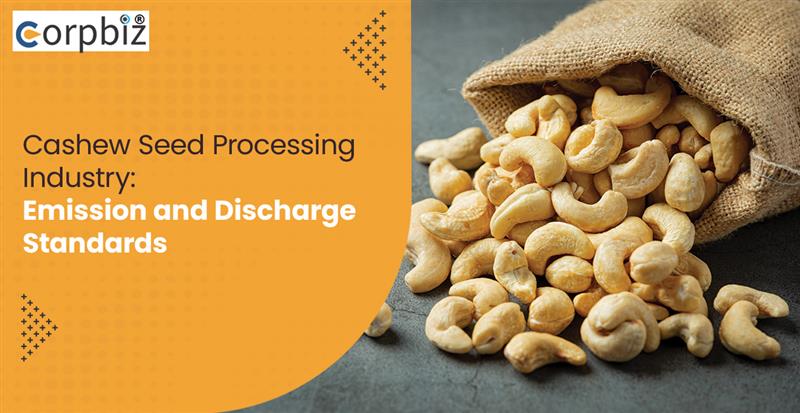
Cashew Seed Processing Industry: Emission and Discharge Standards
Cashew seed processing is an important agro-based industry concentrated in the coastal regions of India. This sector also contributes significantly to export earnings. However, as the scale of processing increases, the concern for environmental impact also increases, especially air emissions, wastewater discharge, and solid waste management.
Therefore, the government of India laid down specific standards for emission or discharge of environmental pollutants under the Environment (Protection) Act, 1986, which cashew seed processing units must follow. These standards control pollution and ensure environmentally friendly processing.
If you are in the industry or planning to start one, it is mandatory to understand and comply with these rules; otherwise, you could face penalties, closure notices and legal troubles.
General View of Cashew Seed Processing Industry
Cashew seed processing is a labour-intensive and export-oriented industry that is more active in coastal states of India such as Kerala, Goa, Maharashtra, Andhra Pradesh, Tamil Nadu and Odisha. India’s cashew export market is counted among the world’s largest, and this agro-industry employs lakhs of workers, especially the women workforce.
Cashew nut processing is the work of converting raw cashew nuts into an edible form. Its process takes place in multiple stages:
- Roasting or Steaming- raw nuts are heat-treated so that the shell becomes soft and the nut is not damaged.
- Shelling- theshell is removed by hand tools or machines.
- Peeling- thethin Testa layer is removed.
- Grading- Nuts are separated based on size and colour.
- Packing – moisture-proof packaging is available for both export and domestic markets.
This industry not only earns foreign exchange by exporting to countries like the USA, UAE, Netherlands, Japan, Saudi Arabia, etc., but during processing, there are also environmental challenges of air pollution, wastewater generation, and solid waste management.
For this reason, the government has established specific emission and discharge standards, ensuring the cashew industry maintains environmental safety while generating profits.
Talk To Expert

Cashew Seed Processing: Emission & Discharge Rules
(4.8)


Why Environmental Standards Matter for the Cashew Seed Processing Industry?
Look, there are multiple stages in cashew processing, roasting, shelling, peeling, grading, and packaging, and each stage has its environmental impact.
- Air pollution occurs from roasting, especially from smoke and shell oil vapours.
- Wastewater pollution occurs from the grading and washing stages.
- Solid waste is generated in the form of shells, husks, and dust.
If these pollutants are released directly into the environment without treatment, they contaminate water bodies, degrade air quality, and create occupational hazards.
That is why the government has established specific permissible limits, enabling the industry to balance environmental care with profit.
Air Emission Standards for Cashew Seed Processing
The major emission in cashew seed processing is from the roasting stage. At this stage, Cashew Nut Shell Liquid (CNSL) vapours and smoke are released, which are harmful.
According to Government standards:
- Particulate Matter (PM): The Maximum limit is 150 mg/nm3 (milligrams per normal cubic meter).
- Sulphur Dioxide (SO2): should not exceed 100 mb/nm3.
- Odour control: proper chimney height and use of air pollution control devices (like wet scrubbers, cyclones) is mandatory.
What should you do?
You should install CNSL recovery systems in your roasting kilns, which will reduce smoke, recover valuable oil, and maintain compliance.
Read more: All About The Air (Prevention and Control of Pollution) Act, 1981
Wastewater Discharge Standards for Cashew Seed Processing
During processing, a lot of wastewater is generated in the washing and cleaning stages, which contains oil residues, suspended solids and organic matter.
Discharge Standards (as per CPCB guidelines):
- pH: 6.5 to 8.5
- BOD (Biochemical Oxygen Demand): maximum 30 mg/L
- COD (Chemical Oxygen Demand): maximum 250 mg/L
- TSS (Total Suspended Solids): maximum 100 mg/L
- Oil and Grease: maximum 10 mg/L
It is strictly prohibited to discharge wastewater into a river, pond or municipal drain without treatment. You will have to install an Effluent Treatment Plant (ETP), which consists of an oil trap, settling tank and biological treatment systems.
Solid Waste Management in the Cashew Industry
A variety of solid waste is generated during the cashew processing. Materials like shells, husk, dust, grading residue, and packaging waste are often dumped without proper management, leading to serious environmental problems such as soil contamination, groundwater pollution, and foul odour.
As per the standards:
- Cashew shells: these shells contain cashew nut shell liquid (CNSL), which is an industrial raw material, used in making paints, lubricants and brake linings. As per the standards, the shells left after extracting CNSL can be reused as biomass fuel; it is both cost-saving and eco-friendly.
- Husk and Dust: It is organic, hence it can be converted into compost and used in local farms or gardens. Composting reduces waste volume and improves soil fertility.
- Grading residue: small or broken nuts that are not of export quality can be sold to the confectionery industry or local markets to reduce waste.
- Plastic packaging waste must be collected only by authorized recyclers as per the Plastic Waste Management Rules, 2016. This ensures that plastic does not end up in landfills and waterbodies.
What can you do?
Implementing waste segregation at the source system within your plant leads to increased recycling efficiency, decreased disposal costs, and a strong compliance record during inspections.
Occupational Health and Safety Standards
Along with environmental compliance, there is another equally important thing: worker safety. There are many stages in the cashew seed processing where workers are directly exposed to heat, fumes, dust, and sharp tools. If proper safety measures are not followed, this can lead to respiratory problems, skin burns, hearing loss, and occupational injuries.
Key Safety Concerns and their solutions:
- Roasting stage- in this, cashew nut shell liquid (CNSL) vapors and smoke are released that contain harmful chemicals. These can cause irritation or burns on falling on the skin, and can cause respiratory issues if inhaled. Therefore, it is mandatory to provide heat-resistant gloves, masks and protective aprons to workers in the roasting unit.
- Peeling and shelling- sharp-edged tools and manual handling pose a risk of cuts and blisters. Workers should be given cut-resistant gloves and ergonomic seating arrangements for comfortable posture.
- Dust Exposure – The grading and packing stages generate a lot of dust, which is harmful to the lungs. Installing dust extraction units and regular cleaning systems is helpful.
- Ventilation- There should be proper air circulation in the processing area so that fumes and dust do not accumulate. Installing exhaust fans and cross-ventilation systems improves air quality.
- Noise control- the noise level of shelling machines and grading equipment is high. According to standards, noise levels should not exceed 85 dB. For this, the use of sound-dampening panels or ear protection devices is necessary.
Conduct regular safety training sessions in which workers are taught the correct use of PPE (personal protective equipment), emergency response, and First-Aid procedures. This is important not only for compliance but also for increasing workforce morale and productivity.
Penalties for Non-Compliance
If you do not follow these standards, you can face penalties under the Environment (Protection) Act, 1986:
- Fine of Rs. 1 lakh
- Unit closure
- Imprisonment up to 5 years in extreme cases.
This means compliance is not optional; it is mandatory for business survival.
Best Compliance Practices in the Cashew Seed Processing Industry
Here are some practical best practices that will keep you 100% compliant with emission standards and wastewater discharge norms:
- Install proper pollution control devices.
- Install wet scrubbers to filter out harmful gases.
- Use dust collectors and cyclones in grading and shelling units.
- Install ETP, which includes oil traps, settling tanks and biological treatment systems to meet wastewater discharge standards.
- Regular monitoring of emissions and effluents
The biggest part of compliance is continuous monitoring. Get your air emissions and wastewater samples tested by NABL-accredited labs every 3-6 months.
3. Train staff on waste handling and control systems
Your pollution control devices will be effective only if the staff operates them correctly. So conduct regular training sessions in which workers are taught:
- Correct use of PPE
- Waste segregation at source
- Emergency spill control procedure
4. Maintain proper documentation for inspections
Paperwork is your best friend during SPCB and CPCB inspections. Include:
- Pollution control device maintenance logs
- Emission and effluent test reports
- Waste disposal challans
These documents make your compliance legally strong.
Don’t think of compliance as a one-time project; it is a continuous process that requires regular monitoring, upgrading, and training.
Licenses and Requirements for Cashew Seed Processing Business
Before starting your cashew seed processing business, you must be aware of the licenses as well as permits required. The significant licenses and requirements for the Cashew Seed Processing Business are mentioned below-
- Company Registration
- GST Registration
- FSSAI Registration
- Import Export Code Registration
- NOC from the Pollution Control Board
- APEDA Registration
- AGMARK Certificate
- Other Licenses and Permits
Conclusion
Cashew seed processing is a profitable industry, but if you want to run your business sustainably, compliance with environmental standards is compulsory. The government has established clear permissible limits for air emissions, wastewater discharge, and solid waste management, making your unit environment-friendly and avoiding legal hassles.
In the long term, this compliance will improve your brand reputation, increase export opportunities, and build trust with the local community. So, consider compliance not as a cost, but as a long-term investment.
For further guidance about starting your business venture in the cashew seed processing industry, visit www.corpbiz.io.
Frequently Asked Questions about Cashew Seed Processing Industry
What are the licenses and permits required for starting your business in the Cashew Seed Processing Industry?
The licenses and permits required for starting your cashew seed processing business are mentioned below-
– FSSAI Registration for Food Safety
– GST Registration
– IEC Code (In case, dealing with international trade)
– Trade License
– Pollution Control NOC
– APEDA Registration
– Other licenses and permitsCan a cashew seed processing unit operate without pollution control devices?
Not. Operating a cashew seed processing unit without devices can lead to penalties, closure and legal action.
What is the easiest way to follow compliance for the cashew seed processing industry?
Firstly, you need to install proper devices. In addition to this, you need to do regular monitoring. Most importantly, you need to ensure the timely disposal of waste responsibly.
Is the cashew processing business profitable?
A cashew processing business has the potential to become highly profitable and rewarding in the long run. By reducing the costs of cashews that you are going to export, you will be able to reap healthy profits.
What is the subsidy for a cashew processing unit?
APEDA announces 40% subsidy on machinery for the cashew industry. In order to boost and revive cashew exports, the Government has declared a slew of measures that comprise a subsidy for upgradation of processing machinery along with support for branding and marketing of the commodity overseas.
Read more: How Indian Startups Are Tackling Plastic Pollution?